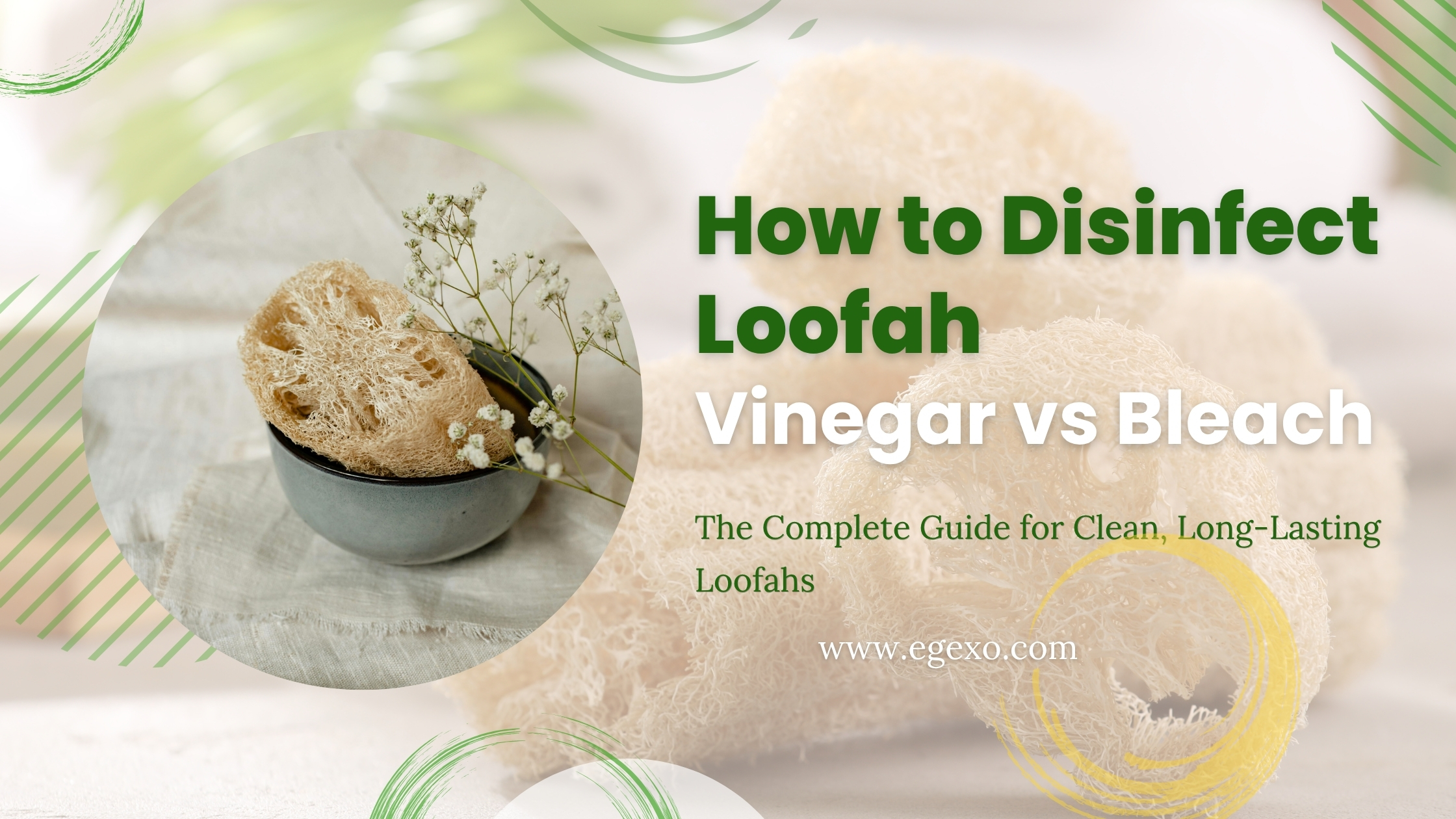
How to Disinfect Loofah: Vinegar vs Bleach — The Complete Guide for Clean, Long-Lasting Loofahs
Why Disinfecting Your Loofah Is Not Optional
Most people scrub their skin every day with a loofah without ever thinking about what lives inside it. Studies show that a used loofah can harbor millions of bacteria, including Pseudomonas aeruginosa and Staphylococcus aureus, within just a few days of regular use. This is not a minor hygiene concern — it is a serious skin health issue.
Whether you are a spa owner purchasing loofah sponges in bulk or a home user who just picked up a natural loofah from the shelf, knowing how to disinfect loofah properly is what separates a healthy skincare tool from a bacterial breeding ground.
At Egexo, we have spent 10 years processing and exporting natural Egyptian loofahs to markets across Europe, North America, and Asia. During that time, we have learned that product quality and proper maintenance go hand in hand. A premium loofah that is not disinfected regularly will degrade faster, smell worse, and ultimately underperform — no matter how good its source material is.
This guide covers everything you need to know: why loofah disinfection matters, how vinegar and bleach compare as disinfectants, step-by-step instructions for both methods, and practical advice for wholesale buyers evaluating loofah hygiene standards. By the end, you will know exactly which method suits your needs and how to extend the life of your loofah significantly.
Ready to shop quality Egyptian loofahs before or after you read? Browse our bath and body loofah collection or request wholesale samples to evaluate quality firsthand.
Why Natural Egyptian Loofahs Accumulate Bacteria Faster Than You Think
The Anatomy of a Loofah and Why It Traps Pathogens
A natural loofah is the fibrous skeleton of a fully matured Luffa aegyptiaca fruit. Its structure is a complex three-dimensional mesh of cellulose fibers — which is exactly what makes it such an effective scrubbing tool. Those same interconnected fibers, however, create hundreds of micro-pockets that trap moisture, dead skin cells, body oils, and soap residue after every single use.
When moisture stays trapped inside the fiber network — especially in humid bathroom environments — bacteria and mold multiply rapidly. Research from Dermatology Reports found that natural loofahs showed detectable bacterial growth within 24 to 48 hours of first use if they were not properly rinsed and dried. After one week without disinfection, colony counts can reach levels that pose a genuine infection risk, particularly for users with sensitive or broken skin.
Why Egyptian Loofahs Are Still the Best Choice
This bacterial risk is not a reason to avoid natural loofahs — it is a reason to maintain them correctly. Egyptian loofahs, specifically those grown in the Nile Delta region and processed by suppliers like Egexo, have a naturally denser and more uniform fiber structure compared to loofahs grown in other regions. This density means they are easier to rinse clean and they dry faster when used properly, which directly reduces bacterial buildup between uses.
Egexo’s farm-to-export process ensures that every loofah leaves Egypt already cleaned, bleached to food-grade standards where required, and dried to a moisture content that minimizes mold risk during shipping. This pre-treatment gives both retailers and individual users a cleaner starting point than most competitors provide.
For spa owners and retailers stocking natural loofah products, understanding this baseline quality difference matters. It affects both the product’s hygiene maintenance schedule and the end customer’s satisfaction. If you are evaluating suppliers, our quality standards page outlines the grading criteria we apply to every batch.
Vinegar vs Bleach: The Core Comparison for Loofah Disinfection
Before diving into the step-by-step methods, it is worth understanding what each disinfectant actually does to a loofah and how they compare across the metrics that matter most.
Comparison Table: Vinegar vs Bleach for Loofah Disinfection
| Criteria | White Vinegar | Household Bleach (Diluted) |
|---|---|---|
| Active Disinfecting Agent | Acetic acid (5%) | Sodium hypochlorite (3-6%) |
| Bacteria Killed | Most common bacteria (70-80% reduction) | Broad-spectrum (99%+ reduction) |
| Mold and Mildew | Effective against most mold species | Highly effective |
| Fiber Damage Risk | Low — safe for repeated use | Moderate — weakens fibers over time |
| Odor After Treatment | Fades within 30 minutes | Fades within 1-2 hours |
| Safe for Sensitive Skin | Yes, when fully rinsed | Requires very thorough rinsing |
| Environmental Impact | Biodegradable, low impact | Contains chlorine, higher impact |
| Disinfection Frequency | Can be used after every 2-3 uses | Recommended no more than once per week |
| Recommended Soak Time | 5-10 minutes | 3-5 minutes (diluted solution) |
| Cost (per treatment) | Very low | Low |
What This Means in Practice
Vinegar is the safer, gentler, and more environmentally friendly option for routine loofah disinfection. It is ideal for daily or every-other-day maintenance, particularly for users with sensitive skin or for spas that want to maintain an eco-friendly brand image.
Bleach is more powerful and appropriate for deeper disinfection when a loofah has been heavily used, exposed to someone with a skin infection, or when mold is visibly present. It should be used sparingly to avoid breaking down the natural fibers prematurely.
For wholesale buyers and spa owners, this distinction has a direct impact on product lifespan and replacement frequency. A loofah maintained with vinegar will typically last 4 to 6 weeks before replacement is recommended. One that is bleached weekly may degrade in 2 to 3 weeks, increasing your procurement volume but decreasing per-unit product satisfaction. You can learn more about how Egexo supports bulk purchasing decisions by visiting our wholesale loofah resources.
How to Disinfect Loofah with Vinegar: Step-by-Step
What You Will Need
- One cup of undiluted white distilled vinegar (5% acidity)
- A clean bowl or sink basin large enough to submerge the loofah
- Clean running water
- A dry, ventilated space for drying
Process Table: Vinegar Disinfection Method
| Step | Action | Time Required | Notes |
|---|---|---|---|
| 1 | Rinse the loofah thoroughly under warm running water | 60 seconds | Remove all visible soap residue and debris |
| 2 | Squeeze out excess water | 30 seconds | Do not wring forcefully — squeeze gently |
| 3 | Submerge loofah fully in undiluted white vinegar | 5-10 minutes | Ensure entire loofah is covered |
| 4 | Gently agitate loofah in the vinegar every 2-3 minutes | During soak | Helps vinegar penetrate all fiber layers |
| 5 | Remove and rinse thoroughly under warm running water | 90 seconds | Rinse until vinegar smell begins to fade |
| 6 | Squeeze out water gently and reshape | 30 seconds | Restore natural shape before drying |
| 7 | Hang in a dry, well-ventilated area — never in a closed cabinet | Minimum 2-3 hours | Proper drying is as important as disinfection |
Tips for Best Results
The single most underestimated step in loofah disinfection is drying. Bacteria regrow fastest in moisture. A loofah that is disinfected correctly but stored damp will re-contaminate within 24 hours. This is why Egexo always recommends that spas and retailers educate their customers on drying technique as much as on cleaning method.
For spa businesses managing large loofah inventories, the vinegar method can be scaled efficiently. Soaking multiple loofahs in a larger basin of vinegar simultaneously is safe and effective, provided each item is fully submerged and properly dried afterward.
How to Disinfect Loofah with Bleach: Step-by-Step
Dilution Is Non-Negotiable
Never apply undiluted bleach directly to a natural loofah. Concentrated bleach will destroy the cellulose fibers rapidly and may leave residue that irritates skin. The correct dilution is one tablespoon of household bleach per one gallon of water — this is equivalent to approximately a 0.05% sodium hypochlorite solution, which is effective for disinfection without causing structural damage.
Process Table: Bleach Disinfection Method
| Step | Action | Time Required | Notes |
|---|---|---|---|
| 1 | Prepare diluted bleach solution (1 tbsp bleach per 1 gallon water) | 2 minutes | Use gloves and ensure ventilation |
| 2 | Rinse loofah under warm water before soaking | 60 seconds | Never add soap to bleach solution |
| 3 | Submerge loofah fully in diluted bleach solution | 3-5 minutes maximum | Do not exceed 5 minutes — fiber damage risk increases |
| 4 | Remove loofah and rinse extremely thoroughly | 2-3 minutes | Multiple rinse cycles are essential |
| 5 | Smell test — no bleach odor should remain | Immediate | If smell persists, rinse again for 1-2 more minutes |
| 6 | Squeeze gently and reshape | 30 seconds | Handle gently — bleach weakens fibers slightly |
| 7 | Dry completely in ventilated area | Minimum 3-4 hours | Bleach treatment may slow initial drying |
When to Choose Bleach Over Vinegar
Bleach disinfection is appropriate when a loofah has been used by someone with a diagnosed skin infection, when visible mold appears on the surface, or after a loofah has been stored improperly for an extended period. It is also suitable for an initial deep clean when switching to a new loofah that has been sitting in storage.
For spa owners, bleach should be reserved for periodic equipment sanitization rather than routine maintenance. A written maintenance protocol helps staff apply the right method consistently. For help structuring your loofah product line, speak with our export and wholesale team.
Loofah Disinfection Frequency: A Practical Schedule
Knowing how to disinfect is half the equation. Knowing when to disinfect is equally critical for maintaining hygiene without accelerating fiber degradation.
Recommended Disinfection Schedule
| User Type | Vinegar Disinfection | Bleach Disinfection | Full Replacement |
|---|---|---|---|
| Daily personal user | Every 2-3 uses | Once per month | Every 4-6 weeks |
| Occasional user (2-3x per week) | Once per week | Once every 6 weeks | Every 6-8 weeks |
| Spa or wellness center | After every 3-5 client uses | Weekly for communal tools | Every 2-4 weeks |
| Retail display loofahs | Before first use | Not typically needed | Rotate every 3-4 months |
This schedule is based on average bathroom humidity levels and normal bacterial growth rates. In humid climates or tropical environments, the timeline should be shortened by approximately 30 percent.
Pros and Cons: Natural Loofah vs Synthetic Sponge for Hygiene Maintenance
Many consumers and spa buyers wonder whether the disinfection challenge justifies choosing a natural loofah over a synthetic alternative. The answer depends on your priorities.
Pros and Cons Table
| Factor | Natural Egyptian Loofah | Synthetic Sponge |
|---|---|---|
| Disinfection Ease | Moderate — requires regular care | Easy — dishwasher safe options |
| Bacterial Risk (unmaintained) | Higher due to organic fibers | Lower due to non-porous surface |
| Exfoliation Quality | Superior — irregular natural fiber texture | Consistent but less effective |
| Environmental Impact | Fully biodegradable | Non-biodegradable, petroleum-based |
| Skin Sensitivity Compatibility | Better when maintained properly | Can harbor bacteria in sponge pores |
| Average Usable Lifespan | 4-8 weeks (with proper care) | 4-6 weeks |
| Odor Development | Faster without maintenance | Slower but still occurs |
| Wholesale Cost (bulk pricing) | Competitive — especially Egyptian origin | Varies by material type |
| Consumer Preference (eco-aware market) | Strongly preferred | Declining demand |
The natural loofah wins on exfoliation performance, environmental credentials, and consumer perception. The synthetic sponge is easier to maintain in high-volume institutional settings. For spas targeting eco-conscious clients, the natural Egyptian loofah is consistently the better choice from both a marketing and performance standpoint.
Browse the full range of Egexo body and bath loofahs or explore our pet and spa grooming loofahs for specialized applications.
Quality Checklist: How to Evaluate Loofah Hygiene Before You Buy
For wholesale buyers, the disinfection requirements of the final product depend heavily on the quality of the loofah at the point of purchase. A loofah that has been properly processed and packaged requires far less remediation by the end user.
Buyer Quality Evaluation Checklist
| Quality Indicator | What to Check | Acceptable Standard |
|---|---|---|
| Color | Even pale yellow to light tan | No dark spots, no gray patches |
| Odor | Mild, neutral, or faint natural scent | No musty, sour, or chemical smell |
| Fiber Density | Firm and consistent across entire body | No soft or hollow sections |
| Moisture Level | Dry to the touch and throughout | Should not feel cool or damp |
| Cleanliness | Free of seeds, black residue, and debris | Zero visible contamination |
| Bleaching Treatment | Uniform if pre-bleached | No streaks or uneven coloration |
| Packaging Integrity | Sealed or protected from open air | No open bags or loose stacking without protection |
| MOQ Flexibility | Supplier offers testing quantities | Ability to order samples before full commitment |
Egexo provides samples for qualified wholesale buyers. The sample cost is credited to your first order of 2,000 units or more, placed within 20 days. Evaluating a physical sample against these criteria before placing a bulk order is the single most effective quality assurance step available. For buyers who want full transparency, our loofah quality standards documentation outlines every specification we apply.
Expert Insight from Egexo
With 10 years of experience exporting natural loofahs from Egypt’s Nile Delta, our team at Egexo has observed one consistent pattern across markets: the buyers and consumers who report the longest loofah lifespans and highest satisfaction are those who treat disinfection and drying as equally important steps.
The vinegar soak is a powerful tool, but it cannot overcome improper drying. When a loofah is stored in a closed shower caddy or sitting in standing water, no disinfection method fully compensates for that moisture environment. The most effective single upgrade a user can make is to hang their loofah outside the shower in a dry, ventilated location after every use.
For wholesale buyers, this insight is valuable product education to pass along to retail customers. Educating the end user reduces return complaints, extends the product’s perceived lifespan, and builds brand trust. If you are interested in private label loofah products with custom care instruction packaging, explore our private label manufacturing service or custom product design options.
FAQ Section
Q1: How often should I disinfect my loofah? A: If you use your loofah daily, disinfect it every 2 to 3 uses with white vinegar. A deeper disinfection using diluted bleach is appropriate once per month. The most important habit between disinfections is thorough rinsing and complete drying after every use. Loofahs stored while still damp will re-contaminate within hours regardless of how recently they were disinfected.
Q2: Can I disinfect a loofah in the microwave or dishwasher? A: The microwave method is effective for killing bacteria but only works when the loofah is damp and the treatment lasts a full 2 minutes on high heat. Always check for any embedded metal wire or accessories before microwaving. The dishwasher method works on the top rack using the hot cycle but may reduce a natural loofah’s lifespan faster than vinegar treatment due to the heat and detergent combination.
Q3: How do I know when a loofah needs to be replaced rather than disinfected? A: Replace your loofah immediately if it develops a persistent odor that does not resolve after disinfection, shows visible dark mold spots, begins to fall apart structurally, or has been used for longer than 6 weeks under regular daily use. No amount of disinfection revives a loofah that has structurally degraded.
Q4: Is vinegar safe to use on Egyptian natural loofahs specifically? A: Yes. White distilled vinegar at 5% acidity is entirely safe for natural loofah fibers and is actually one of the most recommended cleaning methods for natural plant-based materials. Egyptian loofahs with their dense cellulose fiber structure respond particularly well to vinegar treatments, with no fiber degradation observed under regular use conditions.
Q5: For spa businesses, what is the recommended loofah hygiene protocol? A: Spas should use a fresh loofah for each individual client or disinfect thoroughly between uses using diluted bleach solution. Staff should rinse each loofah immediately after use, soak in diluted bleach for 3 to 5 minutes, rinse extensively, and allow complete air drying before the next use. A replacement schedule of every 2 to 4 weeks is standard in professional wellness environments.
Q6: Does vinegar kill all bacteria in a loofah? A: White vinegar at 5% acidity reduces bacterial load by approximately 70 to 80 percent in a single 5-minute soak, which is effective for routine hygiene maintenance. It does not achieve pharmaceutical-grade sterilization. For environments requiring a higher disinfection standard, diluted bleach achieves 99 percent or greater bacterial elimination and is the appropriate choice.
Q7: What minimum order quantities does Egexo offer for natural loofahs? A: Egexo has no MOQ on standard products, which suits importers, distributors, spa chains, and retail buyers at different scales. Specific MOQ details and pricing tiers are outlined in our product catalog. We also offer sample orders for buyers who want to evaluate product quality before committing to a full bulk purchase.
Q8: Can I use apple cider vinegar instead of white vinegar to disinfect my loofah? A: White distilled vinegar is strongly preferred over apple cider vinegar for loofah disinfection. Apple cider vinegar has a similar acidity but contains additional organic compounds that can leave residue in the loofah fibers and potentially contribute to odor over time. White vinegar is cleaner, more neutral, and more effective for this application.
Conclusion
Knowing how to disinfect loofah properly is one of the most impactful and underappreciated hygiene habits available to both individual users and professional spa operators. The choice between vinegar and bleach is not a matter of one being universally better — it is a matter of matching the right tool to the right situation. Vinegar is your reliable, skin-safe everyday solution. Bleach is your powerful intervention for serious contamination or periodic deep cleaning.
The quality of the loofah itself plays a defining role in how well disinfection works. Egyptian loofahs processed to Egexo’s standards begin with cleaner fibers, better moisture control, and more uniform structure — all of which directly support effective disinfection and longer usable lifespans.
Key Takeaways:
- Disinfect with vinegar every 2-3 uses for routine maintenance
- Use diluted bleach once per month or when contamination is serious
- Drying completely after every use is as important as disinfection
- Replace loofahs every 4-6 weeks regardless of cleaning frequency
- Egyptian natural loofahs offer superior hygiene outcomes when properly maintained
Ready to upgrade your loofah supply?
- For Wholesale Buyers: Request a bulk quote or download our full product catalog
- For Individual Orders: Shop our bath and body collection or order samples