

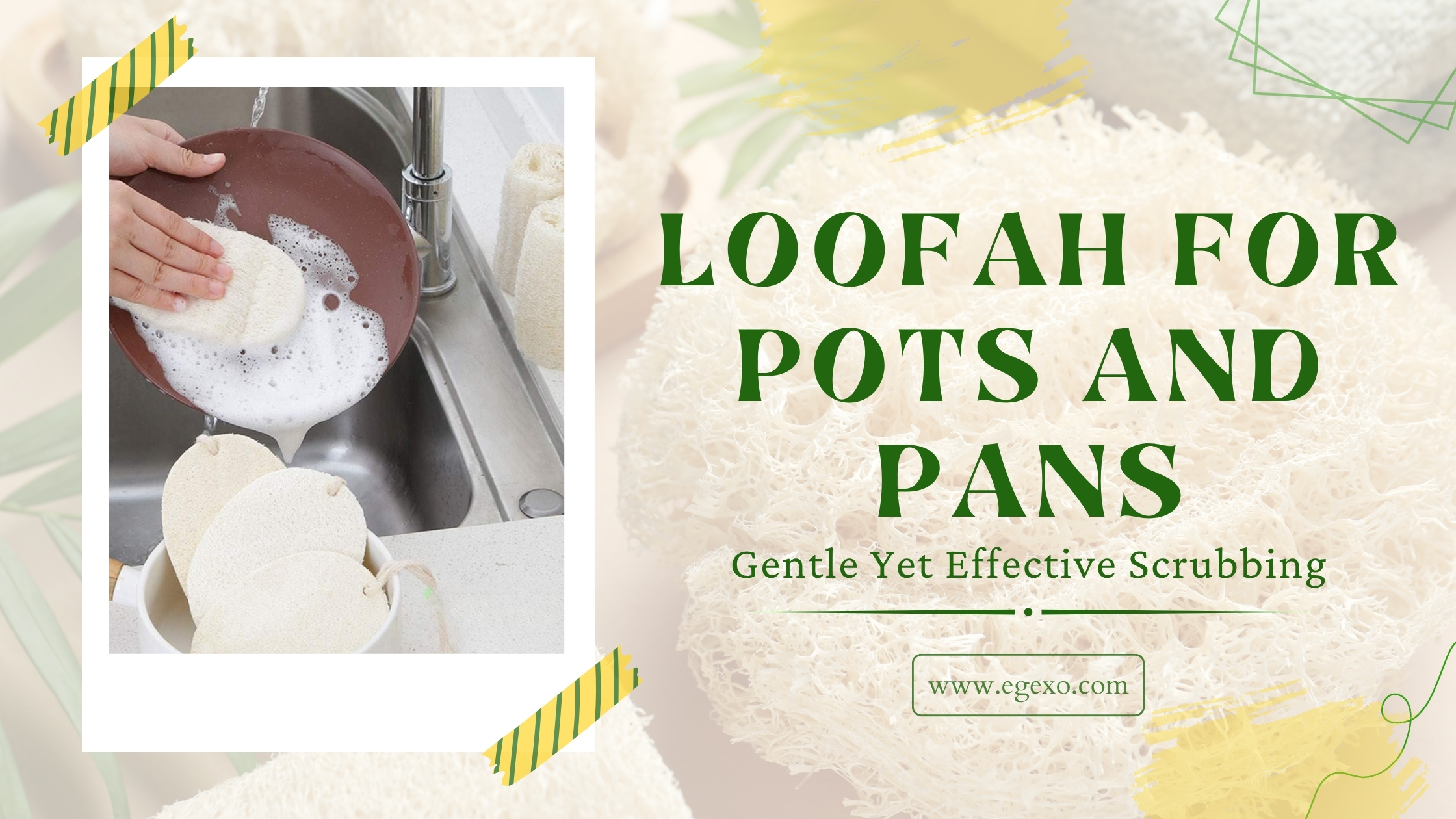
Loofah for Pots and Pans: Gentle Yet Effective Scrubbing
Most people associate the loofah with the shower, but the kitchen is where the natural loofah has arguably made its biggest comeback in recent years. Global sales of natural kitchen scrubbers grew by approximately 12% between 2022 and 2024, driven almost entirely by consumers switching away from plastic sponges and synthetic scrub pads toward plant-based alternatives.
Using a loofah for pots and pans is not a new idea. Before plastic became the default kitchen material in the mid-20th century, dried plant fibers were the standard scrubbing tool in kitchens across Egypt, Asia, and the Americas. What is new is the quality consistency and commercial availability that suppliers like Egexo now bring to the market, making it practical for both individual households and large-scale kitchen supply distributors to source premium kitchen loofah reliably.
This guide covers everything you need to know about kitchen loofah: why it works so well on cookware, how it compares to competing products, how to use and maintain it for maximum lifespan, and what wholesale buyers need to evaluate when sourcing kitchen loofah for retail or food service supply chains.
Whether you are a home cook looking for a sustainable dish scrubber or a distributor evaluating your next eco-product line, this guide gives you the factual foundation to make a confident decision.
For wholesale buyers ready to explore options now, the Egexo kitchen loofah collection is a practical starting point.
What Is a Kitchen Loofah and How Does It Work
A kitchen loofah is made from the dried fibrous interior of the Luffa aegyptiaca plant, the same botanical source as bath loofahs, but processed and shaped specifically for cookware cleaning. The key difference from a bath loofah is typically density and firmness. Kitchen loofahs are generally produced from slightly denser fiber sections of the luffa gourd, giving them more rigidity and scrubbing power for food residue without requiring the extreme abrasiveness of steel wool or nylon pads.
The mechanical action is straightforward. The three-dimensional fiber network creates hundreds of contact points with the cookware surface simultaneously. When combined with dish soap and water, this network dislodges food particles through friction while the open mesh allows debris and water to pass through rather than accumulate the way solid sponges do.
This self-flushing property is one of the most practically important advantages of kitchen loofah over conventional sponges, which trap food particles in closed cells and become bacterial reservoirs within days of first use.
The Science Behind Why Loofah Cleans Cookware Effectively
Research published in food safety literature consistently shows that porous, open-mesh cleaning tools harbor significantly less bacteria than solid sponges when properly rinsed and dried. The rapid moisture loss from loofah fiber after use creates an environment that is less hospitable to bacterial growth than the dense, moisture-retaining foam of a conventional kitchen sponge.
Egexo’s farm-to-export process ensures that kitchen loofah products are processed to controlled moisture levels below 12% at export, which supports hygienic storage and a long shelf life between production and first use.
Loofah for Pots and Pans vs Other Kitchen Scrubbers
This is where the practical case for kitchen loofah becomes most convincing. The comparison is not just about eco credentials. It is about measurable performance across the metrics that matter in a working kitchen.
Comparison Table: Kitchen Loofah vs Alternative Scrubbers
| Feature | Natural Kitchen Loofah | Conventional Sponge | Steel Wool Pad | Nylon Scrub Pad | Silicone Scrubber |
|---|---|---|---|---|---|
| Abrasiveness | Medium (adjustable) | Low | Very High | Medium-High | Low |
| Non-Stick Safe | Yes (light pressure) | Yes | No | Marginal | Yes |
| Bacteria Retention | Low (open mesh dries fast) | Very High | Moderate | Moderate | Low |
| Microplastic Shedding | None | Moderate | None | High | None |
| Biodegradable | Yes, 30-60 days | No | Partially | No | No |
| Usable Lifespan | 3-6 weeks | 1-2 weeks | 2-4 uses | 2-4 weeks | Months |
| Effective on Baked-On Residue | Yes (soaked) | No | Yes | Yes | No |
| Safe for Ceramic Cookware | Yes | Yes | No | Marginal | Yes |
| Safe for Stainless Steel | Yes | Yes | Yes (scratches) | Yes | Yes |
| Safe for Cast Iron | Yes | Yes | Yes | Yes | Marginal |
The kitchen loofah delivers a uniquely balanced performance profile. It is abrasive enough to remove baked-on food from stainless steel or cast iron but gentle enough, when used with appropriate pressure, for ceramic and even some non-stick surfaces. No synthetic scrubber offers that range.
For wholesale buyers evaluating kitchen loofah for inclusion in eco-product lines or kitchen supply catalogs, this performance breadth is a significant selling advantage over single-purpose scrubbers.
How to Use a Loofah for Pots and Pans Effectively
Knowing how to use a kitchen loofah correctly separates a user who loves the product from one who gives up after the first frustrating experience. The technique is slightly different from plastic scrubbers, and understanding why makes the adjustment easy.
Step-by-Step Kitchen Loofah Usage Guide
| Step | Action | Detail | Why It Matters |
|---|---|---|---|
| 1 | Soak the loofah | 30-60 seconds in warm water | Activates fibers, increases flexibility and cleaning surface |
| 2 | Apply dish soap | Directly to loofah or pan surface | Soap reduces friction and carries away loosened residue |
| 3 | Start with gentler areas | Rims and less soiled areas first | Calibrates pressure before tackling baked-on sections |
| 4 | Use circular motion on residue | Focus on soiled spots | Circular motion distributes pressure more evenly than back-and-forth |
| 5 | Apply more pressure for baked-on food | Increase pressure gradually | Fiber abrasiveness is sufficient; patience replaces brute force |
| 6 | Rinse pan and loofah together | Under running warm water | Clears food debris from both surfaces simultaneously |
| 7 | Squeeze out loofah completely | Squeeze and release several times | Prevents residue from setting inside fiber network |
| 8 | Hang or stand loofah to dry | In ventilated area away from sink base | Complete drying between uses is critical for hygiene |
Tips for Specific Cookware Types
Stainless Steel Pans: The kitchen loofah performs excellently on stainless steel, even on burned or caramelized residue. Soak the pan with a small amount of dish soap and warm water for 5 to 10 minutes before scrubbing for best results on stubborn deposits.
Cast Iron: Use the loofah with minimal soap on cast iron to avoid stripping the seasoning. A dry or barely damp loofah with coarse salt as an abrasive agent is an effective method for cast iron cleaning that preserves the seasoning layer while removing food particles.
Non-Stick Cookware: Use a fully soaked loofah with very light pressure. The natural fiber is gentle enough for most non-stick surfaces when applied without excessive force, but always check the cookware manufacturer’s guidance for any restrictions on mechanical cleaning tools.
Ceramic and Enamel: Excellent compatibility. The loofah’s medium abrasiveness removes staining from ceramic interiors without scratching the glaze, which is a task that steel wool would destroy and a standard sponge often cannot complete.
Loofah for Pots and Pans: Quality Specifications That Matter
For consumers, quality primarily determines how long the loofah lasts and how well it performs. For wholesale buyers, quality specifications determine customer satisfaction rates, return rates, and brand reputation.
Kitchen Loofah Specifications Table
| Specification | Premium Grade | Standard Grade | Economy Grade |
|---|---|---|---|
| Fiber Density | 130-150 per cm2 | 110-130 per cm2 | 85-110 per cm2 |
| Typical Size | 10 x 10 cm to 12 x 12 cm | 8 x 8 cm to 10 x 10 cm | Variable |
| Thickness | 3-5 cm | 2-3 cm | 1.5-2.5 cm |
| Moisture at Export | Below 10% | Below 12% | Below 14% |
| Color | Pale ivory | Light tan | Medium brown |
| Fiber Shedding | Minimal | Low | Moderate |
| Lifespan (average use) | 5-6 weeks | 3-4 weeks | 2-3 weeks |
| MOQ (Wholesale) | 500 pieces | 1,000 pieces | 2,000 pieces |
| Private Label Available | Yes | Yes | No |
Egexo’s kitchen loofah products are produced to Premium and Standard grade specifications from Nile Delta Egyptian luffa. Egyptian Luffa aegyptiaca naturally produces denser, more resilient fiber than varieties grown in Southeast Asia or Latin America, a result of the mineral-rich alluvial soil and long growing season that the Nile Delta provides.
Review Egexo’s quality standards for detailed technical specifications, and request samples to assess quality before committing to a bulk order.
The Sustainability Case for Kitchen Loofah
The kitchen is one of the most significant sources of single-use plastic waste in the average household. A conventional kitchen sponge, which is typically made from polyurethane foam bonded with nylon or polyester fibers, is replaced every 1 to 2 weeks and then sent to landfill where it will persist for hundreds of years. A household that uses 2 sponges per month generates approximately 24 synthetic scrubbing tools per year, each contributing to microplastic contamination in waterways.
A natural kitchen loofah from Egyptian luffa is completely plant-based and biodegrades fully within 30 to 60 days after disposal. It requires no petroleum-derived manufacturing inputs, produces no microplastic shedding during use, and can even be composted at end of life.
For eco-focused retailers and distributors, this sustainability profile is a primary marketing driver. Consumer surveys consistently show that sustainability claims influence purchasing decisions in the kitchen supplies category for approximately 67% of shoppers aged 25 to 44, the core demographic for premium kitchen products.
Environmental Impact Comparison
| Metric | Natural Kitchen Loofah | Conventional Sponge | Nylon Scrub Pad |
|---|---|---|---|
| Material Source | Renewable plant (luffa) | Petrochemical | Petrochemical |
| Manufacturing Carbon Footprint | Very Low | High | High |
| Microplastic Shedding | None | Yes (polyurethane) | Yes (nylon) |
| Biodegradation Time | 30-60 days | 200+ years | 50-100 years |
| Compostable | Yes | No | No |
| Sustainable Supply Available | Yes | No | No |
| Eco-Certification Possible | Yes | Rarely | No |
For buyers building an eco-product line or private label kitchen brand, this comparison provides the factual foundation for sustainability marketing claims. Egexo’s private label loofah manufacturing service allows retailers to brand kitchen loofah products with custom packaging that highlights these environmental credentials.
Loofah Kitchen Scrubber Care and Maintenance
Getting the maximum lifespan from a kitchen loofah, which should be 4 to 6 weeks for a premium grade product with proper care, requires following a simple but consistent maintenance routine.
Kitchen Loofah Care Schedule
| Frequency | Task | Method | Benefit |
|---|---|---|---|
| After every use | Thorough rinse | Run under warm water, squeeze until clear | Removes food particles preventing bacterial growth |
| After every use | Complete drying | Hang vertically or stand in dish rack | Open fiber dries 3-4x faster than a sponge |
| Weekly | Deep clean | Boil in water for 5 minutes OR microwave damp for 90 seconds | Kills bacteria and mold spores |
| Weekly | Inspection | Check for discoloration, persistent odor, fiber breakdown | Early replacement prevents bacterial contamination of cookware |
| Every 4-6 weeks | Full replacement | Replace entirely regardless of visible condition | Fiber degradation is not always visible |
The weekly deep cleaning method is worth highlighting. Studies of kitchen sponge hygiene consistently show that microwaving a damp sponge for 90 seconds kills over 99% of the bacteria present. The same principle applies to natural loofah, and the open fiber network actually makes this more effective because steam can penetrate the entire structure rather than just the surface.
For consumers interested in exploring the full range of kitchen loofah products available for individual and household purchase, Egexo’s collection offers multiple sizes and grades.
What Wholesale Buyers Need to Know About Sourcing Kitchen Loofah
The kitchen loofah market is growing rapidly across multiple retail channels, from specialty eco-stores to mass-market grocery retailers and online marketplaces. For distributors, importers, and private label brands, this growth represents a meaningful business opportunity, but only if the product sourced meets quality standards that drive repeat purchasing rather than returns and complaints.
Wholesale Buyer Checklist: Kitchen Loofah Sourcing
| Evaluation Criterion | What to Verify | Egexo Standard |
|---|---|---|
| Farm Origin | Direct farm, not broker | Nile Delta, Egypt |
| Fiber Grade | Density and color specifications | Premium and Standard grades |
| Export Compliance | Documentation and certifications | Full documentation |
| MOQ Flexibility | Starting quantities for new buyers | From 500 pieces |
| Sample Availability | Pre-order quality verification | Yes |
| Custom Sizing | Ability to specify dimensions | Available |
| Private Labeling | Brand and packaging customization | Full service |
| Lead Time | Confirmed production-to-shipment | 15-25 days |
| Countries Served | Export infrastructure | 40+ countries |
The kitchen loofah category benefits from relatively strong margins compared to commodity cleaning products. Retailers who position Egyptian loofah scrubbers as premium eco kitchen tools can achieve retail margins of 50 to 65 percent above wholesale cost, particularly in health food stores, eco-specialty retail, and online direct-to-consumer channels.
Businesses interested in exploring the full scope of available products, including custom kitchen loofah shapes, rope handles, or branded packaging, can review the custom loofah product design options or request a wholesale quotation.
For a full overview of available kitchen loofah specifications, sizes, grades, and MOQs, download the Egexo product catalog.
Loofah for Pots and Pans: Addressing Common Concerns
Will a Loofah Scratch My Cookware?
This is the most common concern among first-time kitchen loofah users. The answer depends on two variables: the loofah grade and the amount of pressure applied. A Premium Grade Egyptian kitchen loofah used with moderate pressure will not scratch stainless steel, ceramic, or enamel cookware. It will not scratch glass bakeware or porcelain. Applied with significant force, any abrasive tool can potentially scratch softer coatings, but the loofah’s natural fiber provides enough tactile feedback to prevent accidental over-scrubbing.
The only cookware category where extra caution is warranted is Teflon-coated non-stick pans, particularly older or worn non-stick surfaces. Use a fully soaked loofah with minimal pressure and inspect the coating before use.
Does a Kitchen Loofah Smell After Use?
An improperly maintained kitchen loofah can develop odor, but this is a maintenance issue rather than a product defect. The cause is always bacterial growth from food residue left in the fiber. Following the care schedule above, particularly the post-use rinse and complete drying, eliminates this issue for the majority of users. Weekly deep cleaning provides additional protection.
A quality Egyptian kitchen loofah should have a neutral to slightly natural scent when dry and clean. Any persistent sour or musty odor is a signal to replace it, not to soak it longer.
Is Kitchen Loofah Safe Around Food?
Natural loofah from a verified supplier is made from the Luffa aegyptiaca plant fiber with no synthetic additives, dyes, or chemical treatments in a quality product. It is food-contact safe in the sense that it introduces no chemical residue to cookware. However, like any cleaning tool, it should be maintained hygienically. A loofah that has not been properly rinsed and dried is a bacterial risk, just as a dirty sponge is.
Pros and Cons of Using Loofah for Pots and Pans
| Factor | Pros | Cons |
|---|---|---|
| Cleaning Power | Effective on baked-on food | Requires soaking for maximum effect |
| Surface Safety | Safe for most cookware | Extra care needed for worn non-stick |
| Hygiene | Dries fast, resists bacteria | Requires consistent maintenance |
| Sustainability | Biodegradable, compostable | Must replace every 4-6 weeks |
| Cost Efficiency | Longer lifespan than standard sponge | Slightly higher upfront cost |
| Odor Control | Good with proper care | Can develop odor if stored wet |
| Availability | Widely available from quality suppliers | Quality varies significantly by source |
Expert Insight from Egexo
After 25 years cultivating Luffa aegyptiaca along the Nile Delta, we have observed a consistent pattern in the kitchen loofah market: the products that generate the most complaints are almost never the concept that is the problem. They are low-grade luffa processed quickly, dried inadequately, and sold under eco-branding that the product itself cannot support.
A genuine Premium Grade Egyptian kitchen loofah has structural integrity that you can feel immediately. It holds its shape when dry, flexes and conforms to cookware surfaces when wet, and does not begin shedding fiber aggressively after the first use. It also dries completely within 2 to 3 hours of rinsing, which is what makes it hygienically superior to a sponge.
For wholesale buyers, we strongly recommend requesting and physically testing samples before any volume commitment. Our sample ordering process is designed to make this easy. For consumers, look for pale ivory or light yellow color and a neutral dry scent as the fastest quality indicators when purchasing kitchen loofah.
Learn more about what separates Egexo from other suppliers at Why Choose Egexo.
FAQ Section
Q1: Is a loofah safe to use on non-stick pans? A: A fully soaked Premium Grade natural kitchen loofah can be used safely on most non-stick surfaces with light to moderate pressure. The natural fiber is significantly less abrasive than steel wool or nylon pads. For older or worn non-stick coatings, use minimal pressure and always inspect the surface before cleaning. Egyptian loofah from a verified source like Egexo contains no synthetic additives that could interact with non-stick coatings.
Q2: How long does a kitchen loofah last when used for pots and pans daily? A: A Premium Grade Egyptian kitchen loofah used daily for dishwashing and cookware cleaning typically lasts 4 to 6 weeks with proper maintenance. Standard grade lasts 3 to 4 weeks. The key factors affecting lifespan are post-use rinsing completeness, drying between uses, and weekly deep cleaning. A loofah that is stored wet without rinsing will degrade in under 2 weeks regardless of grade.
Q3: How does a kitchen loofah compare to a standard sponge for cleaning baked-on food? A: For baked-on food residue, a soaked kitchen loofah outperforms a standard sponge in most cases. The sponge’s flat surface and low-profile foam cells create less effective mechanical friction than the loofah’s three-dimensional fiber network. For extremely carbonized residue, soaking the pan first for 10 minutes and then applying the loofah with focused circular pressure on the affected area produces results comparable to steel wool without the surface scratching risk.
Q4: What is the minimum order quantity for kitchen loofah from Egexo? A: Egexo’s minimum order quantity for kitchen loofah starts at 500 pieces for Premium Grade and 1,000 pieces for Standard Grade. MOQs for custom sizes, rope-handle designs, or private label packaging may vary based on design complexity. New buyers are encouraged to request a detailed quotation or download the product catalog to review all available options before committing.
Q5: How do I clean and maintain a kitchen loofah to prevent odor? A: Rinse the loofah thoroughly under warm running water immediately after every use, squeezing repeatedly until the water runs clear. Hang it in a ventilated area to dry completely. Once per week, either boil it in water for 5 minutes or microwave it damp for 90 seconds to kill accumulated bacteria. Replace it every 4 to 6 weeks regardless of appearance. Odor development is almost always the result of storing a wet loofah without rinsing, which allows food particles to decompose inside the fiber network.
Q6: Why is Egyptian kitchen loofah considered superior to loofah from other countries? A: Egyptian Luffa aegyptiaca grown in the Nile Delta produces fiber that is measurably denser (120 to 150 fibers per square centimeter versus 70 to 100 for Southeast Asian varieties) and more structurally uniform. This produces a kitchen scrubber with more consistent abrasiveness, better durability, and less fiber shedding than lower-grade alternatives. The Nile Delta’s mineral-rich soil and long growing season are the primary factors behind this quality advantage, and Egexo’s 25-plus years of direct cultivation ensures that this quality standard is maintained consistently across every production batch.
Q7: Can retailers profitably sell Egyptian kitchen loofahs as a private label product? A: Yes. Kitchen loofah positioned as a premium eco-friendly scrubber in health food retail, eco-specialty stores, or online direct-to-consumer channels commands margins of 50 to 65 percent above wholesale cost. The combination of sustainability credentials, genuine functional superiority over conventional sponges, and the growing consumer preference for plastic-free kitchen products creates strong market positioning. Egexo’s private label manufacturing service includes product specification, branding design support, and packaging options for retailers building their own kitchen cleaning product line.
Q8: Are there different kitchen loofah shapes beyond the standard flat slice? A: Yes. Kitchen loofah is available in several configurations including flat discs or squares for general scrubbing, tubular or cylinder shapes for bottle and cup interior cleaning, rope-attached or ring designs for hanging storage, and custom shapes specified by buyers for branded product lines. Egexo’s custom loofah product design service allows wholesale buyers to specify exact dimensions, shapes, and configurations for their specific retail or food service application.
Conclusion
The case for loofah for pots and pans is straightforward when the full picture is on the table. It outperforms conventional sponges in longevity, hygiene, and sustainability. It handles a wider range of cookware surfaces than steel wool or nylon pads. It produces no microplastic waste and biodegrades completely. And when sourced from a premium Egyptian luffa supplier like Egexo, it delivers consistent performance that consumers trust enough to repurchase repeatedly.
For wholesale buyers, the kitchen loofah category combines a growing consumer trend, strong margin potential, and a genuine product story that resonates with the eco-conscious market segments driving growth in kitchen and home categories.
For consumers, switching from a synthetic sponge to a natural kitchen loofah is one of the simplest and most impactful changes available in the household plastic reduction effort.
Key Takeaways:
- Natural kitchen loofah outperforms conventional sponges in hygiene, lifespan, and surface safety
- Egyptian luffa from Nile Delta farms produces the highest fiber density and most durable kitchen scrubber available
- Proper maintenance, including post-use rinsing and complete drying, is the single biggest factor in loofah lifespan and hygiene
- Premium Grade Egyptian kitchen loofah supports retail margins of 50 to 65 percent in eco-focused channels
- Replacing synthetic sponges with natural loofah eliminates microplastic shedding and 200-plus year landfill persistence
Ready to experience Egyptian loofah quality?
- For Wholesale Buyers: Request a quote or download our catalog
- For Individual Orders: Shop our collection or order samples