

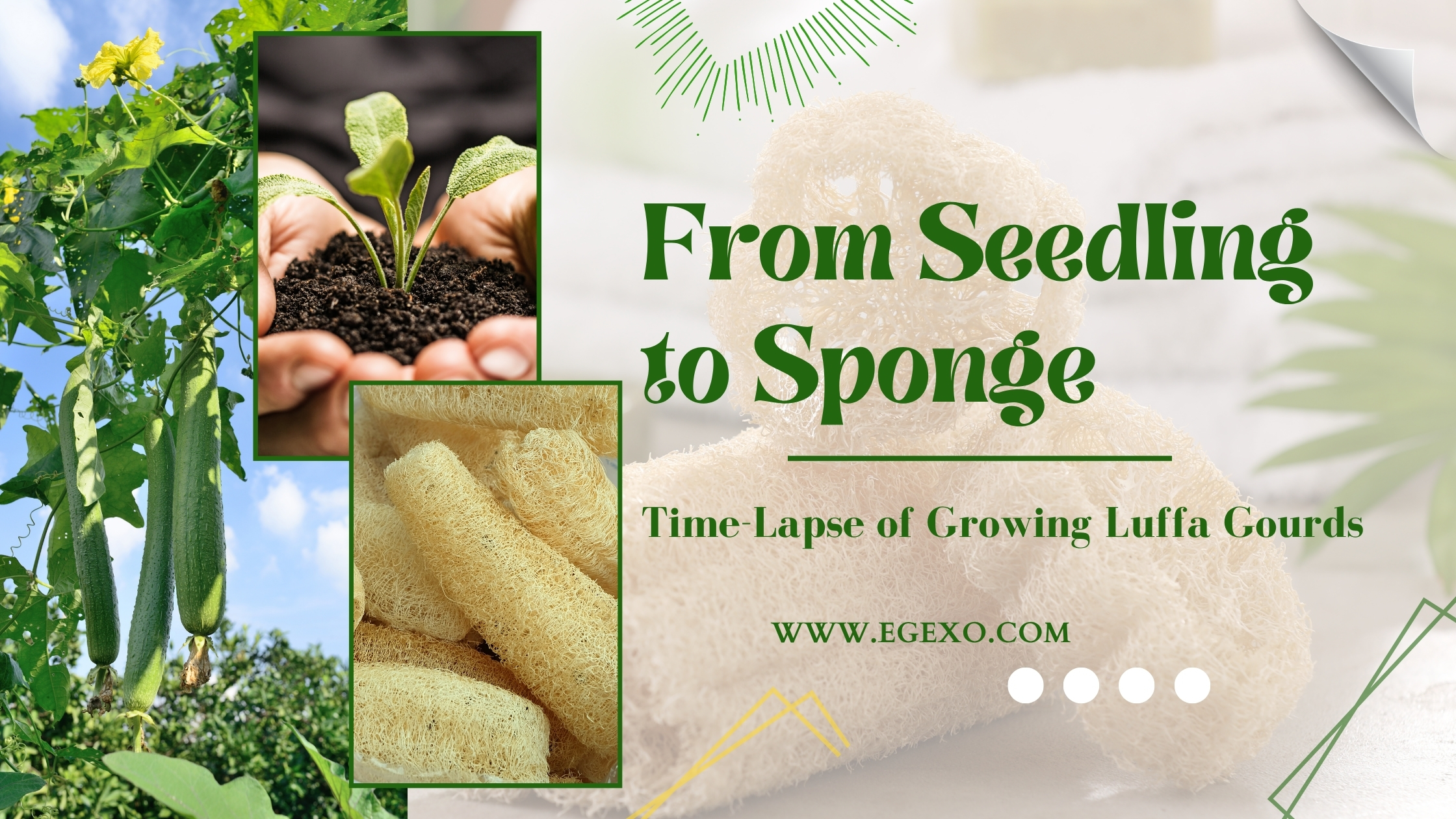
From Seedling to Sponge: Time-Lapse of Growing Luffa Gourds
Most people pick up a loofah sponge without ever stopping to wonder where it came from or how long it took to reach their hands. The answer might surprise you: what looks like a synthetic bath accessory is actually the fibrous skeleton of a gourd, grown in sun-drenched fields, processed by hand, and dried to become one of the most versatile natural scrubbers in the world. Understanding the journey from seedling to sponge is not just a curiosity exercise. For spa owners, retailers, and importers, it is the foundation for evaluating quality, choosing the right supplier, and building a sourcing strategy that holds up under scrutiny. For everyday consumers, it is the story behind a product that deserves a place in every eco-conscious bathroom.
At Egexo, we have spent more than 25 years cultivating luffa gourds across Egyptian farmland, refining every stage of the process from soil preparation to export-ready packaging. This post is our most detailed look yet at what that journey involves, why Egypt produces some of the finest luffa in the world, and what every buyer, whether ordering a single pack or a full container, should know before placing an order.
If you are a wholesale buyer looking to evaluate suppliers, or a consumer who wants to understand what makes one loofah dramatically better than another, you are in exactly the right place.
The Plant Behind the Product: What Is Luffa?
Luffa, sometimes spelled loofah, belongs to the Cucurbitaceae family, the same botanical group that includes cucumbers, zucchini, and squash. The two commercially cultivated species are Luffa aegyptiaca, also known as smooth luffa, and Luffa acutangula, the ridged variety. Both produce edible fruit when harvested young and usable fibrous sponges when allowed to mature fully and dry on the vine.
The plant grows as a climbing vine, reaching 10 to 15 meters in length under optimal conditions. It is monoecious, meaning male and female flowers appear on the same plant, and it relies on bees and other pollinators to set fruit. A single healthy vine can produce 10 to 20 usable gourds per season, depending on climate, soil quality, and farming practice.
Why Egyptian Luffa Stands Apart
Egypt has cultivated luffa commercially for decades, and the Nile Delta region in particular offers growing conditions that are difficult to replicate elsewhere. Long dry summers, alkaline-free irrigation water drawn from the Nile, sandy loam soil with excellent drainage, and warm nights that promote even cell development in the fibrous interior all contribute to a sponge that is denser, more uniformly textured, and longer-lasting than luffa grown in humid tropical climates.
The Egyptian loofah fiber tends to be coarser at the outer layer and softer toward the core, which is exactly the structure that makes it effective as a bath scrubber without being abrasive enough to damage skin. This natural gradient is a product of the climate, not a processing technique.
For wholesale buyers evaluating quality standards, Egyptian origin is one of the first indicators worth confirming in a supplier audit.
Stage One: Seed Selection and Soil Preparation
The journey from seedling to sponge begins months before any visible growth. Egexo farmers select seeds from the previous season’s highest-quality gourds, prioritizing specimens that demonstrated uniform fiber density, consistent wall thickness, and no signs of insect or fungal damage. This seed selection process is one of the underappreciated quality controls in loofah production. Weak seeds produce thin-walled gourds with patchy fiber distribution, a problem that only becomes visible after drying, when it is too late to correct.
Soil preparation involves loosening the topsoil to a depth of approximately 40 centimeters, adding organic matter to improve moisture retention, and testing pH levels to ensure they fall in the 6.0 to 7.0 range optimal for luffa. Raised beds or trellised row systems are set up before planting to give vines a structure to climb from the earliest stage of growth.
Germination and Early Growth (Days 1 to 21)
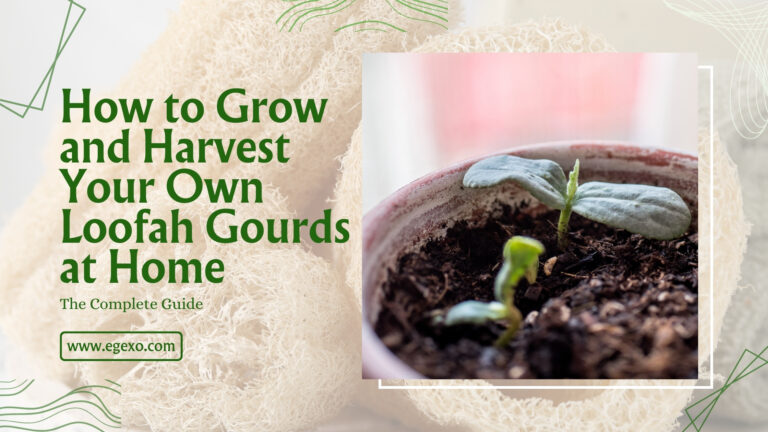
Seeds are planted 2 to 3 centimeters deep in late spring when soil temperatures consistently reach 21 degrees Celsius or higher. Germination occurs within 7 to 14 days. In the first three weeks, the plant is establishing its root system and sending up the initial pair of cotyledon leaves followed quickly by true leaves with the characteristic deeply lobed shape.
During this phase, irrigation is frequent but light. Waterlogging in early growth is one of the leading causes of vine failure. Farmers at Egexo monitor soil moisture levels daily, adjusting based on weather forecasts and field observation rather than a fixed schedule. This hands-on approach is part of what separates quality-focused cultivation from volume-only production.
Stage Two: Vine Development and Flowering (Weeks 3 to 8)
By the end of the third week, the vines begin their rapid vertical climb. Luffa grows fast, sometimes adding 15 to 20 centimeters of new growth per day during peak summer conditions. Trellises guide this growth and ensure the developing gourds hang freely rather than resting on the soil, which would cause flattening and uneven fiber compression on the lower side.
Flowering begins around week six to eight. Male flowers appear first, several days before female flowers emerge. This sequence is normal and important: premature hand-pollination before female flowers are ready reduces fruit set significantly. Egexo farmers know this timing by experience and observe each plant individually rather than applying a calendar-based schedule.
Pollination and Fruit Set
After successful pollination, the female flower base begins to swell within 48 hours. This is one of the most visually dramatic moments in the luffa growth cycle: a tiny green nub transforms into a recognizable gourd shape within just a few days. At this point the plant redirects most of its energy into the developing fruit.
Farmers remove any damaged or malformed young fruits at this stage rather than allowing them to compete for nutrients with healthy specimens. A single vine carrying too many developing gourds produces smaller, less fibrous sponges across the board. Selective thinning is therefore both a quality measure and a yield optimization strategy.
Stage Three: Gourd Maturation and the Fibrous Interior (Weeks 8 to 16)
This is the longest and in many ways the most critical phase of the journey from seedling to sponge. Over eight to ten weeks, the gourd goes through a transformation that is invisible from the outside but radical on the inside.
In the early weeks of this phase, the interior of the gourd is filled with a wet, spongy pulp surrounding immature seeds. The fiber network exists at this stage but is soft, hydrated, and interspersed with cellular tissue. As maturation progresses, the moisture content drops steadily, the cellular tissue breaks down, and the fibrous vascular network becomes more prominent and pronounced.
The Internal Fiber Network
The loofah fiber you see in the final product is the vascular system of the gourd, specifically the xylem and phloem network that carries water and nutrients throughout the fruit during growth. As the gourd dries and the surrounding tissue degrades, this network is revealed in three dimensions: a dense, interlocking mesh that is simultaneously flexible and abrasive.
The uniformity of this mesh is directly tied to growing conditions. Consistent moisture and temperature during maturation produce evenly spaced fiber strands. Stress events like sudden temperature drops, irrigation gaps, or pest damage create thin spots, dense knots, or areas where the fiber has collapsed partially. These defects are apparent in the finished sponge and significantly affect the product’s usable lifespan.
For buyers comparing suppliers, this fiber uniformity is one of the most reliable quality indicators available. Egexo’s farm to export process is built around protecting this internal structure at every stage.
| Maturation Stage | Week Range | Fiber Status | Moisture Content |
|---|---|---|---|
| Early fruit set | 8 to 10 | Soft, cellular tissue dominant | 90 to 95% |
| Mid-maturation | 10 to 13 | Fiber network forming, tissue thinning | 65 to 80% |
| Late maturation | 13 to 15 | Fiber prominent, seeds hardening | 30 to 50% |
| Harvest ready | 15 to 16 | Outer skin yellowing, gourd lightweight | 15 to 20% |
Stage Four: Harvest, Peeling, and Processing
Knowing exactly when to harvest is a skill developed over seasons of observation. A gourd harvested too early retains too much cellular tissue and produces a sponge with a dark, sticky residue that is difficult to remove completely. A gourd left too long on the vine becomes overripe, and the fiber begins to degrade from the inside out.
The visual cues for harvest readiness include yellowing of the outer skin, a papery texture when the surface is touched, a hollow sound when tapped, and a significant reduction in weight relative to the gourd’s size. At Egexo, experienced harvesters assess each gourd individually using all four criteria before cutting.
Peeling and Seed Removal
After harvest, gourds are soaked in clean water for 24 to 48 hours to loosen the outer skin. The skin is then removed by hand, a step that requires care to avoid tearing the fiber network underneath. Seeds are shaken out and collected separately for the next planting season or for specialty seed sales.
The peeled loofah is then washed thoroughly, laid out on drying racks, and exposed to direct sunlight. This bleaching stage is natural and produces the light tan color associated with high-quality, unprocessed luffa. Artificial bleaching with chemicals produces a whiter appearance but degrades fiber strength, shortens product lifespan, and leaves residues that are problematic for consumers with sensitive skin.
Quality Grading at the Farm
Before any loofah leaves the farm, it passes through a manual grading process that assigns each piece to one of four quality tiers based on fiber density, uniformity, wall thickness, and absence of defects.
| Quality Grade | Fiber Density | Recommended Use | Typical MOQ |
|---|---|---|---|
| Grade A Premium | Dense, uniform mesh | Spa, premium retail | 500 units |
| Grade A Standard | Uniform, minor variation | Retail bath and body | 1,000 units |
| Grade B | Moderate variation | Economy retail, bulk supply | 2,000 units |
| Grade C | High variation, some defects | Industrial, craft, DIY | 5,000 units |
Wholesale buyers placing their first order with Egexo can request samples from any grade before committing to a full purchase, which is the most reliable way to verify that grading standards align with your own quality expectations.
Stage Five: Cutting, Shaping, and Finishing
Raw whole luffa is the starting point for a wide range of finished products. At this stage, the processing branch determines the final SKU: whole body loofahs, bath discs, kitchen scrubbers, loofah-on-a-rope, pet grooming pads, and more. Each product form requires different cutting techniques, shapes, and in some cases secondary processing steps.
Cutting Techniques and Tolerances
Luffa is cut using both band saws for high-volume production and hand knives for artisan finishes. Consistent thickness is the primary quality target: a 2.5-centimeter bath disc that varies by more than 3 millimeters across a production batch creates inconsistent product weight and scrubbing intensity, both of which matter to retail buyers whose customers expect uniform performance.
Egexo’s processing facility maintains dimensional tolerances of plus or minus 2 millimeters for all cut products, verified through regular caliper sampling during production runs.
Product Finishing Options
| Finish Type | Description | Best For |
|---|---|---|
| Natural unbleached | Light tan, no chemical treatment | Eco-conscious retail, spa |
| Natural bleached | Pale ivory, sun-bleached only | Premium bath collections |
| Wrapped | Packaged in net or kraft paper | Ready-to-shelf retail |
| Private label | Custom branding, tags, packaging | Brand owners, private label buyers |
| Custom shape | Die-cut or hand-shaped to spec | OEM, specialty retail |
For buyers interested in branded product lines, Egexo offers full private label loofah manufacturing and custom loofah product design services that cover everything from shape development to packaging artwork.
Growing Timeline at a Glance: Seedling to Sponge
| Phase | Duration | Key Activities | Quality Control Points |
|---|---|---|---|
| Seed selection and soil prep | 2 to 4 weeks before planting | Soil testing, seed grading, trellis setup | Seed viability, pH testing |
| Germination | Days 7 to 14 | Irrigation monitoring, pest checks | Germination rate tracking |
| Vine and flower development | Weeks 3 to 8 | Trellis management, pollination support | Fruit set rate, vine health |
| Gourd maturation | Weeks 8 to 16 | Irrigation calibration, fruit thinning | Fiber density checks, moisture sampling |
| Harvest | Week 15 to 16 | Visual assessment, hand harvesting | Skin color, weight, tap test |
| Peeling and drying | 5 to 10 days post-harvest | Water soak, hand peel, sun drying | Color, fiber integrity |
| Grading and cutting | 1 to 3 days post-drying | Manual grade assessment, cutting, QC | Dimensional tolerances, grade assignment |
| Packing and export | 3 to 7 days post-processing | Labeling, packaging, documentation | Compliance checks, container loading |
From the moment a seed goes into the ground to the moment a finished loofah arrives at an import warehouse, the typical cycle runs 20 to 24 weeks, depending on variety, growing conditions, and processing specifications. Planning your sourcing calendar around this timeline helps avoid supply gaps during peak retail seasons.
Supplier Evaluation Checklist for Wholesale Buyers
Before committing to a loofah supplier, these are the criteria that distinguish reliable, quality-focused operations from low-cost alternatives that cut corners in ways that only become visible after delivery.
| Evaluation Criterion | What to Look For | Red Flag |
|---|---|---|
| Farm ownership | Supplier grows their own luffa | Sourcing from third-party intermediaries |
| Growing region | Egypt, recognized origin | Vague or unspecified origin |
| Quality grading | Written grade standards with photos | Verbal assurances only |
| Sample availability | Free or low-cost samples before bulk order | Minimum order required to see product |
| MOQ flexibility | Graded MOQs starting at 500 units | Single inflexible MOQ for all buyers |
| Processing transparency | Photos or video of processing facility | No facility documentation provided |
| Export experience | Documented export history, customs knowledge | First-time exporter claims |
| Private label capability | In-house design and packaging | Outsourced to unverified third parties |
Egexo scores positively on all eight criteria. You can review our full story at the why choose Egexo page, or request a quotation directly to discuss your specific requirements.
Consumer Guide: Choosing a Loofah Based on How It Was Grown
For individual consumers, the growing and processing details above translate directly into practical buying guidance.
A loofah with uniform fiber density scrubs evenly across its entire surface. A poorly graded one creates friction hot spots that can irritate skin. A naturally sun-dried loofah retains structural integrity longer than one dried artificially or chemically treated. A loofah grown in Egypt’s dry climate carries a lower baseline microbial load than one grown in a humid tropical environment.
The bath and body loofah collection at Egexo covers the full range from gentle exfoliation discs to firm whole-body scrubbers, all made from Grade A luffa grown on Egyptian farms. For kitchen use, the kitchen loofah category offers scrubbing pads purpose-made from coarser-grade fiber that handles pots and surfaces without falling apart after three uses.
How to Maintain Your Loofah After Purchase
- Rinse thoroughly after every use and hang to dry in a ventilated area
- Replace your loofah every 3 to 4 weeks for bath use, every 6 to 8 weeks for kitchen use
- Avoid soaking in standing water, which accelerates microbial growth
- For a quick refresh, soak for 5 minutes in a diluted white vinegar solution once a week
For pet owners and spa operators, the pet and spa loofah range offers softer-grade options suited to more sensitive applications. Browse the full shop to see the complete range.
FAQ Section
Q1: How long does luffa take to grow from seedling to sponge? A: The full cycle from seedling to sponge takes approximately 20 to 24 weeks under optimal conditions. Germination occurs within 7 to 14 days after planting, flowering begins around week 6 to 8, and gourd maturation takes an additional 8 to 10 weeks. After harvest, peeling, drying, grading, and processing add another 1 to 2 weeks before the finished loofah is ready. Egyptian growing conditions, with consistent heat and low humidity, tend to produce results at the shorter end of this range.
Q2: What makes Egyptian luffa better than luffa grown in other countries? A: Egyptian luffa benefits from a combination of long dry summers, Nile-sourced irrigation water, sandy loam soil with superior drainage, and traditional farming expertise developed over decades of commercial cultivation. These conditions produce a denser, more uniform fiber network with a natural coarse-to-soft gradient from the outer layer to the core. This structure gives Egyptian loofahs a longer usable lifespan and more consistent scrubbing performance than luffa grown in humid tropical climates, where faster growth tends to produce looser, less durable fiber.
Q3: How do wholesale buyers verify loofah quality before placing a bulk order? A: The most reliable approach is to request product samples before committing to any bulk purchase. Samples allow you to assess fiber density, dimensional consistency, color uniformity, and structural integrity firsthand. You should also ask the supplier for their written grading standards, facility photos, and export documentation. Egexo offers sample requests through a straightforward process at egexo.com/request-loofah-samples and provides grade-specific samples for direct comparison.
Q4: What is the minimum order quantity for wholesale loofah from Egexo? A: Egexo operates a tiered MOQ system based on product grade and type. Grade A Premium products start at 500 units, Grade A Standard at 1,000 units, Grade B at 2,000 units, and Grade C at 5,000 units. Custom orders involving private labeling or specialty cutting may have different minimums depending on the complexity of the specification. Contact us through the quotation request page for a precise MOQ based on your product requirements.
Q5: Is natural loofah safe for sensitive skin? A: Yes, when the loofah has been processed without chemical bleaching or synthetic treatments. Natural luffa fiber is inherently hypoallergenic, and the cell structure is free of the microplastics present in synthetic scrubbers. For sensitive skin, Grade A Premium loofahs are recommended because their finer fiber uniformity means no dense knots or abrasive patches that could cause localized irritation. Always wet the loofah thoroughly before use and rinse completely after, and replace regularly to prevent bacterial accumulation.
Q6: Can loofah be used for purposes other than bathing? A: Luffa has a remarkably wide range of applications beyond personal bathing. In the kitchen it functions as a highly effective scrubber for cookware, counters, and produce. In horticulture, raw loofah slices are used as seed germination pads. In industrial and craft contexts, luffa fiber is used for insulation padding, shoe insoles, and packaging material. Egexo supplies products across all these categories, including raw loofah scrubbers for industrial buyers and specialty applications.
Q7: How does Egexo ensure consistent quality across large wholesale orders? A: Quality consistency at scale requires control at every stage of the supply chain, not just final inspection. Egexo achieves this through farm-level seed selection, daily monitoring during maturation, a four-tier grading system applied before cutting, dimensional tolerance checks during processing, and final lot inspection before packing. Our quality standards documentation details the specific metrics we monitor and the rejection thresholds we apply at each stage. Wholesale buyers can also request pre-shipment inspection certificates for orders above a defined volume.
Q8: What private label options are available for retailers ordering wholesale loofah? A: Egexo offers comprehensive private label services including custom product shapes, branded hang tags, kraft paper or net sleeve packaging, custom color options for wrapping materials, and full packaging artwork support. The minimum order for private label production varies by product type and packaging complexity. Details are available on the private label loofah manufacturing page, and our design team can also assist with concept development through the custom loofah product design service.
Expert Insight from Egexo
After more than 25 years of growing luffa on Egyptian farmland, the lesson that has shaped our entire operation is this: the quality of the finished sponge is decided in the field, not in the processing facility. No amount of careful cutting, grading, or packaging can correct for fiber that was compromised during maturation because of inconsistent irrigation, premature harvest, or careless vine management. Buyers who ask about processing standards are asking the right questions, but the most revealing question to put to any supplier is: do you grow your own luffa, and can I visit your farm? At Egexo, the answer to both is yes. Our farm to export process page provides a documented view of every stage, and we welcome buyer visits during growing season for first-hand verification.
Conclusion
The journey from seedling to sponge is a 20-to-24-week process that involves seed selection, soil preparation, vine cultivation, pollination management, gourd maturation, harvest timing, peeling, sun drying, quality grading, cutting, finishing, and packaging. Every stage contributes to the quality of the final product. Every shortcut taken at any stage shows up in the loofah you eventually hold in your hands.
Egyptian luffa, grown under the conditions Egexo has refined over more than two and a half decades, consistently produces sponges with superior fiber density, longer lifespan, and more uniform performance than alternatives grown in less suitable climates. Whether you are building a wholesale import business or simply looking for a bath scrubber worth buying, the origin and growing process of your loofah matters more than most product descriptions will tell you.
Key Takeaways:
- Luffa takes 20 to 24 weeks to grow from seedling to finished sponge under Egyptian conditions
- Egyptian climate and soil produce denser, more uniform fiber than tropical growing environments
- Quality is determined in the field, not in the processing facility
- Wholesale buyers should request samples and verify grading standards before bulk ordering
- Natural, sun-dried, unbleached luffa is safer, more durable, and more eco-friendly than chemically processed alternatives
Ready to experience Egyptian loofah quality?
- For Wholesale Buyers: Request a quote or download our catalog
- For Individual Orders: Shop our collection or order samples