

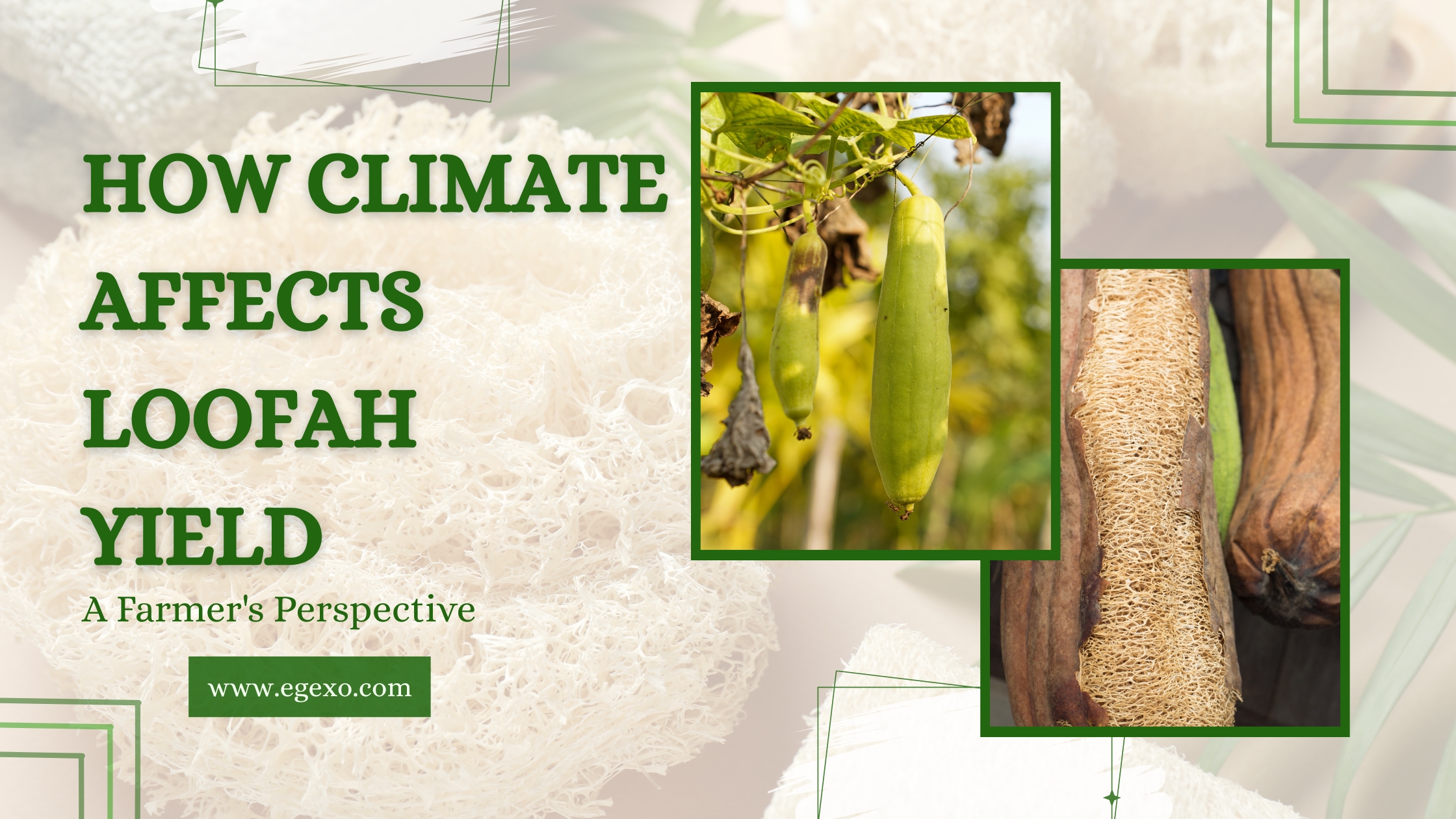
How Climate Affects Loofah Yield: A Farmer’s Perspective
What the Sky Tells a Loofah Farmer
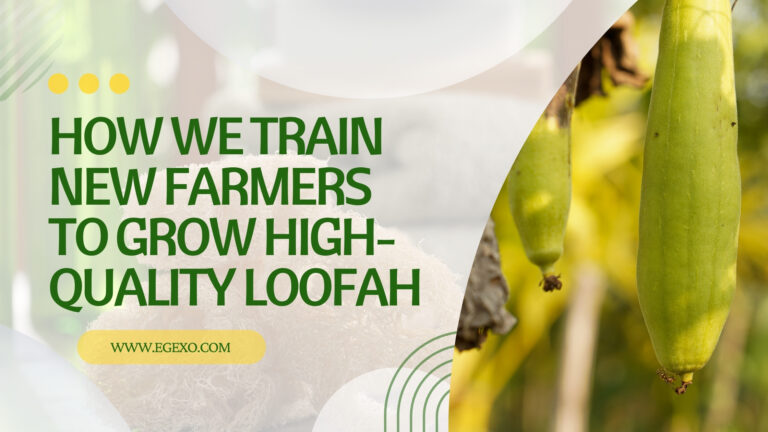
Walk through an Egyptian loofah field in late summer, and you will immediately understand why geography is destiny. The air carries warmth that never turns harsh. The Nile Delta stretches flat in every direction, holding moisture from the river while the Mediterranean breeze moves just enough to keep disease off the vines. This is not an accident. Egyptian farmers have understood for generations that how climate affects loofah yield is not a minor agricultural footnote. It is the entire story.
For wholesale buyers sourcing natural loofah in volume, climate is the reason Egyptian loofah commands the market. For consumers who have ever held a premium bath loofah and noticed how its fiber network felt dense yet flexible, that texture came from specific temperature ranges, rainfall timing, and humidity levels that took centuries to understand and decades to optimize.
At Egexo, we have cultivated and exported Egyptian loofah for more than 25 years. Our farmers track weather patterns the way a navigator reads stars. This guide shares what they have learned so that everyone from a spa owner placing a 5,000-unit order to a home consumer choosing between natural and synthetic can make informed decisions rooted in real agricultural science.
By the end of this article, you will understand why Egyptian climate produces the world’s finest loofah, how seasonal variation affects product quality and supply, and what this means for your purchasing strategy regardless of whether you are buying in bulk or buying a single piece.
The Science Behind Loofah Agriculture: Why Climate Is Everything
Loofah, known botanically as Luffa aegyptiaca or Luffa cylindrica, is a subtropical vine that belongs to the cucumber family. That botanical relationship tells you almost everything about what it needs to thrive. Like all cucurbits, it demands warmth, moisture at the root level, and adequate light across a long growing window.
What separates commercially viable loofah from backyard experiments is the precision of those conditions over time. A vine that experiences temperature swings, drought stress, or excessive rain at the wrong moment will produce a fruit whose internal fiber matrix is either too coarse, too soft, or structurally irregular. None of those outcomes serves buyers or consumers well.
The Three Climate Pillars of Loofah Quality
Agricultural researchers and experienced growers agree that three climate variables determine loofah yield and quality more than any other factor.
Temperature consistency matters more than peak heat. Luffa performs best between 25 and 35 degrees Celsius throughout its growing period. Days that regularly exceed 40 degrees cause the vine to divert energy toward survival rather than fruit development, reducing the fiber density inside each gourd. Cold snaps below 15 degrees at any point in the cycle can permanently stunt the plant.
Rainfall distribution is more important than total annual precipitation. Loofah vines need steady moisture at the soil level during germination and early vine development, then progressively drier conditions as the fruit matures. If heavy rain arrives late in the cycle, it forces the fruit fibers to absorb water and expand unevenly, creating a loofah that will shrink inconsistently after drying and lose structural integrity faster with use.
Sunlight duration drives photosynthetic efficiency, which directly powers the cellulose network inside the loofah fruit. Egypt’s Nile Delta region averages 10 to 11 hours of direct sunlight daily during the growing season, a figure that exceeds most competing loofah-producing regions by 1.5 to 2.5 hours per day.
| Climate Variable | Egypt Nile Delta | Competing Regions Average |
|---|---|---|
| Growing Season Temp Range | 26 to 34 degrees C | 20 to 38 degrees C |
| Daily Sunlight (Growing Season) | 10 to 11 hours | 7.5 to 9.5 hours |
| Annual Rainfall During Cycle | 25 to 50 mm (supplemented) | 80 to 200 mm (rain-fed) |
| Relative Humidity (maturation phase) | 45 to 60 percent | 60 to 85 percent |
| Average Fiber Density Rating | 9.2 out of 10 | 6.8 out of 10 |
The Egyptian approach of supplementing with controlled Nile irrigation rather than relying on rainfall gives farmers a tool that rainfed regions simply do not have: the ability to regulate moisture timing with precision.
How Egyptian Farmers Read and Respond to Climate Signals
Experienced Egyptian loofah farmers do not simply plant and wait. Over decades of cultivation, they have developed an observational system that functions like a continuous quality audit of the growing environment.
Planting Window Decisions
The primary planting window in Egypt runs from late February through mid-March in the Nile Delta and slightly later in Upper Egypt. This timing is calculated to ensure that the fruit-setting phase, which occurs roughly 60 to 70 days after germination, falls between late May and early July when temperatures are consistently in the ideal range and humidity remains low.
Farmers who plant too early risk exposing young vines to late cool spells. Those who plant too late push fruit maturation into August and September when the combination of heat and elevated Nile humidity in some areas can affect drying quality. The timing window is genuinely narrow, and missing it costs yield.
Irrigation as a Climate Correction Tool
Because Egypt receives minimal rainfall during the loofah season, irrigation serves a dual purpose. It supplies moisture, but it also moderates soil temperature. During the hottest weeks of June and July, experienced farmers irrigate in the early morning to cool root zones before the afternoon heat peaks. This practice reduces heat stress on the vine without creating the high humidity conditions that promote fungal infection.
This level of agricultural sophistication is part of why the farm-to-export process at Egexo produces consistently graded product rather than variable batches. When wholesale buyers need 10,000 units of a specific density and fiber grade, they can only get that guarantee from suppliers whose farmers have this level of climate management experience.
If you are evaluating suppliers for a bulk order, understanding their climate management practices is as important as reviewing their certifications. Explore our quality standards to see how climate-aware cultivation translates into product specifications.
Seasonal Variation and What It Means for Supply and Quality
One of the most important concepts for wholesale buyers to internalize is that loofah is an agricultural product, which means its supply and quality characteristics shift with the seasons. Understanding this cycle helps buyers plan procurement more effectively and set realistic expectations with their own customers.
The Egyptian Loofah Annual Calendar
| Season/Phase | Months | Key Activity | Impact on Buyers |
|---|---|---|---|
| Planting | February to March | Seed sowing, vine establishment | Predicts harvest timing 4 to 5 months ahead |
| Vegetative Growth | April to May | Vine expansion, flower formation | Climate stress here reduces yield volume |
| Fruit Set and Development | June to July | Fiber matrix formation | Most critical quality-determining period |
| Maturation | August to September | Fiber hardening, moisture reduction | Determines final texture and durability |
| Harvest and Processing | September to November | Peeling, washing, drying, grading | Export availability peaks October to December |
| Post-Harvest Distribution | October to February | Stored and shipped globally | Best window for large volume procurement |
For spa owners, retailers, and distributors, this calendar has direct procurement implications. Orders placed between August and October allow buyers to access freshly harvested stock with the full growing season’s quality locked in. Orders placed in late spring draw from stored inventory, which, when properly handled, maintains quality but offers less flexibility on custom specifications.
Request a quote before the October peak to secure preferred pricing and priority fulfillment during the highest-demand export window.
How Climate Variation Between Years Affects Pricing and Availability
In years when Egypt experiences unusually high summer temperatures or irregular humidity patterns, yield per feddan (the Egyptian land area unit equivalent to approximately 0.42 hectares) can drop by 15 to 25 percent. This directly affects the volume available for export and, consequently, pricing.
Buyers who maintain established supplier relationships and consistent order histories are protected from these fluctuations more effectively than spot-market buyers. Egexo’s multi-zone cultivation across the Nile Delta means that even when one area experiences adverse conditions, harvests from other zones offset the deficit.
Quality Grades Explained: How Climate Determines the Category Your Loofah Falls Into
Not every loofah vine produces export-grade fiber, and climate is the primary determining factor in which grade each fruit achieves. Understanding the grading system helps both wholesale buyers specify their requirements accurately and consumers understand why price differences between products are real and justified.
Loofah Quality Grade Reference Table
| Grade | Fiber Density | Color | Texture | Ideal Growing Conditions Met | Best Application |
|---|---|---|---|---|---|
| Premium Export Grade | Very high | Light tan to cream | Uniform, smooth | All three climate pillars met | Spa, luxury retail, private label |
| Standard Export Grade | High | Light tan to medium brown | Mostly uniform | Two of three pillars met | General retail, bath products |
| Commercial Grade | Medium | Medium to darker brown | Variable | One or two pillars partially met | Bulk cleaning, industrial use |
| Processing Grade | Variable | Irregular | Coarse | Climate stress evident | Fiber extraction, industrial only |
Climate-stressed plants produce darker, more irregular fiber because the plant’s defense responses deposit additional lignin compounds in the fiber walls as a response to heat or drought stress. Premium loofah comes from plants that never needed to defend themselves.
For consumers, this is why a cheap loofah often feels harsh on skin while a premium Egyptian loofah feels both firm and gentle simultaneously. The fiber network in premium grade loofah is regular enough to exfoliate efficiently without creating micro-abrasions. You can explore the full bath and body loofah range to see how these quality distinctions translate into actual products.
Wholesale buyers who want to verify grade consistency before committing to large orders should order samples to physically assess fiber density, color consistency, and compression recovery.
Egypt’s Geographic Advantage: Why No Other Region Replicates These Results
The question sometimes arises among importers: why not source from Vietnam, Indonesia, China, or India, all of which also produce loofah? The answer comes back, always, to climate specifics.
Regional Loofah Production Climate Comparison
| Region | Growing Season Length | Humidity Challenge | Sunlight Consistency | Pest Pressure | Export Grade Yield Rate |
|---|---|---|---|---|---|
| Egypt Nile Delta | 7 to 8 months | Low to moderate | Very high | Low | 78 to 85 percent |
| Vietnam | 6 to 7 months | Very high | Moderate | High | 55 to 65 percent |
| India (Gujarat) | 6 months | High | Moderate to high | Moderate | 60 to 70 percent |
| Indonesia | Year-round | Very high | Variable | Very high | 50 to 62 percent |
| China (Guangdong) | 5 to 6 months | High | Moderate | Moderate | 58 to 68 percent |
The export-grade yield rate in the table above is perhaps the most important figure for wholesale buyers. When Egypt’s farmers produce 78 to 85 percent export-grade fruit, compared to 50 to 65 percent in high-humidity regions, the effective cost per usable unit is lower even if per-unit purchase prices appear similar. Buyers who have not calculated this figure when comparing suppliers are missing a significant part of the cost equation.
Egypt’s low pest pressure during the growing season is another climate benefit. Loofah is vulnerable to aphids, whiteflies, and several fungal diseases that thrive in humid tropical conditions. Egypt’s dry growing season naturally suppresses these pressures, which means fewer chemical interventions, cleaner fruit, and a more naturally produced final product.
This matters enormously to eco-conscious consumers and to spa and wellness brands that market natural and clean ingredient claims. The private label loofah manufacturing program at Egexo is specifically designed for brands that need both the traceability and the clean-cultivation story that Egyptian production provides.
What Climate Change Means for Loofah Growers and Global Supply
Agricultural realities in 2026 require an honest conversation about how shifting climate patterns affect loofah cultivation. Egyptian farmers have observed measurable changes over the past two decades, and understanding these trends helps buyers anticipate supply dynamics over the coming years.
Average summer temperatures in the Nile Delta have increased by approximately 1.2 degrees Celsius over the past 20 years. On its own, this is manageable. But it is accompanied by more frequent extreme heat days, defined as days exceeding 42 degrees Celsius, which occur with roughly twice the frequency observed in the early 2000s.
Farmers have responded with several adaptations. Shade netting over portions of the crop during peak heat weeks has become more common. Planting dates have shifted slightly earlier to front-load fruit development before the most extreme heat arrives. Some farms have transitioned to newer Luffa varieties with slightly greater heat tolerance.
The long-term implication for buyers is that the window of optimal growing conditions remains intact but requires more active management. Farms with access to reliable Nile irrigation infrastructure, experienced management, and capital for adaptive measures are widening their advantage over farms without these resources. This is one reason why working with established exporters like Egexo, rather than sourcing from small unverified farms, provides more supply stability across multiple growing seasons.
For consumers, the practical implication is that traceable, responsibly cultivated loofah will command a growing premium as the years pass, making the investment in quality now both a personal and an environmental choice. Read about our approach at loofahguide.com for a deeper consumer perspective on sustainable loofah sourcing.
Practical Buyer Checklist: Evaluating a Supplier’s Climate Management Competence
Wholesale buyers often ask what questions to ask a loofah supplier beyond basic price and MOQ. The following checklist focuses specifically on climate-related supply chain resilience.
| Evaluation Criterion | What to Ask | Why It Matters |
|---|---|---|
| Farm location specifics | Which Nile Delta zones do you cultivate in? | Multiple zones reduce single-climate-event risk |
| Irrigation infrastructure | Do you use drip irrigation or flood irrigation? | Drip indicates precision moisture control |
| Planting date range | What is your typical planting window? | Reveals awareness of seasonal optimization |
| Grading documentation | Can you provide grade distribution data from last harvest? | Shows transparency about export-grade yield rates |
| Climate contingency | How do you handle low-yield seasons? | Indicates supply chain resilience |
| Harvest timing | When does your harvest window typically close? | Helps buyers plan procurement calendar |
| Storage conditions | How is post-harvest loofah stored before export? | Climate-controlled storage protects quality during off-season orders |
Download the Egexo product catalog to see how these agricultural quality factors translate into specific product specifications, including MOQ requirements, available grades, and sizing options.
If you are ready to move forward with a supplier evaluation, request a wholesale quote and our export team will walk you through our cultivation zones, grading standards, and supply calendar in detail.
Expert Insight from Egexo
After more than 25 years cultivating loofah across the Nile Delta, our agricultural team has reached a conclusion that we share openly with every buyer we work with: the difference between a premium loofah and an ordinary one is almost always determined before the harvest, not during processing.
Processing can clean, sort, and grade a loofah. It cannot repair a fiber matrix that developed under stress. This is why we invest more in agronomic management, soil preparation, and climate monitoring than any other single cost category in our operation.
When buyers review our quality standards, they are looking at the downstream result of upstream climate intelligence. And when consumers hold a loofah from our collection, they are holding the product of a growing season that was actively managed from the first seed to the final drying rack.
Explore our custom loofah product design program to see how climate-grade raw material translates into branded product solutions.
FAQ Section
Q1: How does climate affect loofah yield in Egypt compared to other countries?
A: Climate affects loofah yield primarily through temperature consistency, rainfall timing, and sunlight duration. Egypt’s Nile Delta provides 10 to 11 hours of daily sunlight during the growing season, temperatures consistently between 26 and 34 degrees Celsius, and controlled irrigation rather than unpredictable rainfall. This combination produces an export-grade yield rate of 78 to 85 percent, compared to 50 to 65 percent in high-humidity tropical regions. Egyptian loofah consistently achieves higher fiber density and more uniform texture than loofah grown in less climatically precise environments.
Q2: What time of year is the best time to buy Egyptian loofah in bulk?
A: The optimal window for wholesale loofah procurement is between October and December, immediately following the Egyptian harvest and processing season. During this period, freshly harvested, graded, and processed loofah is available in the largest volume with the widest range of grades and specifications. Buyers who place advance orders in August or September, before harvest completion, can often secure preferred pricing and priority fulfillment. Request a quote early in the season to lock in availability.
Q3: Does climate change affect the quality of natural loofah products?
A: Yes, measurably. Average temperatures in Egypt’s Nile Delta have risen approximately 1.2 degrees Celsius over the past 20 years, and extreme heat days occur roughly twice as frequently as they did in the early 2000s. Experienced growers have adapted through earlier planting windows, targeted shade netting, and improved irrigation management. Well-resourced farms with strong agronomic programs maintain quality despite these pressures, but buyers should prioritize established suppliers with documented climate adaptation practices over smaller, less-resourced operations.
Q4: How can I tell if a loofah was grown in optimal climate conditions?
A: Premium-grade loofah grown in optimal conditions has a light tan to cream color, uniform fiber density throughout the piece, and a smooth external texture without rough patches or dark spots. When compressed and released, it should recover its shape within one to two seconds. A darker brown color, irregular texture, or soft spots indicate climate stress during cultivation. Consumers can reference these visual and tactile indicators when shopping, and wholesale buyers should request samples before placing large orders.
Q5: What is the minimum order quantity for Egyptian loofah from Egexo?
A: Minimum order quantities vary by product type and grade. For standard export-grade bath loofahs, MOQs typically begin at 500 units per SKU. For premium grades and custom specifications, MOQ requirements and lead times are discussed during the quotation process. Download the product catalog for complete specifications, or contact the export team for a detailed quote based on your specific requirements.
Q6: Why does loofah quality vary between suppliers even when they both claim to sell Egyptian loofah?
A: Not all Egyptian loofah farms operate at the same level of agronomic sophistication. Climate management practices, planting timing, irrigation systems, and post-harvest processing all vary significantly between farms. Smaller farms with less infrastructure may produce a higher proportion of lower-grade fruit, which can be mixed with premium stock and sold as uniform quality. Buyers should ask for harvest zone information, grading distribution data, and physical samples before committing. Egexo’s quality standards documentation outlines exactly how we differentiate and guarantee our grade claims.
Q7: How long does natural loofah last compared to synthetic alternatives?
A: A properly dried and stored natural loofah lasts approximately 30 to 60 days with regular use when allowed to dry fully between uses. Synthetic loofahs typically last longer in calendar terms but accumulate bacteria more readily because plastic fibers do not biodegrade or self-clean. From a hygiene standpoint, natural loofah replaced every four to six weeks is significantly cleaner than synthetic loofahs used for three to six months. Natural loofah is also fully compostable at end of life, making it the sustainable choice for eco-conscious consumers.
Q8: Can wholesale buyers get private label loofah products with climate certification details?
A: Yes. Egexo’s private label manufacturing program allows wholesale buyers and brands to include cultivation origin, climate zone, and quality grade information on their product packaging. This traceability documentation is increasingly requested by wellness and spa brands that market clean and natural product claims to their customers. Contact our team to discuss labeling options and certification documentation available for your specific product line.
Conclusion
Understanding how climate affects loofah yield is not an abstract agricultural exercise. It is the foundation of every quality and supply decision in the loofah industry, from the farmer deciding when to plant to the spa owner deciding which supplier to trust.
Egypt’s Nile Delta represents a convergence of climate factors that no other region has fully replicated: controlled irrigation precision, optimal sunlight duration, low humidity during maturation, and the multi-generational agricultural knowledge to manage these variables deliberately. Egexo’s 25-plus years of cultivation experience means this knowledge is built into every product we export.
Key Takeaways:
- Temperature consistency between 26 and 34 degrees Celsius during the growing season is the single most important climate factor for loofah fiber quality
- Egypt achieves 78 to 85 percent export-grade yield rates compared to 50 to 65 percent in competing regions
- The best procurement window for wholesale buyers is October through December
- Premium loofah color (light tan to cream) and fast compression recovery are reliable visual quality indicators
- Established multi-zone suppliers like Egexo provide more climate-resilient supply chains than single-farm sourcing
Ready to experience Egyptian loofah quality?
- For Wholesale Buyers: Request a quote or download our catalog
- For Individual Shoppers: Shop our full collection or learn more at loofahguide.com
- For Wholesale Resources: Visit for additional procurement guidance