

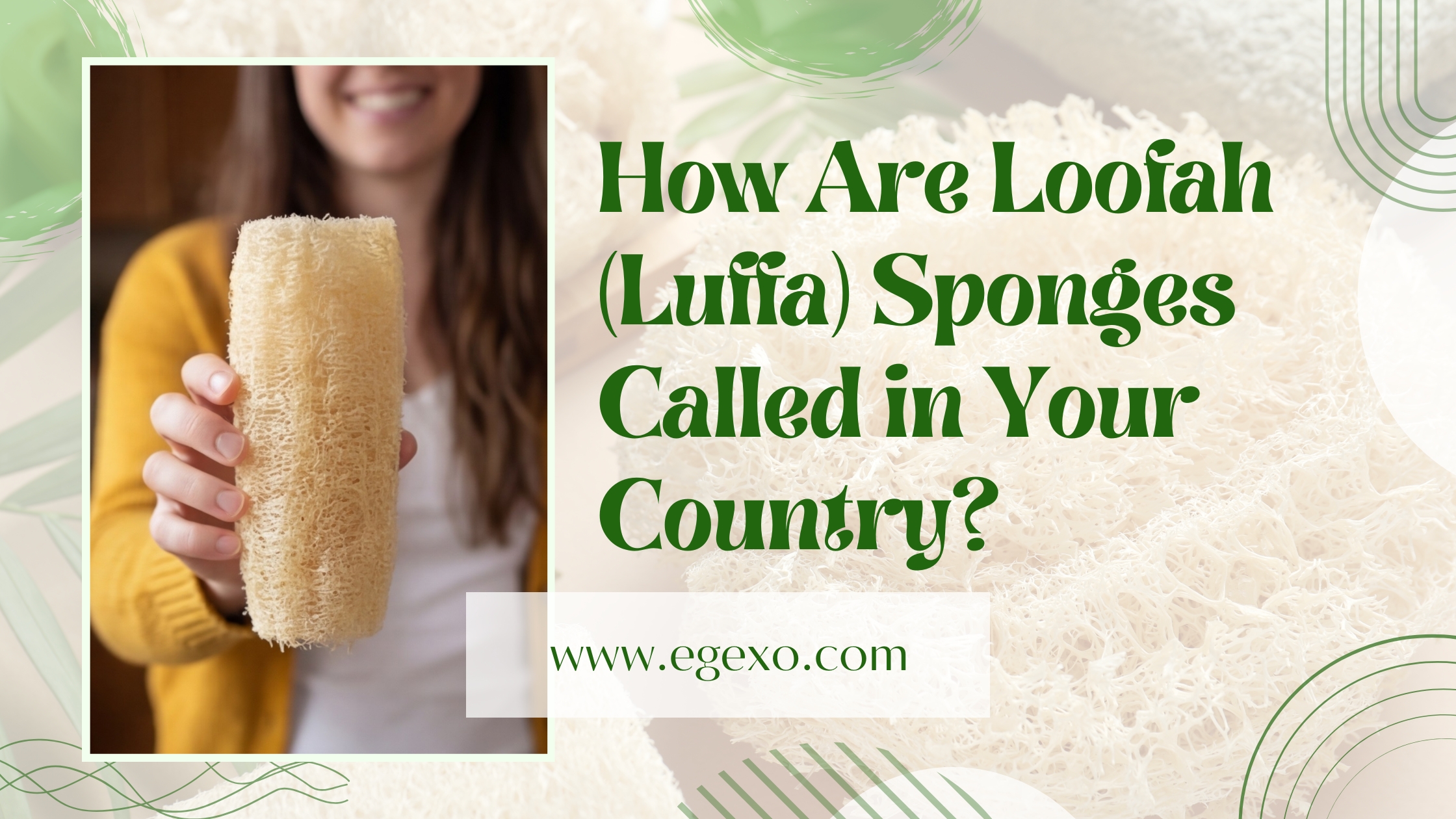
How Are Loofah (Luffa) Sponges Called in Your Country?
There is a good chance you have used one without knowing its full story. A plant-based scrubbing sponge grows on a vine, gets harvested and dried, and ends up in bathrooms and kitchens across more than 80 countries. But what is it actually called? The answer depends entirely on where you are in the world. How are loofah (luffa) sponges called in your country? That single question opens up a fascinating window into botany, trade history, language, and global commerce.
For individual consumers, the name you grew up with shapes how you shop, what you search online, and even which products you trust. For wholesale buyers, importers, and spa suppliers, understanding these naming conventions is not just interesting trivia. It is a practical business tool that affects product labeling, customs documentation, SEO for e-commerce listings, and how you communicate with end customers in different markets.
At Egexo, we have been cultivating, processing, and exporting Egyptian luffa for over 25 years. In that time, we have shipped to dozens of countries and worked with buyers who call our product by at least a dozen different names. This article covers the most common names used globally, why those names exist, and how both buyers and everyday users can apply that knowledge. You will also find quality benchmarks, a regional naming guide, and practical buying tips whether you are ordering a single piece or a full container.
The Botanical Identity Behind Every Name
Before diving into regional terminology, it helps to understand what the plant actually is. Luffa is a genus of tropical and subtropical vines in the Cucurbitaceae family, the same plant family that includes cucumbers, melons, and squash. The two species most commonly used for sponges are Luffa aegyptiaca (also called Luffa cylindrica) and Luffa acutangula, which produces a ridged variety.
Why Egypt Dominates Global Luffa Production
Egypt is not just a historical producer. It is the world’s leading exporter of natural loofah sponges today. The Nile Delta’s fertile soil, long growing season, and decades of agricultural expertise have made Egyptian luffa the global benchmark for quality. Egexo’s farms operate in this region, applying generations of cultivation knowledge to produce luffa that meets the strict standards of spa chains, retailers, and distributors worldwide.
The fiber structure of Egyptian-grown luffa tends to be denser and more uniform than luffa grown in Southeast Asia or Latin America. That density translates to longer product lifespan, better exfoliation performance, and higher resistance to tearing during processing and use. If you are a wholesale buyer comparing sources, Egyptian origin is a meaningful quality signal, not just a geographic label.
For individual consumers browsing bath products, knowing the origin of your loofah matters more than most packaging suggests. A luffa labeled simply as “natural sponge” might come from plants harvested too early, poorly dried, or grown in nutrient-poor conditions.
How Are Loofah Sponges Called Around the World?
This is where the global picture becomes genuinely interesting. The same product carries different names depending on the country, the language, and sometimes the regional dialect. Below is a comprehensive regional breakdown.
Regional Name Table: Loofah (Luffa) Around the World
| Region / Country | Common Local Name(s) | Notes |
|---|---|---|
| United States and Canada | Loofah, Luffa, Loofa | “Loofah” dominates retail; “luffa” used in botanical and trade contexts |
| United Kingdom and Ireland | Loofah, Luffa sponge | British English standardized on “loofah” in the 20th century |
| Egypt and Arab World | Leefa, Lifa, Liffa | Arabic root; also used in North Africa and the Levant |
| Germany and Austria | Luffa, Luffaschwamm | Schwamm means sponge; luffa entered German from botanical Latin |
| France | Luffa, Éponge luffa | French beauty and wellness market uses both terms |
| Spain and Latin America | Lufa, Esponja vegetal, Estropajo | Estropajo commonly refers to kitchen scrubbing use |
| Italy | Luffa, Spugna vegetale | Spugna vegetale means vegetable sponge |
| Portugal and Brazil | Bucha vegetal, Luffa | Bucha is the dominant Brazilian Portuguese term |
| Japan | Hechima | Traditional Japanese name; long cultural history of luffa cultivation |
| China | Si Gua / Si Gua Luo | Direct translation: silk melon; widely used in traditional medicine |
| South Korea | Susebak, Loopa | Susebak specifically refers to the bath sponge use |
| India | Ghosavela, Turai, Torai, Neti | Varies significantly by region and language |
| Indonesia and Malaysia | Oyong, Petola, Luffah | Multiple names reflecting diverse ethnic traditions |
| Turkey | Lifli Kabak, Kabak Lifi | Kabak means gourd; Lifi refers to the fiber or filament |
| Russia and Eastern Europe | Lyuffa, Myochalkа | Myochalka is also a general term for bath scrubber |
| Netherlands | Luffa, Sponskomkommer | Sponskomkommer literally means sponge cucumber |
| Poland | Luffa, Naturalny Scrub | Retail often categorizes it under natural scrub products |
| Mexico | Estropajo, Zacate | Zacate also used for other fibrous scrubbing plants |
| West Africa | Kpakpo, Muaka, Sifon | Varies significantly across countries and ethnic groups |
What This Means for Business and Labeling
If you are a retailer or importer targeting multiple markets, product labeling becomes a strategic decision. A UK consumer scanning a shelf expects to read “loofah” while a Brazilian customer reaches for “bucha vegetal.” An Indonesian buyer browsing an online catalog may search “oyong” or “petola” depending on their background.
Egexo’s export team regularly helps wholesale clients adapt product descriptions, label copy, and marketing materials to match local naming conventions. This is part of the private label loofah manufacturing service that allows you to sell the same Egyptian-quality product under your own brand with localized packaging.
Why the Name Varies: A Brief History of Luffa Trade
The word “loofah” itself entered the English language from the Arabic “lif” or “louf,” reflecting the historical route through which the plant traveled from Africa and Asia into European and American markets. Arab traders introduced luffa fiber products to Mediterranean markets centuries before the plant became a commercial bath product in the Western world.
The Dutch, who were major maritime traders, encountered luffa in Southeast Asia and brought seeds back to Europe. The German term “Luffa” follows directly from the Dutch botanical naming of the 1600s. When British colonists encountered the plant in various parts of the empire, they adapted the Arabic-derived name into “loofah,” which stuck in English-speaking markets.
In Japan, hechima (loofah) has been cultivated since at least the 16th century and is deeply embedded in traditional beauty practices and folk medicine. The Japanese cosmetics industry still incorporates hechima extract in skincare formulations today.
In China, si gua (silk melon) reflects the smooth, silky appearance of the young immature fruit before it develops the fibrous interior. The dried fiber, si gua luo, has been used in traditional Chinese medicine for centuries as a tool for improving circulation and clearing channels.
The Modern Standardization Push
In international trade documentation and customs classification, luffa products typically fall under harmonized system codes related to vegetable plaiting materials or natural sponges. The botanical name Luffa cylindrica appears in official documentation regardless of the retail name used in any given country.
For buyers placing import orders, working with a supplier like Egexo that understands both the trade terminology and the retail naming conventions in your target market is a significant advantage. Review the farm to export process to understand how product is documented, graded, and prepared for international shipment.
Quality Differences That Go Beyond the Name
Whether the product on your shelf is called loofah, luffa, bucha, leefa, or hechima, the actual quality varies enormously based on origin, processing method, and grading standards.
Loofah Quality Grading Comparison Table
| Quality Grade | Fiber Density | Color | Aroma | Typical Use | Durability |
|---|---|---|---|---|---|
| Premium Export Grade | Very high, uniform | Natural off-white to cream | Neutral | Spa, premium retail | 3 to 6 months with care |
| Standard Commercial Grade | Medium | Light tan | Mild | General retail, hospitality | 2 to 4 months |
| Economy Grade | Lower, uneven | Yellow to brown patches | May have earthy scent | Budget retail | 1 to 2 months |
| Processed and Bleached | Variable | Bright white | Neutral | Mass market | 1 to 3 months |
| Raw Unprocessed | High potential | Green to tan | Earthy | Industrial, DIY | Variable |
Premium export grade luffa from Egypt shows a fiber density consistently above 85 percent of the internal volume. That density is what creates effective exfoliation without the harshness that lower-grade products deliver. Egexo applies rigorous quality standards across every batch, detailed at the quality standards page.
What Consumers Should Look For
When buying in retail or ordering online, look for these indicators of quality regardless of what the product is called locally:
- Uniform fiber structure with no visible holes or collapsed sections
- Neutral or very mild scent, not musty or chemically treated
- Consistent color without heavy browning or bleached white uniformity
- Firm but flexible when dry, soft and pliable within 30 seconds of wetting
- Country of origin labeled as Egypt if you want benchmark-quality luffa
Spa owners and wellness retailers sourcing in bulk can order samples from Egexo before committing to a wholesale order, which lets you physically evaluate fiber density, size consistency, and overall condition before purchase.
How Loofah Is Used Across Different Cultures
The name is not the only thing that varies. How people actually use luffa sponges reflects distinct cultural traditions around body care, cooking, and household cleaning.
Bath and Body Use: A Global Perspective
In North America and Western Europe, the loofah sponge is primarily a bathroom product used for body exfoliation during showers. The wellness industry has elevated it into a premium spa product associated with natural beauty routines. Egexo’s bath and body loofah range serves this market with sponges sized and shaped specifically for personal care.
In the Arab world, the leefa has been a hammam staple for centuries. Traditional bathhouse culture involves vigorous scrubbing with a damp luffa to remove dead skin, improve circulation, and prepare skin for treatments. The texture preferences in this market tend toward firmer, denser sponges.
In parts of Southeast Asia, luffa is as much a food product as a bath product. Younger immature fruits are consumed as vegetables in soups, stir-fries, and curries. This culinary tradition means that in markets like Vietnam, the Philippines, and Indonesia, the same plant word covers both food and cleaning applications.
In Japan, hechima has traditionally been associated with skin care and is linked to a particular late-summer beauty practice involving hechima water, the sap extracted from cut vines, which has been used as a natural toner and moisturizer.
Kitchen and Household Cleaning
Kitchen loofahs represent a fast-growing product category as consumers seek alternatives to synthetic scrubbing pads. In Spanish-speaking markets, the estropajo is almost synonymous with kitchen scrubbing rather than body care. Egexo’s kitchen loofah products are shaped and processed differently from bath sponges to meet the specific demands of food-safe cleaning.
For wholesale buyers in the household goods sector, kitchen loofahs represent a strong opportunity. The shift away from plastic sponges is accelerating across Europe and North America, and natural plant-based alternatives command premium positioning in both retail and foodservice supply channels.
Buying Loofah Wholesale: What Buyers in Every Market Need to Know
For importers, distributors, and retailers sourcing luffa products, the naming diversity discussed above has direct practical implications. Here is a concise overview of what to consider regardless of what your local market calls the product.
Wholesale Buyer Checklist
| Consideration | What to Evaluate | Egexo Standard |
|---|---|---|
| Origin verification | Request farm origin documentation | Egyptian Nile Delta farms |
| Quality grading | Ask for graded samples with specifications | Premium and standard grades available |
| MOQ flexibility | Confirm minimum order quantities | Flexible MOQ for new buyers |
| Private labeling | Confirm capability for branded packaging | Full private label service available |
| Export compliance | Verify phytosanitary and customs documentation | Full export documentation provided |
| Sample policy | Test quality before bulk commitment | Free sample program available |
| Lead time | Understand production and shipping timelines | Standard 2 to 4 week lead time |
| Product range | Match product type to your market | 40+ SKUs across all categories |
For buyers entering new markets or expanding a natural products line, Egexo offers custom loofah product design that allows you to specify dimensions, cut styles, packaging, and labeling to match your target audience’s expectations and the regional terminology they use.
Specifications and MOQ Overview
| Product Category | Standard Size Range | MOQ (Units) | Available Grades |
|---|---|---|---|
| Bath Body Sponges | 10cm to 30cm length | 500 units | Premium, Standard |
| Kitchen Scrubbers | 8cm to 15cm length | 1,000 units | Standard, Economy |
| Raw Scrubbers | Full cylinder, 20cm plus | 200 units | Premium, Raw |
| Pet and Spa Grooming | 10cm to 20cm shaped | 300 units | Premium |
| Novelty and Shaped | Custom dimensions | 500 units | Premium, Standard |
Download the complete Egexo product catalog for full specifications across all product categories.
Sustainability and the Natural Loofah Advantage
One reason that loofah sponges, by whatever name they are called, are gaining ground globally is the sustainability conversation. Consumers and retailers alike are under increasing pressure to reduce reliance on plastic and synthetic materials in everyday products.
Natural Loofah vs Synthetic Sponge: Environmental and Practical Comparison
| Factor | Natural Loofah | Synthetic Plastic Sponge |
|---|---|---|
| Biodegradability | Fully biodegradable within weeks | Can take hundreds of years |
| Raw material | Renewable plant crop | Petroleum-derived plastics |
| Production energy | Low, primarily agricultural | High, industrial chemical process |
| Microplastic risk | None | Sheds microplastics with each use |
| Compostability | Yes, fully compostable | No |
| Skin interaction | Natural texture, no synthetic chemicals | Chemical residues possible |
| Durability | 3 to 6 months (premium grade) | 2 to 4 weeks before bacterial contamination |
| End-of-life disposal | Garden compost or bin | Landfill |
| Price positioning | Slightly higher retail | Lower unit cost, higher total cost |
For retailers building eco-friendly product lines, natural loofahs from Egypt represent a credible, documentable sustainability claim. Egyptian luffa cultivation requires no synthetic fertilizers when grown using traditional methods, and the drying process is solar-based, reducing the product’s carbon footprint further.
Explore the full range of natural loofah products and learn more about sustainable sourcing at for wholesale-specific resources or loofahguide.com for consumer-focused guides.
FAQ Section
Q1: What is a loofah sponge called in Arabic-speaking countries?
In Egypt and across the Arab world, the loofah sponge is most commonly called leefa or lifa, derived from the Arabic root word for fiber or filament. In Egyptian Arabic dialect specifically, the pronunciation is closer to “leefa.” This name predates the English word “loofah,” which was actually borrowed from Arabic through trade routes centuries ago. The same plant is cultivated extensively in Egypt, making it both the source of the product and the origin of the most widely used name outside English.
Q2: Is there a difference between “loofah” and “luffa”?
Botanically, luffa is the correct scientific genus name. Loofah is the anglicized retail spelling that became standard in English-speaking markets. Both terms refer to the same plant and the same dried fibrous sponge derived from it. In trade documentation, scientific literature, and botanical catalogs, luffa is preferred. In retail packaging, consumer marketing, and everyday language in the US, UK, and Australia, loofah is more common. For wholesale buyers, it is useful to know both terms since suppliers and trade documents may use either interchangeably.
Q3: What do they call loofah in Brazil and Portugal?
In Brazilian Portuguese, the loofah sponge is almost universally known as bucha vegetal, which translates roughly to vegetable plug or vegetable sponge. In Portugal, the same term is used, though luffa also appears in botanical and specialty wellness contexts. Bucha vegetal is the term you would use when sourcing or labeling products for the Brazilian market. Retail packaging in Brazil that says bucha vegetal will connect immediately with consumers who may not recognize the English word loofah at all.
Q4: How is loofah pronounced and spelled differently in Asian markets?
In Japan, the loofah sponge is called hechima and has a centuries-long history in traditional beauty and folk medicine. In China, the dried fiber sponge is called si gua luo, while the fresh fruit is known as si gua, meaning silk melon. In South Korea, susebak or loopa are used in bath product contexts. In Indonesia and Malaysia, oyong and petola are common names depending on the region. Wholesale buyers targeting Asian markets should use locally recognized names in packaging and marketing materials to maximize consumer recognition.
Q5: Why does Egypt produce the best quality loofah sponges?
Egypt’s Nile Delta provides ideal growing conditions for luffa cylindrica, combining fertile alluvial soil, abundant sunshine, and a long growing season. Egyptian luffa has been cultivated and exported for generations, creating deep agricultural expertise that results in denser fiber structure, more uniform sizing, and superior durability compared to luffa grown in other regions. Egexo has over 25 years of direct cultivation experience and applies strict grading standards from farm to export, making Egyptian-origin luffa the preferred choice for spa chains, premium retailers, and discerning importers worldwide.
Q6: What is the minimum order quantity for wholesale loofah from Egexo?
Minimum order quantities at Egexo vary by product category. Bath body sponges start at 500 units, kitchen scrubbers at 1,000 units, and raw scrubbers at 200 units. New buyers are encouraged to request samples before placing a bulk order to evaluate quality firsthand. Egexo also offers flexible MOQ arrangements for buyers entering new product categories or testing new markets. Contact the export team through the request a quote page for a customized offer based on your specific product and volume requirements.
Q7: Can I sell natural loofah sponges as an eco-friendly product?
Yes. Natural loofah sponges are genuinely biodegradable, compostable, and derived from a renewable plant crop. Unlike synthetic sponges made from petroleum-based materials, luffa leaves no microplastic residue and breaks down in a home compost bin within weeks. These are documentable, verifiable sustainability claims that resonate strongly with environmentally conscious consumers in North American and European markets. When sourced from transparent suppliers like Egexo, you can accurately market the Egyptian origin, natural cultivation methods, and plastic-free processing as part of your product’s sustainability story.
Q8: How long does a natural loofah sponge last compared to a synthetic one?
A premium-grade natural loofah sponge, properly cared for, lasts between 3 and 6 months for personal bath use. A synthetic sponge typically requires replacement every 2 to 4 weeks due to rapid bacterial buildup and structural degradation. Over a single year, a consumer using premium loofah sponges spends less on replacement products than one using synthetic alternatives, while generating significantly less plastic waste. The key to loofah longevity is allowing it to dry completely between uses and rinsing it thoroughly after each session.
Expert Insight from Egexo
After 25 years of growing, processing, and exporting Egyptian luffa to markets across six continents, one thing has become clear: the name on the package matters as much as the quality inside it. We have seen excellent products fail in new markets simply because the labeling used terminology unfamiliar to local consumers. When you partner with Egexo for private label manufacturing, our team reviews the naming conventions, pack size expectations, and consumer preferences in your specific target market before any label goes to print. Egyptian luffa is the global quality standard. Making sure your customer can find it by the name they actually use is how you turn that quality into sales.
Conclusion
The question of how loofah (luffa) sponges are called in your country is far more than a language curiosity. It reflects the plant’s remarkable journey from Egyptian and Asian farms through centuries of trade into bathrooms, kitchens, spas, and wellness routines on every continent. Whether your customers call it loofah, luffa, leefa, bucha vegetal, hechima, or oyong, the underlying product, when sourced correctly, is the same naturally biodegradable, skin-nourishing, high-performance sponge that has been valued across cultures for generations.
For wholesale buyers, understanding these naming conventions gives you a competitive edge in labeling, marketing, and communicating product value to local audiences. For consumers, knowing the origin and quality markers behind any name helps you choose better products and make the most of what nature offers.
Key Takeaways:
- Loofah sponges are known by over 15 distinct names across global markets, all referring to the same Luffa cylindrica plant
- Egyptian-grown luffa is the global quality benchmark due to Nile Delta growing conditions and generations of cultivation expertise
- Name differences have direct implications for product labeling, marketing, and B2B trade documentation
- Natural loofah biodegrades fully, produces no microplastics, and outperforms synthetic sponges in durability and sustainability
- Premium-grade loofah lasts 3 to 6 months with proper care, making it cost-effective for consumers and high-value for retailers
Ready to source the world’s best loofah under whatever name your market uses?
- For Wholesale Buyers: Request a quote or download our product catalog
- For Individual Buyers: Shop our full collection or order free samples