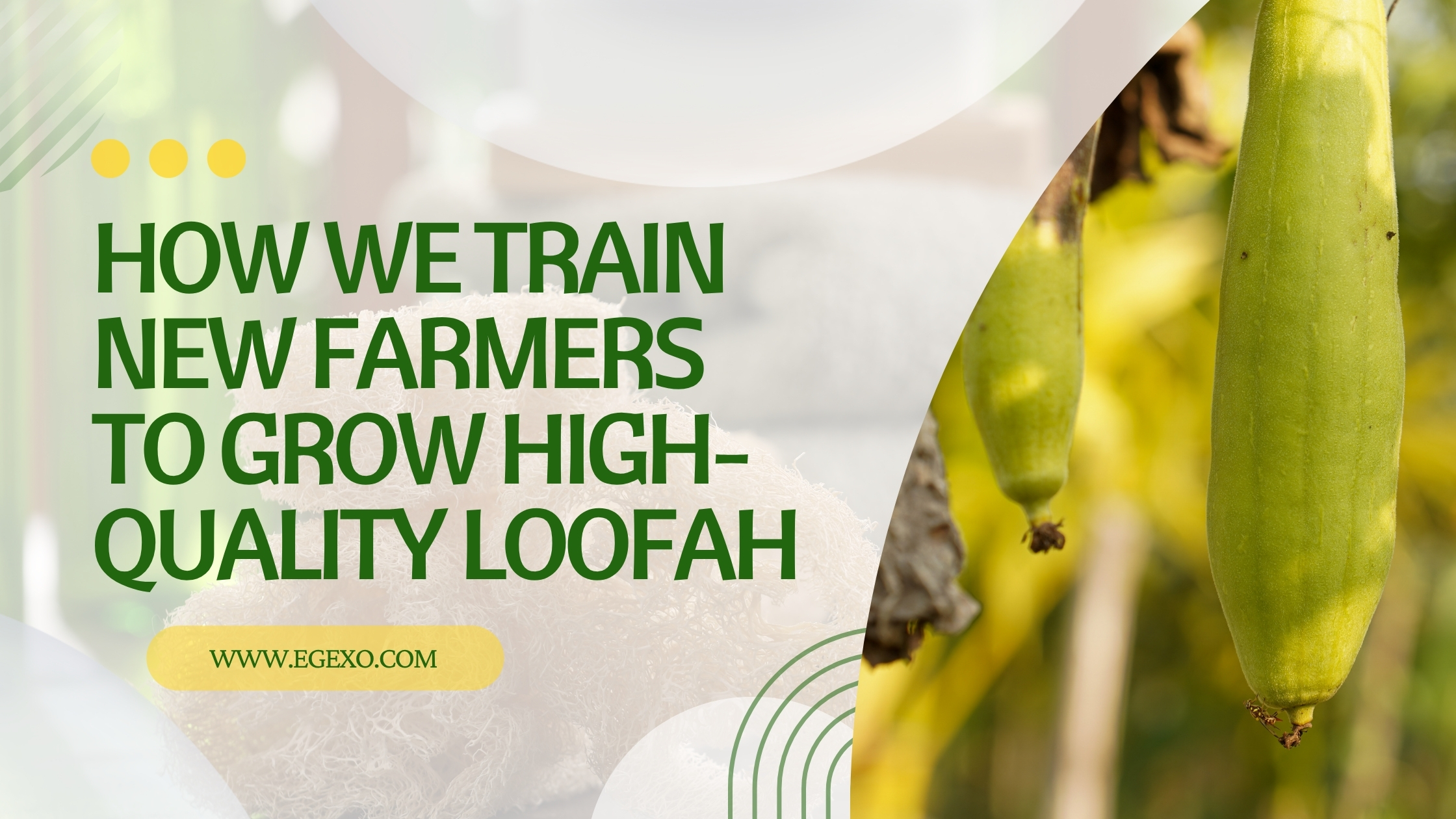
How We Train New Farmers to Grow High-Quality Loofah
The Person Behind Every Loofah You Touch
Most people never think about who grew their loofah. They pick one up from a store shelf, run it under warm water, and step into the shower without a second thought. But behind every single natural loofah is a farmer who made dozens of decisions, every one of which directly affects the quality of what you hold in your hands.
At Egexo, we have spent more than 25 years not just growing loofah, but building a generation of farmers who know how to grow high-quality loofah consistently, season after season. That knowledge does not appear overnight. It comes from a structured training program rooted in Egyptian agricultural tradition, modern agronomic science, and an uncompromising commitment to export-grade standards.
This article takes you inside that process. Whether you are a spa owner evaluating suppliers, a retailer looking for reliable bulk stock, or someone who simply wants to understand what makes one loofah better than another, the answer starts in the field and with the people who tend it.
If you want to skip straight to our products, visit the Egexo shop or explore our farm-to-export process. Otherwise, read on.
Why Farmer Training Is the Foundation of Loofah Quality
There is a common assumption in the natural products industry that loofah is easy to grow. It is a vine plant, after all. You plant the seed, water it, and wait. That assumption is what separates average loofah from export-grade loofah.
The difference between a loofah that falls apart after three uses and one that lasts three months comes down almost entirely to decisions made during cultivation. Soil preparation, irrigation timing, vine spacing, harvest windows, and post-harvest handling all require skill and judgment that only comes through proper training and hands-on experience.
At Egexo, we learned this lesson early. In our first decade, we worked with farmers who had good intentions but inconsistent results. Fiber density varied. Color uniformity was unpredictable. Rejection rates at export inspection were higher than acceptable. The solution was not better equipment. It was better training.
The Real Cost of Untrained Cultivation
For wholesale buyers, inconsistency in loofah quality is not just an inconvenience. It creates real business problems.
| Quality Problem | Cause in Cultivation | Business Impact for Buyers |
|---|---|---|
| Brittle fiber | Harvested too late in the season | High product return rates |
| Dark discoloration | Improper drying after harvest | Customer complaints, unsellable stock |
| Uneven thickness | Poor vine management and spacing | Inconsistent product weight and feel |
| Short lifespan | Immature harvest or pest damage | Negative reviews, brand damage |
| Mold after packaging | Residual moisture in fiber | Entire shipment loss |
Every one of those problems is preventable. And preventing them is exactly what our farmer training program is designed to do.
The Egexo Farmer Training Program: An Inside Look
Our training program runs in cycles that align with the growing season. New farmers who join our network in Beheira and Kafr el-Sheikh, the two primary loofah-growing regions in Egypt, go through an orientation phase before they are ever given seeds to plant.
Training is not a single workshop or a printed manual. It is a layered, ongoing relationship between our senior agronomists and the farming families who partner with us.
Phase 1: Soil and Site Assessment
Before a single seed goes into the ground, new farmers learn to evaluate their land. This is often the most surprising part of training for farmers who have grown other crops. Loofah is specific about its needs.
Our agronomists teach farmers to test for three primary soil conditions: pH balance, drainage capacity, and organic matter content. Egyptian loofah grows best in sandy-loam soil with a pH between 6.0 and 7.0. Fields with heavy clay content or poor drainage produce vines that struggle, yield irregular fruits, and create fiber that is too dense and prone to cracking.
Site orientation also matters. Loofah vines need full sun exposure for at least 8 hours per day. Farmers learn to map their fields and identify the most productive planting rows before the season begins.
Phase 2: Seed Selection and Planting Protocol
Not all loofah seeds are equal. Egexo maintains a proprietary seed stock derived from our best-performing plants over multiple generations. New farmers are taught the criteria we use to select seeds for planting versus seeds we set aside for future breeding.
Key planting metrics farmers learn in this phase:
| Parameter | Egexo Standard | Reason |
|---|---|---|
| Seed germination rate | Minimum 85% | Ensures dense, uniform planting |
| Row spacing | 1.5 to 2 meters | Allows full vine development |
| Planting depth | 2 to 3 cm | Protects seed without limiting germination |
| Irrigation start | Within 24 hours of planting | Prevents seed dormancy |
| Trellis setup | Before germination | Supports vine from first growth |
Farmers who skip or modify these steps see the consequences within six weeks. Vine competition from overcrowding, weak root systems from incorrect depth, and vine collapse without trellis support are all predictable and avoidable failures.
Phase 3: Vine Management and Growth Monitoring
Once the vines begin growing, the training enters its most labor-intensive phase. Loofah vines are aggressive growers and require regular management to ensure the plant puts its energy into fruit production rather than excess foliage.
New farmers spend time each week in the field with senior farmers who demonstrate pruning techniques, leaf thinning practices, and how to identify early signs of pest activity or disease. This hands-on accompaniment period lasts a minimum of six weeks during the first growing season.
One of the most important skills we teach is reading the plant. An experienced loofah farmer can look at a vine and tell whether it needs more water, whether a fungal issue is beginning, or whether the fruit is developing on schedule. This knowledge cannot come from a classroom alone.
If you want to understand how this farm-level management translates into what arrives at your door, read our full farm-to-export process documentation.
Harvest Timing: The Most Critical Skill We Teach
If there is one point in the loofah cultivation process where training makes the biggest difference, it is harvest timing. This is where we invest the most time with new farmers, and where the gap between trained and untrained growers is most visible.
Loofah is harvested for its fibrous interior, not its outer skin. The fruit must reach full maturity for the fiber to develop the right density, flexibility, and durability. Harvest it too early, and the fiber is soft, weak, and will compress permanently after a few uses. Harvest it too late, and the outer skin becomes difficult to remove cleanly, and the fiber darkens and becomes brittle.
How We Teach Harvest Readiness
We use a combination of visual, tactile, and timing indicators:
- Color shift assessment: The outer skin transitions from deep green to a pale yellow-brown when the fruit approaches maturity. Farmers learn to recognize the specific shade we target.
- Sound test: A mature loofah fruit produces a hollow sound when tapped gently. Immature fruits produce a dull thud.
- Weight-to-length ratio: Mature fruits of a given length fall within a predictable weight range. Farmers weigh sample fruits from each row to confirm readiness.
- Fiber separation test: A small incision in the skin allows the farmer to check whether the fiber pulls cleanly from the seed cavity without tearing.
- Seasonal calendar alignment: Based on planting date and local climate data, we give each farmer a predicted harvest window and train them to cross-reference all four physical signs against that calendar.
This multi-signal approach eliminates the guesswork that leads to inconsistent harvests.
Post-Harvest Handling: Where Most Suppliers Fall Short
Even a perfectly grown loofah can be ruined after harvest. This is a painful truth that many small suppliers discover only after customers complain. Post-harvest handling is the final phase of our farmer training, and it covers cleaning, drying, bleaching standards, and initial grading.
Cleaning and Drying Protocol
| Step | Method | Time Required | Quality Indicator |
|---|---|---|---|
| Skin removal | Manual peeling within 4 hours of harvest | 30 to 60 minutes per batch | Clean white to cream fiber |
| Initial rinse | Running water flush to remove seeds and residue | 10 to 15 minutes | Clear rinse water |
| Seed extraction | Gentle shaking after rinse, secondary flush | 5 minutes | No visible seeds in cavity |
| Primary drying | Elevated rack drying in full sun | 2 to 4 days | Fiber moisture below 12 percent |
| Secondary inspection | Visual check for discoloration or mold spots | Per batch | Uniform color throughout |
Farmers who rush the drying phase create the most common and most expensive quality failure in loofah production. Residual moisture trapped in the fiber creates an environment for mold to develop inside the packaging, sometimes weeks after the loofah has shipped.
We require all partner farmers to record drying start and end dates, ambient temperature readings during drying, and final weight measurements. This documentation becomes part of the quality record that follows the batch from the farm to our processing facility.
Quality Grading: Teaching Farmers to See Like a Buyer
Once a loofah has been dried, farmers learn to grade their own product before it reaches our facility. This self-grading step is intentional. When farmers understand the standards used by buyers and exporters, they make better decisions throughout the entire growing and handling process.
Egexo Loofah Quality Grading Standards
| Grade | Fiber Density | Color Range | Length Consistency | Recommended Use |
|---|---|---|---|---|
| Grade A Export | High, uniform | Cream to light tan | Plus or minus 1 cm from spec | Spa, premium retail, private label |
| Grade B Commercial | Medium, mostly uniform | Tan to light brown | Plus or minus 2 cm from spec | General retail, bulk wholesale |
| Grade C Industrial | Variable | Brown, some dark spots | Variable | Kitchen, industrial cleaning |
| Sub-grade | Poor density or mold | Dark brown or discolored | Does not meet specification | Rejected, not exported |
Buyers who work with Egexo receive product graded to their specification before shipment. We offer Grade A export-standard bath and body loofahs, kitchen loofahs, and raw loofah scrubbers from our trained farmer network.
For retailers and spa owners evaluating our quality firsthand, we strongly recommend ordering samples before committing to a bulk order.
What This Means for Wholesale Buyers
For spa owners, retailers, and importers, our training program is not just a nice story. It is a direct explanation of why Egexo loofah performs consistently across large shipments.
When you place a wholesale order with Egexo, you are not buying from a middleman who aggregates product from dozens of unrelated farmers. You are buying from a network of trained, certified growers whose practices we have directly shaped and who we continue to monitor every season.
Supplier Evaluation Checklist for Wholesale Buyers
| Evaluation Criterion | Egexo Standard | Questions to Ask Other Suppliers |
|---|---|---|
| Farmer training program | Formal, seasonal, documented | Do you train your growers directly? |
| Harvest timing control | Multi-signal protocol taught to all farmers | How do farmers determine harvest readiness? |
| Post-harvest documentation | Required for all batches | Can you provide lot-level quality records? |
| Minimum Order Quantity | No MOQ on standard products | What is the MOQ and is it negotiable? |
| Private label capability | Available across all product categories | Can packaging and labeling be customized? |
| Sample ordering | Available on request before bulk commitment | Can I test quality before placing an order? |
If you are comparing suppliers, these questions will reveal very quickly whether a supplier controls their quality or simply resells whatever farmers bring to them.
You can also request a wholesale quote directly or download our complete product catalog to see the full range of products our trained farmer network produces.
For businesses interested in branded products, our private label loofah manufacturing service and custom product design program are both built on the same quality foundation described in this article.
What This Means for Consumers
If you are not a wholesale buyer but simply someone who wants a better loofah experience, the training story matters to you too, just in a different way.
The natural loofah market has a quality problem that most consumers never consciously identify. They buy a loofah, it works adequately for a few weeks, it falls apart, they buy another one. The cycle feels normal because they have never experienced what a properly grown and properly handled loofah actually performs like.
A loofah grown by a trained Egexo farmer, harvested at the right time, dried correctly, and graded to export standard will exfoliate more effectively, maintain its structure for two to three months with proper care, and dry out between uses rather than staying damp and harboring bacteria.
For guidance on getting the most from your loofah, visit loofahguide.com for detailed consumer care guides and product comparisons.
Pros and Cons: Natural Egyptian Loofah vs Synthetic Alternatives
| Factor | Natural Egyptian Loofah | Synthetic Loofah |
|---|---|---|
| Exfoliation quality | Deep, natural fiber texture | Softer, less effective |
| Environmental impact | Fully biodegradable | Plastic, non-biodegradable |
| Lifespan with proper care | 2 to 3 months | 3 to 4 months, but plastic waste |
| Hygiene | Dries quickly, replace monthly | Retains moisture longer |
| Farming and labor | Supports Egyptian farm families | Factory-produced |
| Customization for wholesale | High, including private label | Limited |
| Price point (wholesale) | Competitive in USD per unit | Lower per unit, no sustainability story |
Expert Insight from Egexo
After 25 years of working with Egyptian loofah farmers, our lead agronomist puts it simply: the single biggest predictor of loofah quality is how much respect the farmer gives to timing. Timing of planting, timing of irrigation, timing of harvest, and timing of drying. Every shortcut taken with timing shows up in the finished product.
New farmers often want to harvest early because the fruit looks ready to them. We spend significant time teaching them that what looks ready to the eye and what is ready for export are two different things. When they understand that their reputation, and their income, depends on meeting the standard rather than the deadline, everything changes.
This mindset shift, from thinking like a farmer who grows crops to thinking like a supplier who serves customers, is the real transformation our training program delivers.
For wholesale buyers who want to understand more about how we maintain these standards across our supply chain, visit our quality standards page and our why choose Egexo page.
FAQ Section
Q1: What does it take to grow high-quality loofah consistently?
A: To grow high-quality loofah consistently, farmers need to control several variables simultaneously. These include soil pH management, proper vine spacing, trellis support, accurate harvest timing, and careful post-harvest drying. At Egexo, our training program covers all of these areas in a structured seasonal curriculum. Consistency is not accidental. It is the result of trained decision-making at every stage of cultivation.
Q2: How long does it take to train a new loofah farmer?
A: A new farmer in the Egexo network goes through at least one full growing season of supervised training before operating independently. That represents roughly four to six months of hands-on instruction covering soil assessment, seed selection, vine management, harvest timing, and post-harvest handling. Senior farmers accompany new growers in the field throughout this period, providing real-time guidance and correction.
Q3: What makes Egyptian loofah better than loofah from other countries?
A: Egyptian loofah benefits from ideal growing conditions, including a warm, dry climate, fertile Nile Delta soil, and generations of farming expertise concentrated in specific growing regions. Egypt is one of the world’s top loofah exporters, and the Luffa aegyptiaca species grown there produces a fiber that is denser and more uniform than varieties grown in other regions. Over 10 years of exporting, Egexo has learned to take full advantage of these natural conditions.
Q4: What quality grades does Egexo offer for wholesale buyers?
A: Egexo offers three primary quality grades. Grade A is our export-standard product, featuring high fiber density, cream to light tan color, and tight dimensional consistency. It is ideal for spa suppliers, premium retailers, and private label brands. Grade B suits general retail and commercial wholesale. Grade C is intended for kitchen and industrial cleaning applications. All grades are documented and traceable to the farm of origin.
Q5: Can I order samples before committing to a bulk purchase?
A: Yes. Egexo offers sample ordering for wholesale buyers who want to evaluate quality before placing a bulk commitment. Samples are available across our bath and body, kitchen, raw scrubber, and pet and spa grooming product categories. Visit our sample request page to get started. We recommend requesting samples from the grade category that matches your intended product line.
Q6: How should I store and care for a natural loofah to maximize its lifespan?
A: A natural loofah lasts longest when it is rinsed thoroughly after each use, squeezed to remove excess water, and hung in a well-ventilated area to dry completely between uses. Never leave a natural loofah in a pooled water environment or sealed bag. Replace your loofah every four to six weeks in regular use, or sooner if you notice any darkening of the fiber or persistent odor.
Q7: What is the minimum order quantity for wholesale loofah from Egexo?
A: Egexo’s minimum order quantities vary by product type and customization level. Standard product lines have no MOQ; private label starts from 1,000 units. For private label and custom-designed products, MOQ requirements are discussed during the quotation process. Contact our export team via the wholesale quote request page for product-specific MOQ information.
Q8: Does Egexo offer private label loofah manufacturing?
A: Yes. Egexo offers comprehensive private label manufacturing for brands that want to sell natural Egyptian loofah under their own identity. This includes custom packaging design, branding, labeling, and product bundling. Our private label program is built on the same trained-farmer supply chain described in this article, ensuring that branded products maintain the quality standards your customers expect.
Conclusion
Growing high-quality loofah at export scale is not a matter of planting more seeds and hoping for the best. It is the result of deliberate, documented, repeated training that shapes how farmers think, observe, and act throughout an entire growing season.
At Egexo, our 25-year investment in farmer development is the reason our wholesale buyers report consistent quality across shipments, season after season. It is the reason our private label partners trust us with their brand reputation. And it is the reason individual consumers who discover genuinely well-grown Egyptian loofah rarely go back to what they used before.
Key Takeaways:
- Loofah quality is determined at every stage from soil preparation to post-harvest drying, not just at the farm.
- Egexo’s structured farmer training program covers soil assessment, seed selection, vine management, harvest timing, and grading.
- Harvest timing is the single most critical skill, and the area where untrained farmers most commonly fail.
- Buyers can verify quality through our documented grading system and by ordering samples before bulk commitment.
- Natural Egyptian loofah, grown by trained farmers, outperforms synthetic alternatives on exfoliation quality, sustainability, and shelf life.
Ready to experience Egyptian loofah quality?
- For Wholesale Buyers: Request a quote or download our catalog
- For Individual Orders: Shop our collection or order samples