

How to Select the Right Loofah Grade for Industrial Use
Most buyers assume all loofahs are alike until a shipment fails quality inspection or a spa client complains about scratching. The difference between a product that performs and one that disappoints almost always comes down to grade selection.
Knowing how to select the right loofah grade for industrial use is one of the most practical skills a purchasing manager, spa owner, retailer, or even an informed individual shopper can develop. With global demand for natural loofah products growing steadily, driven by the eco-conscious movement and the wider shift away from synthetic sponges, getting this decision right matters more than ever.
Egypt produces approximately 60 percent of the world’s commercially exported loofah, and Egexo has spent 10 years grading and exporting these products from the Nile Delta region. That field experience translates into a grading system that is both scientifically consistent and commercially practical.
This guide walks you through every aspect of loofah grading, from the biological characteristics that define each grade to the specific applications that match each one. Whether you are placing a bulk wholesale order for a distribution network or simply trying to buy the most effective natural scrubber for your bathroom, this article gives you everything you need to make the right choice.
By the end, you will understand the five core loofah grades, know exactly which grade fits which industrial or personal application, and have a clear framework for evaluating supplier claims about quality.
What Are Loofah Grades and Why Do They Exist
Loofah, known scientifically as Luffa aegyptiaca or Luffa cylindrica, is a fibrous gourd that grows on climbing vines. When the fruit matures and dries, the interior fibrous skeleton becomes the loofah scrubber familiar to millions of consumers worldwide.
Not every loofah grows to the same standard. Factors including harvest timing, vine nutrition, irrigation quality, sun exposure, and post-harvest processing all affect the final fiber density, color, diameter uniformity, and durability of the finished product.
Grading exists to create a consistent commercial language. When a spa distributor in Germany orders Grade A loofahs from a supplier in Egypt, both parties need to agree on what that means in terms of measurable characteristics. Without standardized grading, quality disputes become inevitable and costly.
The Biological Basis of Grade Differences
The fiber structure of a loofah is a network of interlocking cellulose strands. Higher-grade loofahs have denser, more evenly distributed fiber networks. This density directly affects how long the product lasts under repeated use, how effectively it exfoliates skin, and how well it holds its shape after being saturated with water.
Harvest timing is the single most influential variable. Loofahs harvested at peak maturity, typically between 120 and 140 days after planting in Egyptian growing conditions, produce the densest fiber networks. Early harvest produces soft, weak fiber. Late harvest results in brittleness and uneven coloration.
Egexo’s farming teams in the Nile Delta monitor each crop daily during the final weeks before harvest, using both visual inspection and manual fiber resistance testing to confirm optimal picking timing. This attention at the source is what makes Egyptian loofah, and specifically Egexo-sourced loofah, the benchmark standard in international wholesale markets.
The Five Core Loofah Grades Explained
Understanding how to select the right loofah grade for industrial use begins with knowing what each grade actually represents. The following breakdown reflects the grading system used by professional exporters operating under Egyptian agricultural export standards.
Grade Premium (Export Select)
This is the highest classification in commercial loofah grading. Premium grade loofahs are selected from the top 10 to 15 percent of any harvest batch.
Key characteristics include a uniform cream-to-light-tan color with no brown patches, a fiber density rated above 85 on the standard compression resistance scale, diameter consistency within plus or minus 3 millimeters across the length of the piece, and a completely clean cross-section free of seeds, skin residue, or discoloration.
Premium grade is the appropriate choice for luxury spa applications, high-end retail packaging, private label bath products, and any application where the visual appearance of the loofah is part of the consumer value proposition.
For individual buyers, premium grade offers the gentlest yet most effective exfoliation experience. The even fiber network produces consistent results without risk of rough patches or excessive abrasion.
Grade A (Commercial Standard)
Grade A represents the broadest commercially traded loofah classification and accounts for roughly 45 to 50 percent of professional export volumes. This grade meets the requirements of most spa suppliers, mid-range retail brands, and general-use wholesale buyers.
Fiber density falls between 70 and 85 on the compression resistance scale. Minor color variation is acceptable, with up to 10 percent surface variation in tone. Diameter uniformity is maintained within plus or minus 5 millimeters.
For wholesale buyers, Grade A offers the best combination of consistent quality and cost efficiency at volume. Minimum order quantities at this grade are typically lower per unit cost than premium, making it the practical choice for distributors serving mixed retail markets.
Grade B (Functional Processing Grade)
Grade B loofahs meet structural requirements for cleaning and scrubbing functions but do not meet the visual or dimensional standards required for retail presentation. They may show visible color variation, minor surface irregularities, or slight diameter inconsistency.
This grade is ideal for industrial cleaning applications, back-of-house spa use, private manufacturing processes where the loofah will be cut and processed further, and kitchen scrubber production where visual uniformity is less important than fiber durability.
For cost-conscious buyers purchasing at high volumes, Grade B delivers excellent functional performance at significantly reduced cost per kilogram.
Grade C (Industrial Raw Material)
Grade C represents loofah material that is structurally intact but does not meet the appearance or uniformity standards of retail or spa applications. This grade is commonly used in the manufacture of loofah-blended products, as raw filler material, in agricultural applications such as mulching and plant support, and in certain craft and DIY manufacturing contexts.
Industrial buyers sourcing loofah as a raw input material rather than a finished product should evaluate Grade C as their primary option. The cost savings at this tier are substantial.
Processed and Cut Grades
Beyond the five whole-loofah grades, Egexo also supplies processed formats that carry their own classification system. These include loofah slices, loofah powder, loofah fiber sheets, and pre-cut loofah inserts for product manufacturing.
For buyers working in cosmetic manufacturing, soap embedding, or custom product development, processed grades offer precise dimensional control and consistent fiber content per unit.
You can explore the full range of raw loofah scrubber options and processed formats through the raw loofah scrubbers category at Egexo.
Loofah Grade Comparison Table
The table below provides a structured overview of each grade’s specifications, ideal applications, and key performance metrics.
| Grade | Fiber Density Score | Color Uniformity | Diameter Tolerance | Primary Application | Durability Rating |
|---|---|---|---|---|---|
| Premium | 85 – 100 | Uniform cream/tan | +/- 3mm | Luxury spa, premium retail | 8 – 10 weeks daily use |
| Grade A | 70 – 85 | Minor variation acceptable | +/- 5mm | Spa supply, mid-range retail | 6 – 8 weeks daily use |
| Grade B | 55 – 70 | Visible variation allowed | +/- 8mm | Industrial cleaning, processing | 4 – 6 weeks functional use |
| Grade C | 40 – 55 | Significant variation | No standard | Raw material, manufacturing | Varies by application |
| Processed | Standardized by format | N/A | Custom specification | Product manufacturing, cosmetics | N/A |
This table reflects specifications maintained by Egexo across all export batches. For detailed technical data sheets matched to specific applications, you can request samples through the loofah sample ordering page.
How to Match Loofah Grade to Industrial Application
Selecting the correct grade is not only about quality preference. It is a practical decision that affects cost efficiency, customer satisfaction, and product performance across every channel from manufacturing floor to retail shelf.
Spa and Wellness Industry Applications
Spa owners and wellness product buyers operate in a consumer-facing environment where tactile quality and visual presentation carry significant commercial weight. In this sector, anything below Grade A creates measurable risk.
A coarse or visually inconsistent loofah handed to a paying spa guest communicates poor quality and undermines the premium positioning that most spa brands invest heavily to maintain. Premium and Grade A loofahs, by contrast, provide the consistent softness-on-first-contact experience that clients expect.
For bulk spa supply, Egexo recommends Grade A as the standard order and premium grade for VIP treatment packages or gift set inclusions. The bath and body loofah category covers the range of finished spa-ready options available for wholesale ordering.
If your brand is considering adding a private label loofah line to your spa product offerings, Egexo’s private label loofah manufacturing service allows you to build a branded product range using verified-grade materials from source.
Kitchen and Household Product Manufacturing
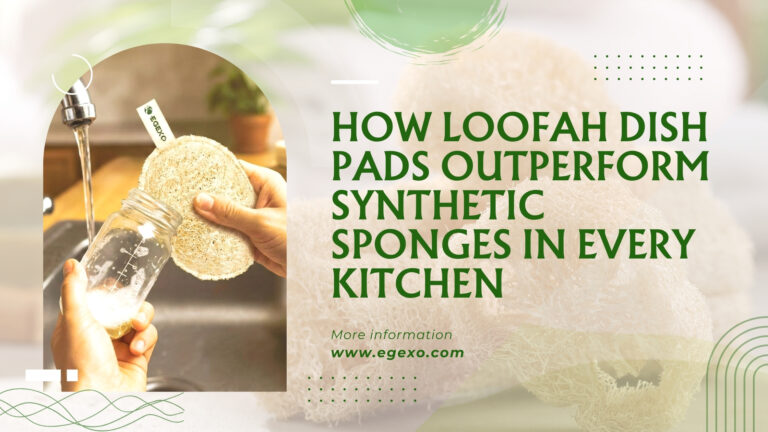
Kitchen loofahs face a different set of demands than body scrubbers. The primary requirement is fiber durability under repeated exposure to dish soap, grease, and scrubbing pressure. Visual appearance matters less than abrasion performance and resistance to fiber breakdown.
Grade B is the most commercially logical choice for kitchen loofah products. The slightly lower visual consistency compared to Grade A does not affect function, and the cost advantage at volume is significant.
For kitchen product manufacturers sourcing raw material for private-label dishwashing scrubbers or eco-friendly cleaning products, the kitchen loofah product category at Egexo provides both finished products and raw inputs at appropriate grade specifications.
Pet and Animal Grooming Products
The pet grooming market is a growing segment for natural loofah. The primary application is as a gentle scrubbing surface for pet bathing, where synthetic alternatives are increasingly being rejected by eco-aware pet owners.
For pet grooming products, fiber softness and safety take priority over all other variables. Premium or Grade A material processed through Egexo’s pet-safe preparation protocols is the appropriate specification. The pet and spa grooming loofah category outlines the available product configurations for this market.
Cosmetic and Soap Manufacturing
Loofah embedded in glycerin soap bars, loofah-infused face scrub formulations, and loofah fiber used in exfoliating cream manufacturing all require processed-grade material with precise dimensional and density specifications.
For cosmetic manufacturers, the critical requirement is batch consistency. A loofah slice embedded in soap must have identical dimensions and fiber density across thousands of production units. Egexo’s custom product design service supports manufacturers in specifying exact processed-grade parameters. You can discuss your requirements through the custom loofah product design page.
Quality Evaluation Checklist for Wholesale Buyers
When evaluating a loofah supplier’s grade claims, buyers should apply a structured assessment process rather than relying solely on supplier-provided documentation.
| Evaluation Criteria | What to Check | Acceptable Standard (Grade A) |
|---|---|---|
| Fiber Density | Manual compression test on 10 samples | Firm resistance, returns to shape in under 5 seconds |
| Color Consistency | Visual inspection across batch | Max 10 percent tonal variation within single order |
| Seed and Residue | Cross-section inspection | Zero visible seeds or skin residue |
| Dimensional Uniformity | Measure diameter at three points per piece | Within 5mm tolerance |
| Moisture Content | Weight variance across stored samples | Under 12 percent moisture at time of shipment |
| Odor | Smell test on fresh samples | Clean, neutral, no mold or fermentation odor |
| Packaging Integrity | Inspect arrival condition | No compression damage, consistent density maintained |
Egexo ships with full quality documentation for each batch, including harvest date records, fiber density test reports, and moisture content certification. You can review the complete quality framework at Egexo’s loofah quality standards page.
Egyptian Loofah: Why Origin Matters for Grade Consistency
Not all loofah origins produce equivalent grade consistency. Understanding the supply chain from cultivation to export is essential context for any buyer who wants to make informed sourcing decisions.
Egypt’s Nile Delta produces loofah under conditions that are difficult to replicate elsewhere. The combination of alkaline soil composition, consistent high temperatures during the growing season, controlled irrigation from the Nile water system, and generations of farming expertise produces loofahs with unusually dense and uniform fiber networks compared to crops from Southeast Asian or Latin American growing regions.
Egexo’s vertically integrated model means the company controls the product from seed to shipment. This farm to export process eliminates the quality dilution that happens when multiple middlemen handle product between farm and final buyer.
For buyers who want to understand why Egyptian loofah consistently outperforms alternatives on grade consistency, the why choose Egexo page provides detailed comparisons and certification information.
For individual consumers, this origin context is equally relevant. When you choose a product made from verified Egyptian loofah at a certified grade, you are choosing a product whose performance characteristics are predictable and consistent, not variable from one purchase to the next.
Industrial Loofah Specifications Table
The following data table provides technical specifications relevant to bulk purchasing decisions.
| Specification | Premium Grade | Grade A | Grade B | Grade C |
|---|---|---|---|---|
| Typical Length Range | 25 – 35 cm | 20 – 35 cm | 15 – 30 cm | Variable |
| Typical Diameter Range | 10 – 14 cm | 8 – 14 cm | 7 – 13 cm | Variable |
| Average Weight per Unit | 80 – 110 g | 60 – 95 g | 45 – 80 g | Variable |
| MOQ (units per order) | 500 units | 200 units | 500 units | 1000 units |
| MOQ (weight per order) | 50 kg | 20 kg | 40 kg | 100 kg |
| Shelf Life (proper storage) | 24 months | 24 months | 18 months | 18 months |
| Moisture Content at Ship | Under 10% | Under 12% | Under 14% | Under 15% |
To place an order or request pricing for any grade, visit the Egexo wholesale quotation page or download the full product catalog for complete specifications across all product lines.
For Individual Consumers: Choosing the Right Grade for Personal Use
While much of this guide addresses industrial and wholesale buyers, individual consumers benefit equally from understanding loofah grading. Most retail loofahs are sold without any grade labeling, which means the buying decision defaults to brand trust and price.
Here is a practical framework for personal purchasing:
Sensitive or dry skin types perform best with premium or Grade A loofahs. The denser, more uniform fiber provides gentle, even exfoliation without the rough patches that can appear with lower-grade materials.
Normal to oily skin types, or those who prefer more vigorous exfoliation, can use Grade A comfortably. The fiber is firm enough to provide effective scrubbing without being abrasive.
For kitchen use at home, Grade B functionality is more than adequate. The cleaning performance is identical to higher grades for most household scrubbing tasks.
When shopping for natural loofah products, look for suppliers who disclose the country of origin and can describe their grading criteria. Egyptian loofah from a verified exporter like Egexo represents the highest standard available in the international market.
You can explore the complete retail and wholesale range at the Egexo shop, where products are organized by application and grade specification.
Expert Insight from Egexo
After 10 years exporting Egyptian loofah, one pattern stands out clearly across our 400+ wholesale customers. The buyers who achieve the best long-term results, whether they are running a luxury spa chain or sourcing material for cosmetic manufacturing, are the ones who take grade selection seriously before the first order is placed rather than after a quality problem surfaces.
The most common mistake is choosing a grade based on the lowest unit price without accounting for return rates, customer complaints, or processing yield loss. Grade B material costs less per kilogram than Grade A, but if 15 percent of units in a retail shipment fail visual inspection, the effective cost per sellable unit is higher.
Our recommendation is always to order samples across two or three grades before committing to bulk quantities. A side-by-side physical comparison under your specific application conditions tells you more than any specification sheet. This is why we offer no-cost sample ordering for qualified wholesale buyers.
Understanding the supply chain from Nile Delta farms to your warehouse is also part of the value. Buyers who have reviewed our farm to export process consistently report higher confidence in grade claims compared to buyers sourcing through opaque intermediary supply chains.
FAQ Section
Q1: What is the best loofah grade for spa use? A: For professional spa applications, Grade A or Premium grade is the correct specification. Premium grade is recommended for luxury treatments and gift packaging where visual consistency is part of the product value. Grade A covers the broad range of standard spa applications including body treatments, scrub stations, and retail spa products. Both grades are sourced from Egyptian loofah crops selected at peak maturity for maximum fiber density and tactile quality.
Q2: How do I verify the grade of a loofah shipment before accepting delivery? A: A reliable on-receipt quality check involves four steps. First, perform a manual compression test on at least ten units from different positions in the shipment. Grade A should return to shape within five seconds of release. Second, inspect color consistency across the batch. Third, cut two or three units cross-section to check for seed residue. Fourth, confirm moisture content by weighing samples and comparing against the supplier’s documented shipment moisture rate. Request grade certification documentation from your supplier before shipment leaves the origin facility.
Q3: What is the minimum order quantity for industrial-grade loofah from Egexo? A: Minimum order quantities vary by grade. No MOQ on standard products. Grade B and Grade C have higher minimums due to their primary use as bulk industrial inputs. Processed and custom-specification formats are quoted individually based on production requirements. For current MOQ details and pricing, submit a request through the wholesale quotation page.
Q4: Is Egyptian loofah better than loofah from other countries? A: Egyptian loofah is widely recognized as the benchmark standard in international commercial markets. The Nile Delta’s specific soil composition, irrigation conditions, and long agricultural tradition produce loofahs with higher average fiber density and more consistent grade characteristics than crops from Southeast Asia or Latin American growing regions. Approximately 60 percent of commercially exported loofah globally originates from Egypt, and professional grade systems used internationally are largely built around Egyptian production standards.
Q5: Can I use industrial-grade loofah for personal skincare? A: Grade A loofah, which is the standard commercial export grade, is entirely appropriate for personal skincare use. It provides effective exfoliation for normal to oily skin. Premium grade is more suitable for sensitive skin due to its denser, more uniform fiber structure. Grade B and Grade C are not recommended for direct skin contact applications as they may include surface irregularities that could cause irritation. For personal shopping, the bath and body loofah category offers appropriately graded products for individual buyers.
Q6: How long does a high-grade loofah last under regular use? A: Premium grade loofahs used daily for bathing or exfoliation typically maintain their structure and effectiveness for 8 to 10 weeks. Grade A loofahs last approximately 6 to 8 weeks under comparable daily use. These durations assume proper rinsing and drying between uses and storage away from prolonged moisture exposure. Loofahs used in industrial or kitchen cleaning contexts have shorter functional lifespans due to the intensity of use and chemical exposure involved.
Q7: What certifications should I look for when sourcing loofah for industrial use? A: For industrial and export-grade loofah, key certifications to request include Egyptian agricultural export certification, moisture content documentation, and for food contact or cosmetic applications, relevant material safety data sheets. Organic certification is available for buyers who require natural and organic product claims in their retail packaging. Egexo provides full documentation packages with every commercial shipment. Review the certification standards at the loofah quality standards page.
Q8: What is the difference between loofah grades for kitchen versus body use? A: The primary differences relate to fiber density requirements and visual standards. Body-use loofahs, particularly for retail and spa applications, require Grade A or Premium for consistent softness and visual appeal. Kitchen-use loofahs can perform effectively at Grade B, where the lower visual consistency is commercially irrelevant but the cleaning abrasion performance remains strong. For wholesale buyers, sourcing the correct grade for each application channel reduces cost without compromising end-user performance.
Conclusion
Selecting the right loofah grade is a decision with real consequences for both industrial buyers and individual consumers. The wrong grade in a wholesale shipment can mean product returns, customer complaints, and damaged supplier relationships. The wrong grade in a personal purchase can mean skin irritation or a product that falls apart after two weeks.
The framework in this guide, built around Egexo’s 10 years of Egyptian loofah expertise, gives you the tools to make this decision correctly every time. Premium and Grade A for applications where tactile quality and visual consistency matter. Grade B for industrial and kitchen processing where functional durability is the priority. Grade C for raw material inputs and manufacturing uses where fiber quality requirements are secondary to volume and cost.
Egyptian loofah remains the global standard because the conditions in the Nile Delta produce fiber characteristics that other origins consistently struggle to match. Sourcing through a vertically integrated supplier like Egexo, which controls the product from cultivation through export, gives buyers access to verified grade consistency that purchasing through intermediary traders cannot reliably provide.
Key Takeaways:
- Premium and Grade A are the correct specifications for spa, retail, and personal skincare applications
- Grade B serves industrial cleaning and kitchen product manufacturing with strong functional performance at lower cost
- Egyptian Nile Delta loofah sets the global standard for fiber density and grade consistency
- Grade verification should involve physical testing, not documentation alone
- Vertically integrated sourcing eliminates quality variability introduced by intermediary supply chains
Ready to experience Egyptian loofah quality?
- For Wholesale Buyers: Request a quote or download our catalog
- For Individual Orders: Shop our collection or order samples