

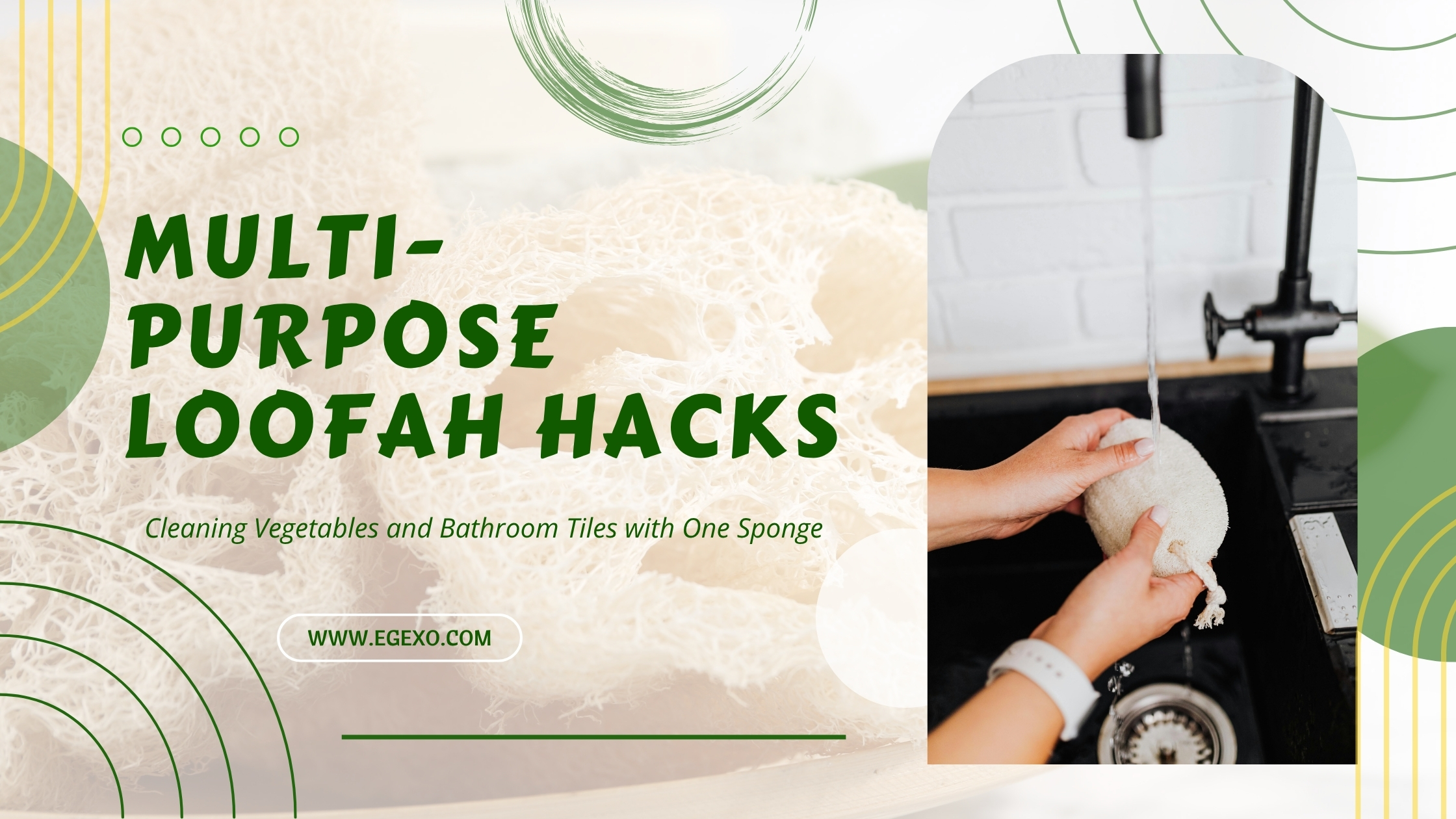
Multi-Purpose Loofah Hacks: Cleaning Vegetables and Bathroom Tiles with One Sponge
Most people tuck their loofah away near the shower and never think twice about it. That habit is costing them money, convenience, and a genuine opportunity to reduce plastic waste in their homes or businesses. A single natural loofah grown in Egyptian soil can scrub a zucchini, descale a bathroom tile, wipe down a kitchen counter, and still hold up for weeks with proper care.
This is not a gimmick. It is practical sustainability backed by the natural structure of the Luffa aegyptiaca plant, which Egexo has been cultivating and exporting for over 25 years from the fertile Nile Delta region. Whether you run a spa, manage a retail product line, or simply want to reduce the number of disposable scrubbers you buy each month, understanding multi-purpose loofah hacks will change how you think about one of the oldest natural tools on earth.
In this guide, you will find step-by-step cleaning methods, a full breakdown of which loofah types work best for which surfaces, comparison tables, and practical advice tailored to both individual users and wholesale buyers sourcing at scale. You will also find direct answers to the questions most people are already searching for.
If you want to see the full range of loofah products available for bulk purchase or personal use, the Egexo shop is a good place to start.
Why a Natural Loofah Outperforms Synthetic Scrubbers for Multiple Tasks
The word “sponge” often brings plastic to mind, but a natural loofah is something structurally different. It is a dried fibrous skeleton from the interior of a gourd. That skeleton forms an open mesh of interlocking fibers, and that mesh is what makes multi-purpose loofah hacks possible in the first place.
The Fiber Network That Does the Work
Synthetic scrubbers are made from nylon, polyester, or melamine foam. They shed microplastics with every use, and most end up in landfills within weeks. A natural loofah, by contrast, is 100 percent plant-based, compostable, and free from synthetic coatings.
The fiber density of Egyptian loofahs from the Nile Delta region is measurably higher than loofahs grown in other regions. This is due to soil mineral content, irrigation quality, and the specific cultivar used. Higher fiber density translates directly into better scrubbing performance per square centimeter, which is why Egexo’s products are trusted by importers across Europe, North America, and Southeast Asia.
For wholesale buyers evaluating product specifications, this matters in a direct commercial sense. A denser loofah lasts longer in the hands of end users, which means lower return rates and stronger brand reputation for retailers who carry natural loofah lines.
Structural Comparison: Natural vs Synthetic Scrubbers
| Feature | Natural Egyptian Loofah | Synthetic Scrubber |
|---|---|---|
| Material origin | Plant-based (Luffa aegyptiaca) | Petroleum-based (nylon, polyester) |
| Microplastic risk | None | High (sheds per use) |
| Average usable lifespan | 4 to 8 weeks with care | 2 to 4 weeks |
| Compostable | Yes, fully biodegradable | No |
| Abrasive control | Adjustable by wet/dry state | Fixed |
| Suitable for food contact | Yes (untreated varieties) | Not recommended |
| Fiber density (Nile Delta) | High (220 to 280 fibers/cm2) | N/A |
| MOQ for wholesale (Egexo) | 500 units per SKU | Varies by supplier |
For consumers, this table answers a simple question: what are you actually buying when you pick up a natural loofah versus a plastic scrubbing pad? For buyers, it frames the quality argument you can make to your own customers.
Multi-Purpose Loofah Hacks for the Kitchen: Vegetables, Dishes, and More
The kitchen is where most people would never think to use a loofah, and that is a missed opportunity. A natural loofah is one of the safest, most effective tools for scrubbing vegetables with thick or firm skin, and it works without chemicals or coatings.
Scrubbing Vegetables the Right Way
Root vegetables like potatoes, carrots, and beets carry soil in their skin crevices. Most people either peel them, losing nutrients in the outer layer, or use a stiff brush that is too aggressive. A damp natural loofah sits between those two extremes.
To use a loofah for vegetable scrubbing:
- Soak the loofah in cold water for 60 seconds until it is fully softened.
- Hold the vegetable firmly under running water.
- Rub the loofah in a circular motion over the skin, applying moderate pressure.
- Rinse the vegetable thoroughly when done.
- Rinse the loofah, wring it out, and allow it to air-dry in an upright position.
This method works for potatoes, cucumbers, zucchini, beets, carrots, and firm-skinned squash. It does not work well for soft-skinned produce like tomatoes or peaches, where even gentle friction can break the skin.
For kitchen loofah products designed specifically for food-contact surfaces, the Egexo kitchen loofah category carries untreated varieties that are safe for this purpose.
Dish Scrubbing and Counter Wiping
A loofah in dry or semi-dry state is more abrasive than when fully saturated. This dual behavior is what makes multi-purpose loofah hacks so practical. For baked-on food residue in pans, use the loofah slightly damp with dish soap. For general surface wiping on counters, use it fully saturated and wrung out halfway.
Avoid using the same loofah section for both food contact and chemical cleaning. If you are working with grout cleaner or heavy-duty tile spray, dedicate that loofah to non-food tasks.
Multi-Purpose Loofah Hacks for the Bathroom: Tiles, Grout, and Body
Bathroom cleaning and personal bathing seem like separate routines, but the same loofah structure serves both. The key is understanding how the fiber mesh interacts with different surfaces and substances.
Tile and Grout Cleaning
Bathroom tiles accumulate soap scum, mineral deposits, and mildew. Most commercial scrubbing pads scratch tile glaze over time, and fine scratches become harbors for bacteria and mold. A natural loofah is firm enough to lift deposits but soft enough to protect the tile surface.
For tile cleaning with a loofah:
- Mix one part white vinegar with two parts water in a spray bottle.
- Spray the tile surface and allow it to sit for 3 to 5 minutes.
- Use a dry or semi-dry loofah to scrub in small circular motions.
- For grout lines, fold the loofah to create a narrow edge and apply targeted pressure.
- Rinse the wall with water and wipe down with a clean cloth.
This method is safe for glazed ceramic, porcelain, and natural stone tiles. It is not recommended for uncoated marble, which can react with vinegar.
Body Exfoliation and Spa Applications
The same loofah properties that make it effective on tiles, its open fiber network and adjustable abrasion, make it excellent for skin exfoliation. When fully saturated, the fibers soften and provide gentle mechanical exfoliation without the risk of micro-cuts associated with synthetic exfoliating scrubbers.
Spas and wellness brands that carry natural loofahs benefit from a product that serves multiple retail categories simultaneously. A single SKU can sit in a cleaning aisle and a wellness aisle, which is a meaningful advantage for retailers with limited shelf space.
For spa-grade and body loofah products in wholesale quantities, the Egexo bath and body loofah category offers multiple sizes and grades suitable for premium branding.
If you are a spa owner or product developer interested in custom labeling, Egexo’s private label loofah manufacturing service allows you to build your own branded loofah line sourced from certified Egyptian origin.
Quality Standards That Make Egyptian Loofah the Best Choice
Not all loofahs are grown equal. The origin of the raw material, the cultivation method, and the post-harvest processing determine the quality of what reaches the end user. Egyptian loofah, specifically from the Nile Delta, is globally recognized as the benchmark for natural loofah quality.
Egexo’s farm-to-export process gives buyers full visibility into how loofahs are grown, harvested, cleaned, and prepared for shipment. This transparency is increasingly important for brands that need to verify sustainability claims for their own customers.
Quality Grading Table for Wholesale Buyers
| Grade | Fiber Density | Color | Size Range | Best Use |
|---|---|---|---|---|
| Grade A Premium | Very high | Uniform light tan | 25 to 35 cm | Spa, retail, body care |
| Grade B Standard | High | Slight variation | 20 to 30 cm | Kitchen, general cleaning |
| Grade C Economy | Moderate | Variable | 15 to 25 cm | Industrial, craft, bulk filler |
| Raw Scrubber | Unprocessed | Natural brown | Custom cut | DIY, private label processing |
Understanding grade distinctions helps wholesale buyers select the right product for their specific market segment. A spa retail brand needs Grade A. A cleaning product line may perform just as well with Grade B at a lower cost basis.
For a full breakdown of grading criteria, visit Egexo’s loofah quality standards page.
Supplier Evaluation Checklist for Wholesale Buyers
| Criteria | What to Verify |
|---|---|
| Origin certification | Egyptian Nile Delta sourcing confirmed |
| Processing method | Sun-dried and bleach-free options available |
| MOQ flexibility | Minimum order quantities that match your volume |
| Sample availability | Ability to test quality before committing to bulk |
| Export documentation | Phytosanitary certificates and customs clearance support |
| Private label options | Custom packaging, branding, and sizing services |
| Lead time | Production to shipment timeline clearly stated |
You can request loofah samples directly from Egexo before placing a wholesale order.
How to Maximize Loofah Lifespan: Care, Rotation, and Replacement
One of the most common complaints about natural loofahs is that they wear out quickly. In almost every case, this is a care problem, not a product quality problem. A well-maintained Egyptian loofah lasts 4 to 8 weeks under daily use, significantly longer than the 2 to 3 weeks most users report.
Daily Maintenance Routine
After every use, the loofah should be rinsed thoroughly under hot water to remove soap, food particles, or cleaning chemicals. It should then be wrung out completely and placed in a position where air can circulate around it. A loofah sitting in a pool of water or pressed against a tile will develop bacteria and mold within days.
Weekly, the loofah should be soaked in a diluted white vinegar solution (one part vinegar to four parts water) for 10 minutes, then rinsed and dried. This inhibits bacterial growth without damaging the fibers.
Loofah Lifespan and Replacement Schedule
| Usage Frequency | Recommended Lifespan | Weekly Care Required |
|---|---|---|
| Daily (body) | 4 to 6 weeks | Rinse, dry, weekly vinegar soak |
| Daily (kitchen) | 3 to 5 weeks | Hot rinse after each use, air dry |
| 3x per week (bathroom cleaning) | 6 to 10 weeks | Rinse, dry, bi-weekly vinegar soak |
| Occasional use | Up to 12 weeks | Rinse after each use, store dry |
For wholesale buyers, this lifespan data supports the replenishment purchasing argument. Customers who understand proper care buy more frequently than those who discard prematurely, but they also return to brands they trust.
Loofah Hacks for Sustainability-Focused Brands and Retailers
The global market for natural personal care products was valued at over 38 billion USD in 2024 and is projected to grow at a compound annual growth rate of 5.8 percent through 2030. Within that market, natural exfoliation and cleaning tools are among the fastest-growing subcategories, driven by consumer demand for plastic-free alternatives.
For retailers and distributors, natural Egyptian loofahs represent a product category with strong margin potential, high consumer recognition, and an alignment with sustainability values that resonates with a growing segment of shoppers.
Egexo supports wholesale partners with custom loofah product design services that allow you to create differentiated SKUs rather than competing on price for a generic product. Custom sizing, bundling, and branded packaging are all available.
For a complete view of available products and configurations, download the Egexo product catalog or contact the export team for a wholesale quote.
Expert Insight from Egexo
With more than 25 years of direct cultivation and export experience from the Nile Delta, the Egexo team has observed one consistent pattern: buyers and consumers who understand the structural difference between Egyptian-grown loofahs and lower-quality imports make better purchasing decisions and report higher satisfaction. Egyptian loofah fibers are denser because the Nile Delta soil provides a unique mineral profile that supports stronger cell wall development in the Luffa aegyptiaca plant. This is not a marketing claim. It is an agricultural reality verified by the consistent performance data we collect from our export partners across 40 countries. When you source from a supplier who grows their own raw material and controls every stage from seed to shipment, you eliminate the quality variability that comes from multi-supplier sourcing chains. That consistency is what makes multi-purpose applications possible. A loofah that holds its structure through kitchen use, bathroom cleaning, and body exfoliation is a loofah grown and processed with precision.
FAQ Section
Q1: Can I use the same loofah for scrubbing vegetables and cleaning bathroom tiles? A: Yes, you can use a natural loofah for both tasks, but hygiene separation is important. The safest approach is to designate different loofahs for food-contact and bathroom surfaces, or use separate sections of a larger loofah for each task. If using the same piece, always clean it thoroughly between uses with hot water and a diluted vinegar rinse. Natural Egyptian loofahs are firm enough for tile scrubbing and gentle enough for vegetable skin without damaging either surface.
Q2: What makes Egyptian loofah better than loofahs from other countries? A: Egyptian loofah, particularly from the Nile Delta region, produces fibers with measurably higher density than loofahs grown in other regions. This is due to the mineral composition of Nile Delta soil, the climate conditions, and the specific Luffa aegyptiaca cultivar used. Higher fiber density means better abrasion performance, longer usable lifespan, and more consistent texture. Egexo has spent over 25 years refining cultivation and harvesting practices that preserve this natural quality advantage.
Q3: What is the minimum order quantity for wholesale loofah from Egexo? A: Egexo offers wholesale loofah with a minimum order quantity of 500 units per SKU for most product lines. MOQ can vary depending on the product grade, size, and customization requirements. For custom private label orders, the MOQ may be higher to cover packaging and branding costs. The best way to confirm MOQ for your specific needs is to request a quote directly through Egexo’s quotation page or download the product catalog for specifications.
Q4: How long does a natural loofah last compared to a synthetic scrubber? A: A properly maintained natural Egyptian loofah lasts 4 to 8 weeks under daily use. A typical synthetic scrubbing pad lasts 2 to 4 weeks before degrading. The key difference in loofah lifespan is post-use care. A loofah that is rinsed thoroughly, wrung out, and allowed to air-dry after every use will outlast one that is left wet in an enclosed space by two to three times. Weekly vinegar soaks further extend the usable life by inhibiting bacterial growth in the fiber network.
Q5: Are natural loofahs safe for food contact when used on vegetables? A: Untreated natural loofahs are safe for food contact surfaces including vegetable skin. The key qualifier is “untreated.” Some commercial loofahs are bleached or treated with preservatives during processing. Egexo offers unbleached, untreated kitchen loofah varieties specifically designed for food-safe applications. Always verify the processing method with your supplier before recommending a loofah for vegetable scrubbing, especially for organic or health-focused retail markets.
Q6: Can loofah be used on natural stone bathroom tiles? A: Natural loofahs are safe for most bathroom surfaces, including ceramic, porcelain, and glazed stone tiles. However, uncoated marble and some limestone surfaces are sensitive to acidic cleaners. If you are using a vinegar-based solution with your loofah on bathroom tiles, avoid contact with uncoated marble. The loofah itself does not damage stone, but the cleaning solution matters. For these surfaces, use a neutral pH cleaner with the loofah instead.
Q7: What is the difference between Grade A and Grade B loofah for wholesale buyers? A: Grade A loofah has higher fiber density, more uniform color, and consistent sizing, typically 25 to 35 cm. It is best suited for spa, wellness, and premium retail applications where the appearance and feel of the product are part of the brand experience. Grade B loofah offers strong cleaning performance at a lower cost point and is well-suited for kitchen cleaning, general household use, or eco-friendly cleaning product lines where functionality is the primary selling point. Both grades are sourced from Egyptian Nile Delta cultivation.
Q8: How do I evaluate a loofah supplier before placing a bulk order? A: A reliable loofah supplier should be able to provide origin documentation confirming the source of raw material, phytosanitary certificates for export compliance, samples for quality testing before bulk commitment, clear MOQ and lead time information, and references from existing wholesale partners. Egexo offers all of these, along with direct access to the cultivation and processing facilities for buyers who want to verify the supply chain firsthand. You can request samples and a quotation through Egexo’s website to begin the evaluation process.
Conclusion
Multi-purpose loofah hacks are not just clever household tips. They represent a practical, evidence-based shift toward more sustainable and cost-effective living and product sourcing. A single high-quality Egyptian loofah, maintained correctly, replaces multiple plastic scrubbers across the kitchen, bathroom, and personal care routine. For wholesale buyers, that versatility translates into a product with multiple retail placement opportunities and strong repeat purchase rates.
Egyptian loofah from the Nile Delta remains the global benchmark for natural fiber quality, and Egexo’s 25-plus years of cultivation and export experience makes it the most reliable source for buyers who need consistency at scale.
Key Takeaways:
- Natural Egyptian loofahs are structurally suited for vegetable scrubbing, tile cleaning, and body exfoliation in a single product
- Fiber density from Nile Delta cultivation gives Egyptian loofah a measurable quality advantage over imports from other origins
- Proper care extends loofah lifespan to 4 to 8 weeks under daily use
- Wholesale buyers can access multiple grades, private label options, and custom designs through Egexo
- The natural personal care market is growing at 5.8 percent annually, making natural loofah a strong retail category
Ready to experience Egyptian loofah quality?
- For Wholesale Buyers: Request a quote or download our catalog
- For Individual Shoppers: Shop our collection or order samples