Contents
- What the Sky Tells a Loofah Farmer
- The Science Behind Loofah Agriculture: Why Climate Is Everything
- How Egyptian Farmers Read and Respond to Climate Signals
- Seasonal Variation and What It Means for Supply and Quality
- Climate and Quality: What to Look For
- Why Egyptian Climate Suits Loofah
- What Climate Change Means for Loofah Growers and Global Supply
- Practical Buyer Checklist: Evaluating a Supplier’s Climate Management Competence
- Advice from Egexo
- FAQ Section
- Conclusion
What the Sky Tells a Loofah Farmer
Walk through an Egyptian loofah field in late summer, and you will immediately understand why geography is destiny. The air carries warmth that never turns harsh. The Nile Delta stretches flat in every direction, holding moisture from the river while the Mediterranean breeze moves across the delta. This is not an accident. Egyptian farmers have understood for generations that how climate affects loofah yield is not a minor agricultural footnote. It is the entire story.
For wholesale buyers sourcing natural loofah in volume, climate is one reason Egyptian loofah is in demand. For consumers who have held an Egyptian bath loofah, its soft, flexible texture comes from the plant and its growing conditions.
At Egexo, we have been exporting Egyptian loofah since 2015. This guide shares how climate and seasons affect loofah so that everyone from a spa owner to a home consumer choosing between natural and synthetic can make informed decisions.
By the end of this article, you will understand why Egyptian climate suits loofah, how seasonal variation affects supply, and what this means for your purchasing plans regardless of whether you are buying in bulk or buying a single piece.
The Science Behind Loofah Agriculture: Why Climate Is Everything
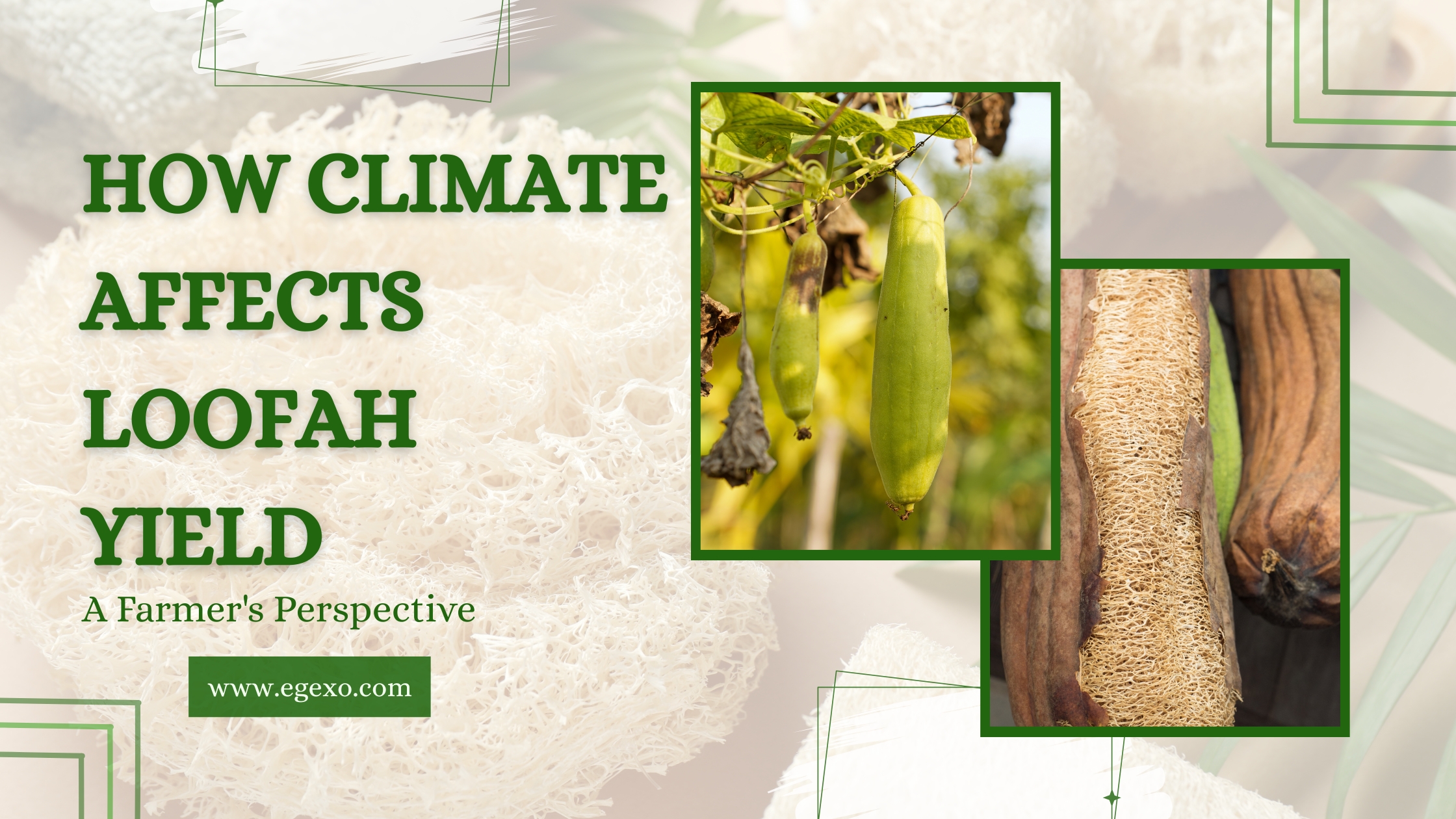
Loofah, known botanically as Luffa aegyptiaca or Luffa cylindrica, is a subtropical vine that belongs to the cucumber family. That botanical relationship tells you almost everything about what it needs to thrive. Like all cucurbits, it demands warmth, moisture at the root level, and adequate light across a long growing window.
What separates commercially viable loofah from backyard experiments is the precision of those conditions over time. A vine that experiences temperature swings, drought stress, or excessive rain at the wrong moment will produce a fruit whose internal fiber matrix is either too coarse, too soft, or structurally irregular. None of those outcomes serves buyers or consumers well.
The Three Climate Pillars of Loofah Quality
Three climate variables matter most for loofah yield and quality.
Temperature consistency matters more than peak heat. Luffa performs best between 25 and 35 degrees Celsius throughout its growing period. Days that regularly exceed 40 degrees cause the vine to divert energy toward survival rather than fruit development, reducing fruit development. Cold snaps below 15 degrees at any point in the cycle can permanently stunt the plant.
Rainfall distribution is more important than total annual precipitation. Loofah vines need steady moisture at the soil level during germination and early vine development, then progressively drier conditions as the fruit matures. If heavy rain arrives late in the cycle, it forces the fruit fibers to absorb water and expand unevenly, creating a loofah that will shrink inconsistently after drying.
Sunlight duration drives photosynthetic efficiency, which directly powers the cellulose network inside the loofah fruit. Egypt’s Nile Delta region has long sunny days during the growing season.
Controlled Nile irrigation, rather than reliance on rainfall, lets farmers regulate moisture timing.
How Egyptian Farmers Read and Respond to Climate Signals
Loofah farmers do not simply plant and wait. They watch the growing environment closely through the season.
Planting Window Decisions
The primary planting window in Egypt runs from late February through mid-March in the Nile Delta and slightly later in Upper Egypt. This timing is calculated to ensure that the fruit-setting phase, which occurs roughly 60 to 70 days after germination, falls between late May and early July when temperatures are consistently in the ideal range and humidity remains low.
Farmers who plant too early risk exposing young vines to late cool spells. Those who plant too late push fruit maturation into August and September when the combination of heat and elevated Nile humidity in some areas can affect drying quality. The timing window is genuinely narrow, and missing it costs yield.
Irrigation as a Climate Correction Tool
Because Egypt receives minimal rainfall during the loofah season, irrigation serves a dual purpose. It supplies moisture, but it also moderates soil temperature. During the hottest weeks of June and July, experienced farmers irrigate in the early morning to cool root zones before the afternoon heat peaks. This practice reduces heat stress on the vine without creating the high humidity conditions that promote fungal infection.
This level of agricultural sophistication is part of why the farm-to-export process at Egexo works with its own farms and partner farms in the Nile Delta, and every order is checked by hand for colour, holes, defects, size and dryness before packing.
If you are evaluating suppliers for a bulk order, ask how they check quality. Explore our quality standards to see how every order is checked by hand.
Seasonal Variation and What It Means for Supply and Quality
One of the most important concepts for wholesale buyers to internalize is that loofah is an agricultural product, which means its supply and quality characteristics shift with the seasons. Understanding this cycle helps buyers plan procurement more effectively and set realistic expectations with their own customers.
The Egyptian Loofah Annual Calendar
| Season/Phase | Months | Key Activity | Impact on Buyers |
|---|---|---|---|
| Planting | February to March | Seed sowing, vine establishment | Predicts harvest timing 4 to 5 months ahead |
| Vegetative Growth | April to May | Vine expansion, flower formation | Climate stress here reduces yield volume |
| Fruit Set and Development | June to July | Fiber matrix formation | Most critical quality-determining period |
| Maturation | August to September | Fiber hardening, moisture reduction | Determines final texture |
| Harvest and Processing | September to November | Peeling, washing, drying, sorting | Sun drying and machine drying follow harvest |
| Post-Harvest Distribution | October to February | Stored and shipped globally | Orders ship by sea, air or express |
For spa owners, retailers, and distributors, this calendar has direct procurement implications. Egexo’s lead time is 7 to 25 days from payment, by quantity and orders in process.
Request a quote to confirm availability and the lead time for your quantity.
How Climate Variation Between Years Affects Availability
In years when Egypt experiences unusually high summer temperatures or irregular humidity patterns, yield per feddan (the Egyptian land area unit equivalent to approximately 0.42 hectares) can drop. This can affect the volume available for export.
Egexo sources from its own farms and partner farms across the Nile Delta.
Climate and Quality: What to Look For
Climate affects the color, texture and dryness of each fruit. Knowing what to look for helps both wholesale buyers specify their requirements accurately and consumers choose a good loofah.
Climate-stressed plants can produce darker, more irregular fiber.
Egyptian loofah is soft and gentle from the first use. You can explore the full bath and body loofah range to see the products.
Wholesale buyers who want to verify quality consistency before committing to large orders should order samples to check texture, color consistency, and dryness.
Why Egyptian Climate Suits Loofah
Loofah is also grown in other countries, including Vietnam, Indonesia, China, and India. Each region has its own climate.
Egypt’s dry growing season is another climate benefit, because pests and fungal diseases thrive in humid tropical conditions. Loofah does not require heavy pesticide or fertilizer.
The private label loofah manufacturing program at Egexo is for brands that want Egyptian natural loofah under their own name.
What Climate Change Means for Loofah Growers and Global Supply
Loofah is an agricultural crop, so climate patterns that change from year to year can affect supply and quality. Understanding this helps buyers plan ahead.
For consumers, choosing natural loofah over plastic is both a personal and an environmental choice. Read about our approach at EGEXO blog for a deeper consumer perspective on sustainable loofah sourcing.
Practical Buyer Checklist: Evaluating a Supplier’s Climate Management Competence
Wholesale buyers often ask what questions to ask a loofah supplier beyond basic price and order size. The following checklist focuses specifically on climate-related supply chain resilience.
| Evaluation Criterion | What to Ask | Why It Matters |
|---|---|---|
| Farm location specifics | Which Nile Delta zones do you cultivate in? | Multiple zones reduce single-climate-event risk |
| Irrigation infrastructure | Do you use drip irrigation or flood irrigation? | Drip indicates precision moisture control |
| Planting date range | What is your typical planting window? | Reveals awareness of seasonal optimization |
| Climate contingency | How do you handle low-yield seasons? | Indicates supply chain resilience |
| Harvest timing | When does your harvest window typically close? | Helps buyers plan procurement calendar |
| Storage conditions | How is post-harvest loofah stored before export? | Dry storage protects quality during off-season orders |
Download the Egexo product catalog to see the product range and sizing options.
If you are ready to move forward with a supplier evaluation, request a wholesale quote and Egexo will reply within 24 hours.
Advice from Egexo
Egexo has been exporting loofah since 2015, and we share one view openly with every buyer we work with: the quality of a loofah is mostly determined by the growing conditions before the harvest, not during processing.
Processing can clean, sort and dry a loofah. It cannot repair a fiber that developed under stress.
When buyers review our quality standards, they see how every order is checked by hand for colour, holes, defects, size and dryness before packing.
Explore our custom loofah product design program to see how Egyptian loofah can become branded product solutions.
FAQ Section
Q1: How does climate affect loofah yield in Egypt compared to other countries?
A: Climate affects loofah yield primarily through temperature consistency, rainfall timing, and sunlight duration. Egypt’s Nile Delta has long sunny days during the growing season and controlled irrigation rather than unpredictable rainfall. Egyptian loofah is soft and gentle from the first use.
Q2: When should I order Egyptian loofah in bulk?
A: Egexo’s lead time is 7 to 25 days from payment, by quantity and orders in process. Loofah is an agricultural product, so request a quote early to confirm availability for your quantity.
Q3: Does climate change affect the quality of natural loofah products?
A: Climate can affect the quality and supply of any agricultural product, including natural loofah. Farmers adapt through planting dates and irrigation management. Request samples before large orders to check the quality yourself.
Q4: How can I tell if a loofah was grown in optimal climate conditions?
A: Good natural loofah has an even natural color, an even texture throughout the piece, and no dark spots, holes or soft spots. When compressed and released, it should recover its shape. A darker color, irregular texture, or soft spots can indicate stress during growing or poor storage. Consumers can reference these visual and tactile indicators when shopping, and wholesale buyers should request samples before placing large orders.
Q5: What is the minimum order quantity for Egyptian loofah from Egexo?
A: No minimum order on standard products. Private label from 1,000 units. Download the product catalog for complete specifications, or contact Egexo for a detailed quote based on your specific requirements.
Q6: Why does loofah quality vary between suppliers even when they both claim to sell Egyptian loofah?
A: Climate management practices, planting timing, irrigation systems, and post-harvest processing can vary between farms. Buyers should ask for harvest zone information and physical samples before committing. Egexo’s quality standards page explains how every order is checked by hand.
Q7: How long does natural loofah last compared to synthetic alternatives?
A: A natural loofah that dries fully between uses should be replaced every few weeks with regular use. Natural loofah is also 100% biodegradable and compostable at end of life, making it a sustainable choice for eco-conscious consumers.
Q8: Can wholesale buyers get private label loofah products?
A: Yes. Egexo’s private label manufacturing program allows wholesale buyers and brands to put their own labels, hang tags and custom packaging on their products. Private label starts from 1,000 units. Contact us to discuss labeling options for your product line.
Conclusion
Understanding how climate affects loofah yield is not an abstract agricultural exercise. It is the foundation of every quality and supply decision in the loofah industry, from the farmer deciding when to plant to the spa owner deciding which supplier to trust.
Egypt’s Nile Delta combines controlled irrigation, long sunny days, and low humidity during maturation. Egexo has been exporting since 2015, from its own farms and partner farms in the Nile Delta.
Ready to experience Egyptian loofah quality?
- For Wholesale Buyers: Request a quote or download our catalog
- For Individual Shoppers: Browse our full collection or EGEXO blog
- For Wholesale Resources: Visit EGEXO wholesale solutions for additional procurement guidance