

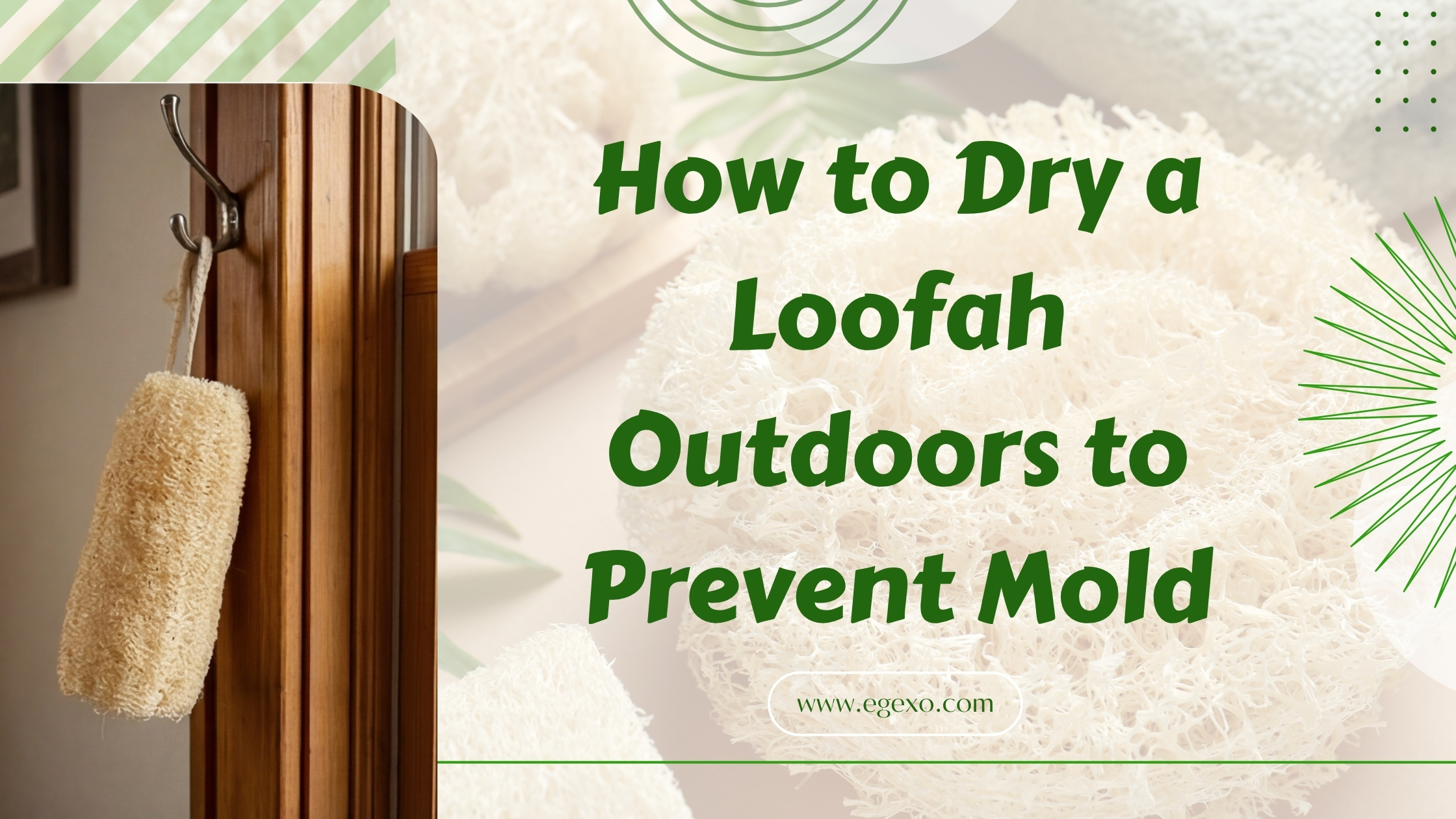
How to Dry a Loofah Outdoors to Prevent Mold
A damp loofah left in a closed shower can develop visible mold within 48 hours. That is not an exaggeration — it is a documented reality of how quickly organic material colonized by moisture becomes a breeding ground for bacteria and fungal growth. If you have ever noticed a musty smell from a loofah that seemed fine just a few days ago, you have already experienced this firsthand.
Knowing how to dry a loofah outdoors to prevent mold is one of the most practical pieces of care knowledge any loofah owner can have. It extends the lifespan of the product, eliminates hygiene risk, and makes a significant difference in whether a natural loofah lasts three weeks or six. For individual consumers, this means getting real value from a quality purchase. For spa owners, wellness retailers, and bulk buyers, it means that the product you supply performs at its promised quality level in the hands of your end customers.
At Egexo, with 10 years exporting Egyptian loofah to more than 40 countries, we have seen every failure mode a natural loofah can experience. Mold is the most preventable — and the most common — of all of them. This guide covers the science behind why outdoor drying works, the step-by-step method for doing it correctly, the conditions that make outdoor drying more or less effective, and what to do when outdoor drying is not practical.
Whether you use a single loofah at home or source thousands of units for a wellness brand, this guide gives you what you need to protect that product from its most common enemy.
Why Mold Grows on Natural Loofahs and What Makes Outdoor Drying the Best Solution
The Science Behind Loofah Mold Growth
Natural loofah is made from the fibrous skeleton of the Luffa cylindrica plant — a gourd with a dense, interconnected network of cellulose fibers. That structure is what makes loofah such an effective exfoliating tool. It is also what makes it vulnerable to mold when moisture is trapped inside it.
The interior of a loofah provides everything mold needs to thrive: organic material, darkness, warmth, and moisture. When a loofah is left in a steamy bathroom without adequate airflow, the interior fiber retains water long after the surface appears dry. Mold spores — which are present on virtually every surface in a bathroom — colonize that interior moisture and begin reproducing.
The critical threshold is approximately 65% relative humidity sustained over time. At or above this level, the interior of a loofah that has not dried properly will begin developing fungal growth within 24 to 72 hours. A closed shower stall or bathroom without ventilation easily reaches and sustains this humidity level.
Why Outdoor Drying Outperforms Indoor Alternatives
Outdoor drying addresses all three conditions that allow mold to develop: it reduces humidity, increases airflow, and in most conditions, exposes the loofah to ultraviolet light, which has a documented antimicrobial effect on organic surfaces.
| Drying Method | Airflow | UV Exposure | Average Drying Time | Mold Risk Level |
|---|---|---|---|---|
| Left in shower | None | None | Does not fully dry | Very High |
| Indoor bathroom hook | Low | None | 4 to 8 hours | High |
| Indoor with fan | Moderate | None | 2 to 4 hours | Moderate |
| Outdoor shade | High | Indirect | 1 to 2 hours | Low |
| Outdoor direct sunlight | High | Direct | 30 to 90 minutes | Very Low |
The data in this table reflects general drying conditions across standard humidity ranges. In high-humidity coastal climates, outdoor drying in shade may need additional time. In arid or semi-arid climates, even brief outdoor exposure can fully dry a loofah.
Egyptian loofah from Egexo — sourced from the Nile Delta where drying conditions informed the original cultivation and processing methods — has a fiber structure particularly suited to rapid moisture release when given adequate airflow. You can explore the full body loofah collection to find the right product for your drying regimen.
How to Dry a Loofah Outdoors to Prevent Mold: The Step-by-Step Method
Outdoor drying is straightforward, but doing it correctly makes a measurable difference in outcomes. These steps apply to any natural loofah, including premium Egyptian varieties sourced from suppliers like Egexo.
Step 1: Rinse Thoroughly After Every Use
Before outdoor drying can work effectively, the loofah must be fully rinsed. After use, squeeze the loofah repeatedly under running warm water to remove soap residue, dead skin cells, and any debris. These organic materials accelerate mold growth even when a loofah is otherwise dry. Rinse until the water running through it is completely clear.
Step 2: Squeeze Out Excess Water
After rinsing, squeeze the loofah firmly several times to expel as much water as possible. Do not twist or wring it aggressively, as this can damage the fiber structure. Firm, even compression is sufficient. The goal at this stage is to reduce the moisture load before outdoor drying begins, which shortens the total drying time needed.
Step 3: Hang in a Location with Direct Airflow
Outdoor drying works best when the loofah is suspended, not laid flat. A flat surface restricts airflow to the underside and creates a contact zone where moisture is trapped. Use a hook, a clothesline clip, or a mesh bag hung from a line. The hanging position allows air to circulate around the entire exterior and through the interior fiber network.
Choose a location that receives natural air movement. Even gentle outdoor air circulation is dramatically more effective than still indoor air for drying a porous organic material like loofah.
Step 4: Position for Sun Exposure When Possible
Direct sunlight is the most effective natural antimicrobial treatment available for loofah drying. Ultraviolet radiation from natural sunlight disrupts the cellular processes of mold spores and bacteria on organic surfaces. A loofah dried in direct outdoor sunlight for 30 to 60 minutes achieves both physical drying and surface sanitization simultaneously.
If full sun is not available, open shade outdoors still provides substantially better airflow than any indoor position. Position the loofah away from walls or fences that could restrict air circulation on one side.
Step 5: Confirm Full Dryness Before Storing
Before bringing the loofah back inside, squeeze it firmly and check for any remaining moisture at the core. The center of a loofah dries last because it has the least direct exposure to airflow. A loofah that feels dry on the outside but releases moisture under firm compression is not fully dry and should remain outdoors longer.
A fully dry loofah has a lighter feel than a damp one, recovers its shape quickly when compressed and released, and produces no water when squeezed firmly.
Drying Conditions: What Works, What Doesn’t, and What to Adjust
Optimal Outdoor Conditions for Loofah Drying
| Condition | Optimal Range | Effect on Drying |
|---|---|---|
| Temperature | 20 to 40 degrees Celsius | Higher temp accelerates evaporation |
| Relative Humidity | Below 60% | Low humidity enables rapid moisture loss |
| Wind Speed | Light to moderate (5 to 25 km/h) | Airflow replaces moisture-saturated air around loofah |
| UV Index | 3 or higher | Meaningful antimicrobial benefit |
| Sun Exposure | Direct, minimum 30 minutes | Fastest drying and best sanitization |
What to Do in High-Humidity Climates
Coastal regions and tropical climates present a specific challenge: the outdoor air may itself be humid enough to slow drying significantly. In these environments, outdoor drying still outperforms indoor drying if there is airflow, but additional steps can help.
Position the loofah in the direction of prevailing wind rather than in still air. A light breeze over a humid loofah moves moisture-saturated air away and brings drier air into contact with the fiber — even when the ambient humidity is high, airflow prevents the static moisture layer that builds up in still conditions.
In very high humidity conditions (above 80% relative humidity), you may want to alternate: dry outdoors for as long as conditions allow, then move to an indoor position with a fan or dehumidifier for the remainder.
Seasonal Adjustments for Outdoor Loofah Drying
| Season | Typical Condition | Recommended Adjustment |
|---|---|---|
| Summer | High temperature, variable humidity | Ideal for outdoor drying, direct sun preferred |
| Spring / Autumn | Moderate temperature, variable humidity | Morning outdoor drying to catch warmest part of day |
| Winter | Low temperature, high humidity | Maximize sun exposure, consider indoor fan supplement |
| Rainy season | High humidity, low UV | Extend outdoor time, use covered but ventilated area |
For wholesale buyers and spa operators who supply natural loofah products to clients in diverse climates, sharing this kind of care guidance with customers directly reduces product return rates and complaint volumes. Egexo provides care documentation support as part of its private label loofah manufacturing and custom product design services.
Outdoor Drying vs Common Indoor Methods: A Practical Comparison
Many loofah users default to indoor drying simply because it is more convenient. Understanding the actual performance gap between outdoor and indoor methods is useful context for making the right habit change.
| Drying Method | Full Dry Time | Mold Risk After 48 Hours | Surface Sanitization | Suitable for Daily Use |
|---|---|---|---|---|
| Left in shower stall | Never fully dries | Extremely High | None | No |
| Hook inside bathroom | 6 to 10 hours | High | None | With effort |
| Window ledge indoor | 3 to 5 hours | Moderate | Minimal UV | Possible |
| Outdoor shade, good airflow | 1 to 3 hours | Low | Indirect UV benefit | Yes |
| Outdoor direct sunlight | 30 to 90 minutes | Very Low | Strong UV benefit | Yes, ideal |
The contrast between leaving a loofah in the shower and drying it outdoors in direct sunlight is not marginal — it is the difference between a product that develops mold in 48 hours and one that remains hygienically clean through weeks of daily use.
This distinction matters enormously for spa operators. A loofah used in a professional setting and improperly stored between treatments is a hygiene liability. Outdoor drying between uses — or access to outdoor airflow stations near treatment areas — is a practical operational consideration worth implementing. For high-volume spa product sourcing, the pet and spa grooming loofah range at Egexo is worth reviewing.
How Egyptian Loofah Fiber Responds to Outdoor Drying
Why Origin Matters for Drying Performance
Not all natural loofahs dry at the same rate. Egyptian Luffa cylindrica cultivated in the Nile Delta has a higher average fiber density than loofah sourced from Southeast Asia or other regions. This density affects drying performance in a way that might seem counterintuitive: denser fiber actually dries faster when given adequate airflow, because the tighter fiber network channels water toward the exterior more efficiently than a loose structure does.
A lower-quality loofah with inconsistent fiber density has zones of higher moisture retention that are difficult to reach through airflow alone. These zones are where mold initiates first. A premium Egyptian loofah from a supplier like Egexo, with uniform high-density fiber achieved through proper harvest timing and processing, dries more completely in less time.
This is one reason that quality at the source directly influences the maintenance experience at the consumer end. The farm to export process documentation at Egexo explains how fiber quality is preserved from harvest through to export.
Fiber Structure and Moisture Release
The fibrous skeleton of Luffa cylindrica is composed of interconnected cellulose channels. When the loofah is hung vertically in airflow, gravity assists moisture migration toward the bottom of the structure, while airflow evaporates moisture from the surface. The combination is more effective than any horizontal drying position.
This is why the hanging method described in the step-by-step section above is not just a preference — it is the physically optimal position for loofah drying, based on how the fiber structure actually works.
When Outdoor Drying Is Not Possible: Effective Indoor Alternatives
There will be times — travel, winter weather, apartment living — when outdoor drying is not a realistic option. These indoor alternatives are ranked by effectiveness:
| Indoor Method | Relative Effectiveness | Requirements | Notes |
|---|---|---|---|
| Hung near open window | High | Window with cross-ventilation | Close substitute for outdoor drying |
| Placed under ceiling fan | Good | Active fan, low humidity room | Move loofah to maximize airflow exposure |
| Hung in front of standing fan | Good | Fan directed at loofah | 1 to 2 hours to full dryness |
| Bathroom with exhaust fan running | Moderate | Exhaust fan left on after drying | Reduces ambient humidity |
| Heated drying rack | Moderate | Heated rack or towel rail | Heat accelerates drying, no UV benefit |
| Left on bathroom shelf | Poor | None | Similar to shower, poor airflow |
The best indoor alternative replicates the key outdoor conditions as closely as possible: airflow, low ambient humidity, and ideally some UV exposure through an open or UV-transmitting window.
Wholesale buyers who are building product care guides for their own branded loofah lines can reference this content structure. Egexo’s team can assist with care guide development as part of the broader private label service. You can also request loofah samples to test drying performance firsthand before building your product line.
Loofah Maintenance Schedule: Building the Right Habits
Outdoor drying is most effective as part of a broader maintenance routine. A loofah that is rinsed thoroughly and dried outdoors daily, but never deep-cleaned, will still accumulate bacterial buildup over time. Here is the complete maintenance schedule that maximizes loofah lifespan and hygiene:
| Maintenance Task | Frequency | Method | Purpose |
|---|---|---|---|
| Thorough rinse | After every use | Warm water, multiple squeezes | Removes soap and skin debris |
| Outdoor drying | After every use | Hang in sunlight or airflow | Prevents mold and bacterial growth |
| Deep cleaning | Once per week | 5 minute soak in diluted white vinegar or baking soda solution | Neutralizes bacteria, removes odor |
| Seed and debris check | Weekly | Visual inspection, gentle shake | Confirms interior cleanliness |
| Structural check | Weekly | Compression and release test | Identifies softening or damage |
| Full replacement | Every 4 to 6 weeks | Compost or natural waste disposal | Hygiene threshold reached |
A loofah that follows this schedule reliably reaches the 4 to 6 week lifespan that premium Egyptian varieties are capable of achieving. Deviating from the drying step is the single most common reason loofahs are discarded at 2 to 3 weeks instead.
Outdoor Drying and the Sustainability Argument
Why Proper Care Is an Environmental Statement
One of the core advantages of natural loofah over synthetic bathroom sponges is its biodegradability. But that advantage is partially undermined when loofahs are discarded prematurely because of preventable mold — a problem that proper outdoor drying eliminates almost entirely.
A loofah that reaches its full 4 to 6 week lifespan instead of being discarded at 2 weeks represents a 50% to 100% reduction in the number of units consumed over time. For consumers committed to a low-waste lifestyle, that math is significant. For retailers and brands whose sustainability credentials depend on product performance, it is a selling point worth communicating.
Egexo’s loofah products are cultivated using traditional agricultural practices that minimize chemical inputs. The raw loofah scrubbers range represents the most minimal-processing option for eco-focused brands. You can learn more about product quality and sourcing standards on the why choose Egexo page.
The Environmental Math of Loofah Lifespan
If a consumer uses one loofah per month with poor drying habits (2 to 3 week lifespan) versus one every 5 to 6 weeks with proper outdoor drying, they use approximately 8 loofahs per year instead of 12 to 14. At scale, across thousands of retail customers, that difference represents significant volume reduction in manufacturing demand and waste generation.
This is the kind of lifecycle data that eco-conscious retail buyers find compelling when evaluating product lines. Egexo can provide supporting documentation for buyers building sustainability messaging around their natural loofah products. Browse the shop or request a wholesale quote to start that conversation.
Mold Prevention Checklist: Everything That Matters
| Mold Prevention Action | Daily | Weekly | Immediately When Noticed |
|---|---|---|---|
| Rinse loofah after use | Yes | – | – |
| Squeeze out excess water | Yes | – | – |
| Dry outdoors or in strong airflow | Yes | – | – |
| Confirm core dryness before storing | Yes | – | – |
| Deep clean with vinegar or baking soda | – | Yes | If odor develops |
| Inspect for visible mold | – | Yes | Always |
| Replace if mold is visible | – | – | Immediately |
| Store in dry, ventilated location | Yes | – | – |
Visible mold on a loofah is not recoverable. A loofah with visible mold growth should be discarded immediately. Using a mold-contaminated loofah on skin introduces fungal material directly to the skin surface and is a genuine hygiene risk. Prevention through outdoor drying is far easier than any remediation attempt.
Expert Insight from Egexo
After 10 years of processing Egyptian loofah for export to more than 40 countries, one pattern we observe consistently is that product longevity complaints almost always trace back to drying habits rather than product quality. Egyptian Luffa cylindrica grown in the Nile Delta has a fiber density and structural resilience that few other natural sponge materials can match. But fiber quality does not override physics — a wet loofah in a closed space will grow mold regardless of its origin. The single most impactful care instruction we give to every buyer, every spa partner, and every consumer is this: after every use, rinse thoroughly, squeeze firmly, and get it outdoors. Sunlight and airflow are the most effective preservatives for a natural loofah — and they are available for free.
FAQ Section
Q1: How long should I dry my loofah outdoors to prevent mold? For most climates, 30 to 90 minutes of direct outdoor sunlight is sufficient to fully dry a natural loofah and achieve meaningful UV sanitization. In high-humidity coastal conditions, allow 2 to 3 hours in outdoor airflow even without direct sun. The key test is to squeeze the loofah firmly after the drying period — if any moisture is released, continue drying. A fully dry loofah feels noticeably lighter and recovers its shape immediately after compression.
Q2: Can I dry my loofah indoors if outdoor drying is not possible? Yes, but indoor drying requires active airflow to be effective. The best indoor alternative is hanging the loofah near an open window with cross-ventilation, or positioning it in front of a fan for 1 to 2 hours. Simply leaving it on a bathroom shelf or hook without airflow is not adequate — it replicates the conditions of a damp shower and still allows mold growth, just more slowly than leaving it in the shower stall itself.
Q3: Does sunlight actually kill mold on a natural loofah? Ultraviolet radiation from direct sunlight has a documented antimicrobial effect and can inhibit mold spore development on organic surfaces. However, UV exposure is most effective as a preventive measure rather than a cure. If visible mold has already developed inside a loofah, outdoor sun exposure will not fully eliminate the colony. A loofah with visible mold should be discarded and replaced. Consistent outdoor drying prevents the conditions in which mold initiates.
Q4: How often should a natural loofah be replaced even with proper outdoor drying? A natural loofah maintained with daily outdoor drying and weekly deep cleaning should be replaced every 4 to 6 weeks of daily use. This timeline reflects the natural degradation of the cellulose fiber structure rather than mold accumulation. Signs that replacement is needed before the 6-week mark include persistent odor that does not resolve after deep cleaning, visible softening of the structure, or fiber shedding during use.
Q5: What is the best way to deep clean a natural loofah alongside outdoor drying? Once per week, soak the loofah for 5 minutes in a solution of one part white vinegar to four parts water, or in a diluted baking soda solution. After soaking, rinse thoroughly under warm running water, squeeze firmly, and immediately take the loofah outdoors to dry completely. The vinegar soak neutralizes odor-causing bacteria and provides a chemical complement to the physical drying that outdoor airflow achieves. Never use bleach on a natural loofah — it degrades the cellulose fiber.
Q6: For spa businesses, how should loofah drying be managed between client treatments? Professional spa settings should have designated outdoor or high-ventilation drying stations where loofahs are rinsed and hung after every treatment. Between-treatment drying should last a minimum of 30 minutes in direct airflow before the loofah is used again. Loofahs used in professional settings should be replaced on a shorter cycle than personal use — every 2 to 3 weeks is a reasonable standard for high-frequency spa use. Egexo’s pet and spa grooming loofah range is designed for professional wellness application.
Q7: Does the quality of the loofah affect how quickly it dries outdoors? Yes, significantly. Premium Egyptian loofahs from the Nile Delta have a denser, more uniform fiber structure than lower-quality alternatives. This density actually accelerates outdoor drying because the tight fiber network channels moisture toward the surface more efficiently. Lower-quality loofahs with inconsistent fiber density have zones of trapped moisture that are harder to reach through airflow, making those zones more susceptible to mold even with outdoor drying. Starting with a quality product makes every care practice more effective.
Q8: Can I use a dryer or hairdryer to speed up loofah drying? A hairdryer on a cool or low-heat setting can assist drying in situations where outdoor options are unavailable, but avoid high heat settings, which can cause the cellulose fiber to become brittle over time. A tumble dryer is not recommended for natural loofah — the mechanical action and heat combination damages the fiber structure and shortens lifespan significantly. Outdoor sun and airflow remain the recommended primary drying method because they are effective, free, and do not damage the product.
Conclusion
Knowing how to dry a loofah outdoors to prevent mold is the single most effective care practice for extending natural loofah lifespan and maintaining the hygiene standard that makes a natural sponge worth using in the first place. The method is not complicated — rinse, squeeze, hang outdoors in airflow and sunlight, confirm full dryness before storing — but it requires building a consistent habit.
For individual consumers, this habit is the difference between a loofah that lasts six weeks and one that is discarded in two. For spa operators and retail brands, it is the care standard that ensures your product delivers the experience your customers expect.
Egyptian loofah from Egexo, grown in the Nile Delta and exported for 10 years, is the natural sponge that responds best to proper outdoor drying — because the fiber quality is there to be preserved.
Key Takeaways:
- Outdoor drying in direct sunlight is the single most effective method for preventing loofah mold
- A loofah left in a closed shower can develop mold within 24 to 72 hours
- Proper outdoor drying extends natural loofah lifespan from 2 to 3 weeks to 4 to 6 weeks
- Weekly deep cleaning with diluted vinegar complements outdoor drying for complete hygiene maintenance
- Premium Egyptian loofah with dense, uniform fiber dries faster and more completely than lower-quality alternatives
Ready to experience Egyptian loofah quality?
- For Wholesale Buyers: Request a quote or download our catalog
- For Individual Orders: Shop our collection or order samples