

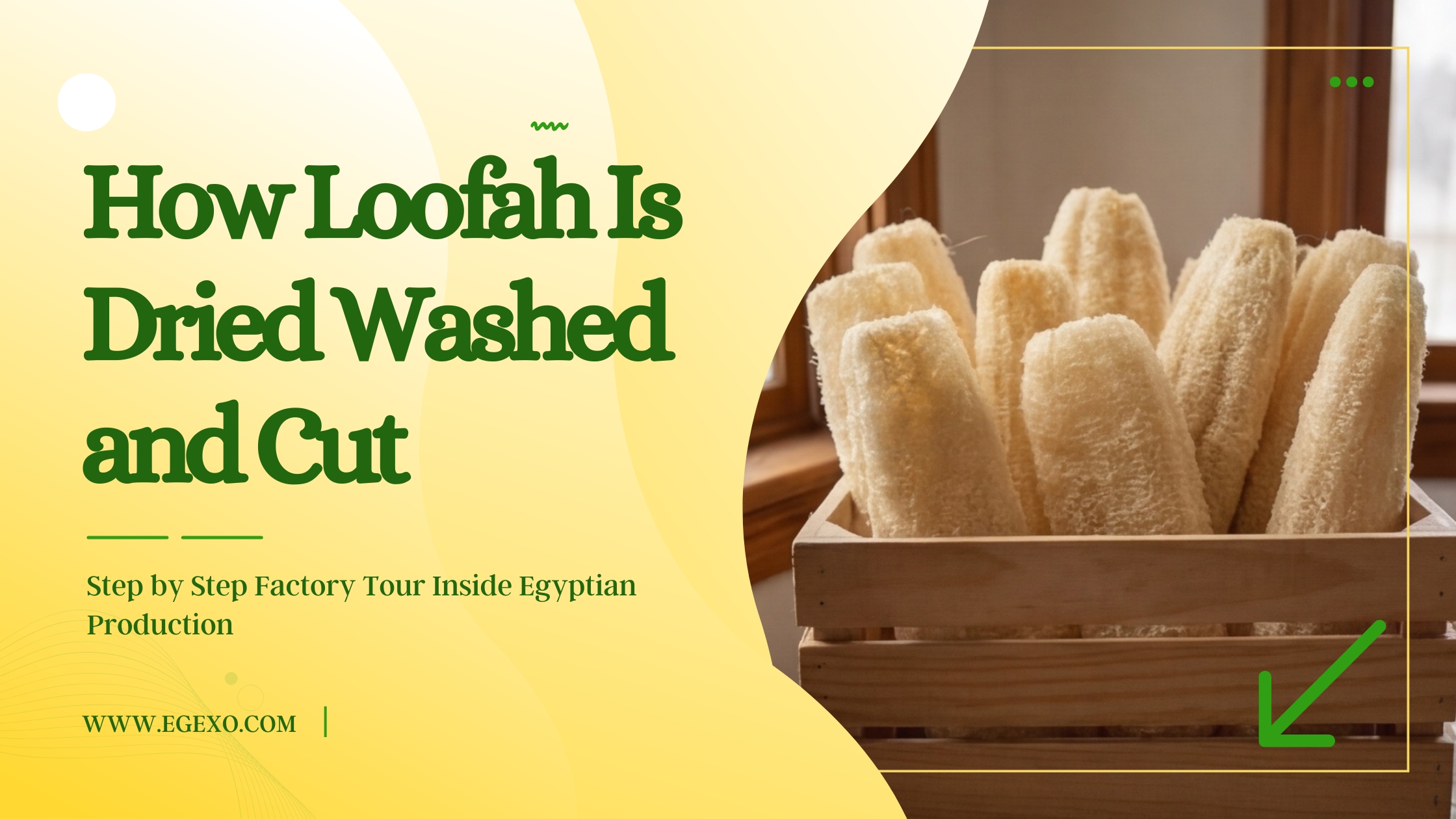
How Loofah Is Dried Washed and Cut: Step by Step Factory Tour Inside Egyptian Production
What Really Happens Between Harvest and Your Bathroom Shelf
Every natural loofah sponge travels through a remarkable transformation before it reaches your hands. Understanding how loofah is dried, washed, and cut during production reveals why some sponges last months while others fall apart in weeks. Whether you operate a spa purchasing thousands of units monthly or simply want to choose the best exfoliating tool for your skin, this factory tour through Egyptian loofah processing will change how you evaluate quality forever.
Egyptian loofah production accounts for over 60 percent of the global natural sponge supply, with facilities processing more than 50,000 tons of raw luffa aegyptiaca annually. The journey from vine to finished product involves precise timing, traditional techniques refined over generations, and modern quality controls that separate premium grade loofahs from inferior alternatives. Egexo, with over 25 years of cultivation and processing expertise, has perfected each stage of this transformation.
This comprehensive guide walks you through authentic factory floors, explaining every step that determines whether a loofah will provide gentle exfoliation or harsh scrubbing, whether it will resist mold for months or deteriorate within weeks, and whether it meets the standards demanded by international retailers and health conscious consumers alike. You will discover the exact processes that wholesale buyers should verify during supplier evaluation and the quality indicators that everyday shoppers should examine before purchase.
Ready to explore premium Egyptian loofah options? Browse our complete bath and body loofah collection or continue reading for insider knowledge that will transform your understanding of this ancient natural product.
The Complete Loofah Processing Timeline From Harvest to Shipment
Before examining each processing stage individually, understanding the complete timeline helps both business buyers planning inventory and consumers appreciating the craftsmanship behind quality loofahs. Egyptian facilities follow seasonal rhythms dictated by the luffa plant itself, with peak harvest occurring between September and November when fiber development reaches optimal maturity.
Understanding Harvest Timing and Raw Material Selection
The processing journey begins not in the factory but in the fields, where mature loofah gourds hang from extensive vine networks covering dedicated farmland. Experienced harvesters evaluate each gourd individually, checking for the characteristic brown coloration and hollow sound that indicates complete fiber development. Premature harvest results in weak, brittle fibers that break during processing, while overripe gourds produce discolored sponges with compromised structural integrity.
Premium facilities like those operated by Egexo maintain direct relationships with farming cooperatives, ensuring raw materials meet specifications before transport to processing centers. This farm to export approach eliminates middlemen who might mix quality grades and guarantees traceability that wholesale buyers increasingly require for certification compliance.
Initial Processing Timeline Overview
| Stage | Duration | Purpose | Quality Impact |
|---|---|---|---|
| Field Drying | 7 to 14 days | Initial moisture reduction | Prevents mold during transport |
| Retting or Soaking | 24 to 72 hours | Outer skin loosening | Affects fiber cleanliness |
| Skin Removal | 1 to 3 hours per batch | Fiber exposure | Determines surface smoothness |
| Primary Washing | 2 to 4 hours | Debris and sap removal | Impacts color and odor |
| Sun Drying | 3 to 5 days | Moisture reduction to 8 to 12 percent | Critical for mold prevention |
| Secondary Washing | 1 to 2 hours | Final sanitization | Ensures hygiene standards |
| Controlled Drying | 24 to 48 hours | Stabilize moisture content | Long term preservation |
| Cutting and Shaping | Varies by product | Create final forms | Determines product type |
| Quality Grading | 15 to 30 minutes per batch | Sort by quality tier | Establishes pricing category |
| Packaging | Continuous | Protect for shipping | Maintains quality during transit |
This timeline explains why quality Egyptian loofahs require 3 to 4 weeks minimum from harvest to shipping readiness. Suppliers promising faster turnaround often skip critical stages, resulting in products prone to mold, unpleasant odors, or premature degradation. When evaluating wholesale suppliers, requesting their complete processing timeline helps identify those cutting corners.
Stage One: The Art and Science of Loofah Drying
Proper drying represents perhaps the single most critical processing stage, directly determining whether your loofah will resist mold growth during months of bathroom humidity exposure. How loofah is dried varies significantly between production facilities, with methods ranging from traditional sun exposure to climate controlled industrial chambers.
Traditional Sun Drying Methods
Egyptian producers have perfected sun drying techniques over centuries, utilizing the region’s consistently low humidity and intense solar radiation. Raw loofah gourds spread across clean concrete or elevated mesh platforms absorb thermal energy that gradually evaporates internal moisture. This process occurs in two distinct phases with dramatically different purposes.
Field drying happens immediately post harvest, with gourds remaining on the vine or arranged in open areas near cultivation sites. During this 7 to 14 day period, moisture content drops from approximately 85 percent in fresh gourds to around 40 percent. This initial reduction prevents bacterial growth during transport to processing facilities while beginning the fiber hardening process that contributes to finished product durability.
Secondary sun drying follows skin removal and primary washing, targeting the critical 8 to 12 percent moisture content range that defines shelf stable loofahs. Fiber networks spread single layer across drying yards rotate multiple times daily, ensuring uniform exposure. Workers check moisture using calibrated meters, as visual assessment alone cannot reliably distinguish between 15 percent moisture content loofahs that will mold within weeks and 10 percent moisture content products remaining fresh for years.
Industrial Drying Alternatives
Modern facilities supplement traditional methods with controlled drying chambers, particularly valuable during Egypt’s brief rainy periods or when processing volumes exceed outdoor capacity. These systems maintain consistent temperatures between 45 and 55 degrees Celsius with humidity levels below 30 percent, achieving reliable moisture reduction regardless of weather conditions.
| Drying Method | Time Required | Consistency | Energy Cost | Quality Outcome |
|---|---|---|---|---|
| Traditional Sun | 3 to 5 days | Weather dependent | Minimal | Excellent when conditions ideal |
| Hybrid Sun plus Chamber | 2 to 3 days | High | Moderate | Consistent premium quality |
| Full Industrial | 24 to 48 hours | Very high | Higher | Reliable commercial grade |
Wholesale buyers should inquire about supplier drying methods, as this directly impacts product reliability across shipments. Egexo quality standards mandate hybrid drying protocols that combine traditional sun exposure benefits with industrial consistency guarantees.
For individual consumers, understanding drying importance helps explain price differences between loofahs. Products from facilities investing in proper drying infrastructure cost more but provide dramatically longer service life, ultimately offering better value despite higher initial pricing.
Stage Two: Washing Procedures That Determine Purity and Safety
The washing stages transform raw dried fibers into the clean, naturally colored sponges consumers expect. Multiple wash cycles serve distinct purposes, from removing organic residues to sanitizing fibers for body contact. How loofah is washed varies as significantly as drying methods, with direct implications for both hygiene and aesthetic quality.
Initial Soak and Skin Removal
Fresh from drying, loofah gourds retain their outer skin layer, a papery covering that must be removed before fibers become usable. Traditional retting involves submerging dried gourds in water tanks for 24 to 72 hours, softening the connection between skin and fiber network. Skilled workers then peel or scrape away loosened skin, revealing the characteristic fibrous structure beneath.
This stage requires careful timing and water management. Insufficient soaking leaves skin fragments attached, creating rough spots that irritate sensitive skin. Excessive soaking allows water penetration deep into fibers, extending subsequent drying requirements and risking internal mold development. Premium facilities monitor water temperature and duration precisely, maintaining conditions that optimize skin loosening without fiber damage.
Primary Washing and Debris Removal
Following skin removal, loofahs enter primary washing systems designed to flush away remaining organic material. Natural loofah plants produce sap and cellular debris that accumulates within fiber networks during growth. Without thorough removal, these residues decompose during storage, producing unpleasant odors and discoloration that characterize low quality products.
Primary washing typically involves three to four water changes, with fibers agitated manually or through mechanical tumbling. Workers inspect individual pieces, separating those requiring additional cleaning from specimens meeting first wash standards. This quality focused approach explains why factory tour visitors often observe workers handling individual loofahs repeatedly rather than processing anonymous bulk batches.
Secondary Sanitization Washing
The final washing stage addresses hygiene requirements for products destined to contact human skin. Methods vary from traditional sun and water cycles to modern sanitization approaches using food grade hydrogen peroxide or ozone treatment. Each method offers distinct advantages that wholesale buyers should understand when evaluating suppliers.
Sanitization Method Comparison
| Method | Effectiveness | Chemical Residue | Environmental Impact | Certifications Supported |
|---|---|---|---|---|
| Extended Sun plus Water | Good | None | Minimal | Organic certified |
| Hydrogen Peroxide | Excellent | Negligible trace | Low | Food contact safe |
| Ozone Treatment | Excellent | None | Very low | Medical grade possible |
| Chlorine Bleaching | Excellent | May retain traces | Moderate | Standard commercial |
Consumers seeking organic or chemical free products should verify supplier sanitization methods. Egexo offers multiple processing options to meet diverse market requirements, including organic certified lines processed exclusively through sun and water sanitization. Explore our complete selection through our shop page or request samples to evaluate different processing standards directly.
Stage Three: Precision Cutting and Product Shaping
How loofah is cut transforms uniform raw cylinders into the diverse product forms filling retail shelves and spa treatment rooms worldwide. This stage showcases the intersection between traditional handcraft skills and modern production efficiency, with cutting methods significantly impacting both product appearance and functional performance.
Understanding Loofah Fiber Structure
Before examining cutting techniques, appreciating loofah anatomical structure explains why certain cuts produce different exfoliation characteristics. Natural loofah fibers grow in a complex three dimensional network, with denser fiber concentration near the outer surface and progressively looser structure toward the central core.
Crosscut sections expose this density gradient, creating surfaces that combine gentler central areas with more vigorous outer zones. Lengthwise cuts maintain uniform fiber density across surfaces, producing consistent exfoliation intensity. Angular cuts create curved surfaces that conform differently to body contours. Understanding these structural implications helps both wholesale buyers selecting products for specific market segments and consumers choosing loofahs appropriate for their skin sensitivity.
Hand Cutting Versus Machine Processing
Traditional Egyptian loofah production relied entirely on skilled workers wielding sharp knives, creating products with organic shapes reflecting individual judgment about each piece’s optimal utilization. This approach remains prevalent for premium grade loofahs, where maximizing usable material from irregularly shaped raw stock takes priority over production speed.
Hand cutting advantages include adaptive responses to fiber density variations, damage avoidance around weak spots, and custom shape creation for specialty products. Skilled cutters evaluate each loofah individually, determining optimal angles and dimensions that machine systems cannot replicate. This explains why premium Egyptian loofahs often display slight variations that distinguish handcrafted quality from mass production uniformity.
Machine cutting systems increasingly supplement hand operations, particularly for standardized products like circular facial pads or uniform body scrubbers. Automated systems deliver consistent dimensions meeting retail packaging requirements while accelerating throughput for high volume orders. Modern facilities integrate both approaches, using machine cutting for standardized lines while reserving hand operations for premium and custom products.
Product Forms and Cutting Specifications
| Product Type | Cutting Method | Typical Dimensions | Primary Application | Common Buyers |
|---|---|---|---|---|
| Whole Cylindrical | Minimal end trimming | 15 to 40 cm length | Multipurpose body | DIY consumers retailers |
| Body Slices | Crosscut machine or hand | 3 to 8 cm thickness | Shower and bath | Spas hotels consumers |
| Facial Pads | Die cut machine | 5 to 8 cm diameter | Gentle face cleansing | Beauty retailers spas |
| Kitchen Scrubbers | Crosscut with core removal | 6 to 10 cm diameter | Dish washing | Kitchen suppliers grocers |
| Exfoliating Strips | Lengthwise cut | Variable | Body scrubbing | Specialty retailers |
| Pet Grooming | Custom shaped | Variable | Animal bathing | Pet supply distributors |
Wholesale buyers seeking specific product forms should specify requirements when requesting quotations. Egexo offers custom product design services for buyers needing unique shapes or dimensions beyond standard catalog offerings.
Consumers interested in DIY cutting should consider purchasing raw loofah scrubbers for customization at home. Whole loofahs provide excellent value for households using multiple product forms or crafters creating handmade gifts.
Quality Control Checkpoints Throughout Production
Quality grading occurs continuously throughout how loofah is dried, washed, and cut rather than solely at final inspection. Understanding these checkpoints helps wholesale buyers evaluate supplier quality systems and enables consumers to recognize indicators distinguishing premium products from inferior alternatives.
Pre Processing Selection Criteria
Quality control begins before processing starts, with incoming raw materials evaluated against established specifications. Premium facilities reject gourds showing signs of pest damage, disease scarring, or developmental abnormalities that compromise fiber integrity. This selection stage typically eliminates 15 to 25 percent of harvested materials at quality focused operations.
Raw Material Inspection Checklist
- Uniform brown coloration indicating full maturity
- Hollow sound when tapped confirming dry internal cavity
- No visible mold spots or discoloration
- Firm fiber structure without soft or spongy areas
- Minimum length and diameter meeting product specifications
- Absence of insect damage or bore holes
- Clean surface without excessive soil adherence
In Process Quality Verification
Each processing stage includes checkpoint inspections that catch defects before additional investment in substandard materials. Post drying moisture testing ensures fibers meet specification before washing begins. Post washing inspections verify complete debris removal and appropriate color development. Pre cutting evaluations identify fiber density patterns guiding optimal utilization.
Egexo maintains documented quality records for every production batch, enabling traceability that wholesale buyers increasingly require for retail compliance. This documentation supports private label manufacturing customers needing verification for their own quality claims.
Final Grading Classification
Finished loofahs receive quality grades determining their market destination and pricing tier. While grading criteria vary between suppliers, Egyptian industry standards recognize four general categories that wholesale buyers should understand.
| Grade | Characteristics | Typical Applications | Price Range Relative |
|---|---|---|---|
| Premium or A | Uniform color excellent density no visible defects | Luxury spas premium retail gift sets | 100 percent baseline |
| Standard or B | Minor color variation good density minimal defects | General retail hospitality midrange spa | 70 to 85 percent |
| Commercial or C | Noticeable variations acceptable density visible minor defects | Discount retail budget hospitality | 50 to 65 percent |
| Utility or D | Significant variations lower density multiple defects | Industrial use bulk applications | 30 to 45 percent |
Download the complete Egexo product catalog for detailed specifications across all available grades and product types.
Environmental Considerations in Modern Loofah Processing
Sustainability increasingly influences purchasing decisions for both wholesale buyers serving eco conscious markets and individual consumers seeking alternatives to plastic bath products. Understanding environmental aspects of how loofah is dried, washed, and cut helps evaluate supplier claims and make informed choices.
Water Usage and Conservation
Traditional loofah processing requires substantial water volumes, primarily during washing stages. A single production cycle processing 1000 kilograms of raw loofahs may consume 8000 to 12000 liters of water through multiple wash stages. Progressive facilities implement water recycling systems that capture and filter wash water for reuse in initial soaking stages, reducing consumption by 40 to 60 percent.
Egyptian facilities benefit from natural advantages including consistent sunshine enabling solar water heating and low humidity accelerating drying without energy intensive dehumidification. These climatic factors contribute to lower overall environmental footprints compared to loofah processing in less favorable regions.
Energy Consumption Patterns
Electricity usage concentrates in lighting, conveyor systems, and any climate controlled drying chambers. Facilities relying primarily on traditional sun drying methods maintain minimal energy footprints, often operating partially off grid using solar panel installations. Industrial drying operations consume more energy but offer carbon offset opportunities through faster processing and reduced spoilage.
Waste Stream Management
Loofah processing generates organic waste materials including removed skins, seeds, rejected fibers, and cutting scraps. Responsible facilities compost these materials, returning nutrients to agricultural land rather than contributing to landfill volumes. Seeds recovered during processing support next season’s cultivation, creating closed loop production systems.
Consumers can extend sustainability thinking beyond initial purchase by composting used loofahs at end of life. Unlike synthetic alternatives persisting in environments for decades, natural loofah fibers decompose completely within 60 to 90 days under proper composting conditions.
What Wholesale Buyers Should Verify During Supplier Evaluation
Business buyers investing in loofah inventory benefit from understanding processing details when evaluating potential suppliers. Beyond requesting samples and comparing prices, knowledgeable buyers investigate processing methods that determine product reliability across large orders.
Essential Supplier Verification Questions
When contacting potential suppliers, the following inquiries reveal processing quality beyond surface impressions:
- What drying methods ensure consistent moisture content across shipments
- How are washing water sources tested for contaminants
- What sanitization methods comply with destination country regulations
- Which quality grades are available and how are they differentiated
- Can processing be customized for specific certifications or requirements
- What traceability documentation accompanies orders
- Are factory inspections available for visiting buyers
Red Flags Indicating Processing Shortcuts
Experienced importers recognize warning signs suggesting suppliers compromise processing quality for cost reduction. Prices significantly below market averages often reflect skipped processing stages rather than operational efficiency. Inconsistent moisture content between samples and bulk orders suggests inadequate drying protocols. Strong residual odors indicate insufficient washing. Rapid deterioration during storage signals improper sanitization.
Why Choose Egexo explains our commitment to transparent processing that supports buyer confidence across orders of any size.
Minimum Order Considerations
Wholesale loofah purchasing typically involves minimum order quantities reflecting efficient production batch sizes. MOQ requirements vary based on product type, customization needs, and supplier policies.
| Product Category | Typical MOQ Range | Lead Time | Customization Available |
|---|---|---|---|
| Standard body loofahs | 500 to 1000 pieces | 2 to 3 weeks | Color size grade |
| Facial pads | 1000 to 2000 pieces | 2 to 3 weeks | Size thickness |
| Kitchen scrubbers | 500 to 1000 pieces | 2 to 3 weeks | Size core options |
| Custom shapes | 1000 to 2500 pieces | 4 to 6 weeks | Full customization |
| Private label | 2500 to 5000 pieces | 4 to 8 weeks | Branding packaging |
Practical Tips for Consumers Evaluating Loofah Quality
Individual buyers benefit from understanding processing methods when selecting loofahs at retail or online. Visual and tactile evaluation reveals processing quality without requiring supplier documentation.
Visual Quality Indicators
Hold potential purchases up to light, examining fiber uniformity and density patterns. Premium processing produces consistent coloration ranging from cream to light tan, without dark spots suggesting mold exposure or white patches indicating bleach overprocessing. Fiber networks should appear intact without significant broken strands or compressed areas revealing rough handling.
Tactile Assessment Techniques
Quality processing creates fibers that feel firm yet slightly flexible when dry. Excessive brittleness suggests overdrying that weakens fibers during use. Soft or spongy areas indicate retained moisture creating mold risk. Gently flex the loofah, listening for cracking sounds that reveal fiber damage invisible to visual inspection.
Smell Testing Importance
Fresh processed loofahs carry mild earthy scents reflecting their natural plant origin. Strong musty odors indicate mold development from improper drying. Chemical smells suggest harsh sanitization that may irritate sensitive skin. Processed loofahs from quality facilities smell essentially neutral, allowing fragrance free use or compatibility with preferred soaps and cleansers.
For more guidance on selecting and maintaining natural loofahs, visit our sister site Loofah Guide featuring comprehensive consumer resources.
Expert Insight from Egexo
After 25 years cultivating, processing, and exporting Egyptian loofahs, our team has observed one factor consistently predicting product longevity above all others: proper drying execution. We have tested loofahs from dozens of competing facilities, and those rushing drying stages to accelerate production invariably disappoint customers with premature mold, fiber breakdown, and odor development.
Our recommendation to wholesale buyers involves requesting moisture content documentation for any significant order. Reliable suppliers maintain calibrated testing equipment and willingly share readings demonstrating their products meet the 8 to 12 percent moisture specification that defines shelf stability. Suppliers hesitating to provide this verification often lack consistent drying protocols or testing capabilities.
For individual consumers, we suggest a simple test before first use: submerge your new loofah briefly, then set it aside overnight. Quality processed loofahs dry completely within 24 hours under normal bathroom conditions. Persistent dampness after this period suggests moisture content issues that will create problems during regular use.
Frequently Asked Questions
Q: How long does the complete loofah processing cycle take from harvest to shipment?
A: Complete processing requires 3 to 4 weeks minimum for quality results. This includes 7 to 14 days initial field drying, 24 to 72 hours soaking for skin removal, 2 to 4 hours primary washing, 3 to 5 days secondary drying, final washing and packaging stages. Suppliers promising significantly faster turnaround typically skip or shorten critical stages that ensure product durability and safety.
Q: What moisture content indicates properly dried loofahs?
A: Properly processed loofahs contain 8 to 12 percent moisture content when finished. Below 8 percent creates excessive brittleness causing fiber breakage during use. Above 12 percent allows mold development during storage and shipping. Quality suppliers test moisture using calibrated meters and can provide documentation verifying specifications compliance.
Q: Why does Egyptian loofah dominate global production?
A: Egypt provides ideal growing conditions including consistent sunshine, low humidity, and Nile Valley irrigation supporting large scale cultivation. Combined with generations of processing expertise and established export infrastructure, Egyptian facilities deliver quality and volume that other regions cannot match. Over 60 percent of global natural loofah supply originates from Egyptian production.
Q: How can wholesale buyers verify supplier processing quality?
A: Request factory tour opportunities or detailed processing documentation. Quality suppliers willingly explain drying methods, washing protocols, and sanitization approaches. Ask for moisture content testing records, traceability documentation, and references from existing customers. Hesitation to provide transparency often indicates processing shortcuts affecting product reliability.
Q: What processing differences explain price variations between loofah products?
A: Price differences primarily reflect processing thoroughness and quality grading. Premium products undergo extended drying ensuring mold resistance, multiple washing cycles achieving complete debris removal, and careful hand cutting maximizing material utilization. Budget products often skip processing stages, mix quality grades, or originate from facilities lacking quality infrastructure.
Q: How should consumers store loofahs to maintain processing quality benefits?
A: Store loofahs in well ventilated areas where they can dry completely between uses. Avoid enclosed containers trapping moisture. Hang loofahs rather than leaving them in shower corners where water accumulates. With proper storage, quality processed loofahs resist mold development for 3 to 6 months of regular use.
Q: What certifications should wholesale buyers request for processed loofahs?
A: Relevant certifications depend on destination markets and retail positioning. Common requests include organic certification for natural processing methods, food contact safety documentation for kitchen products, and quality management certification demonstrating consistent processing standards. Discuss specific requirements when requesting quotations to ensure supplier capabilities match needs.
Conclusion
Understanding how loofah is dried, washed, and cut transforms both purchasing decisions and product appreciation. The 3 to 4 week journey from Egyptian harvest to finished product involves precise drying protocols achieving 8 to 12 percent moisture content, multiple washing stages ensuring hygiene and purity, and skilled cutting operations creating diverse product forms. Each stage directly impacts the quality you receive whether ordering thousands of units for retail distribution or selecting a single loofah for personal use.
Egyptian production facilities like Egexo combine traditional expertise developed over generations with modern quality controls meeting international standards. This blend produces natural loofahs consistently outperforming alternatives from other regions while supporting sustainable agricultural practices.
Key Takeaways:
- Proper drying to 8 to 12 percent moisture content determines mold resistance and longevity
- Multiple washing stages remove debris and ensure hygiene for skin contact safety
- Cutting methods affect exfoliation characteristics and product versatility
- Quality grading systems help buyers select appropriate products for intended applications
- Egyptian loofah production leads global supply with superior quality and expertise
Ready to experience Egyptian loofah quality?
For Wholesale Buyers: Request a bulk quote or download our complete product catalog
For Individual Orders: Shop our collection or order samples to evaluate quality firsthand