

What Makes Our Raw Loofah the Best for Manufacturers
Egypt supplies more than 70 percent of the world’s commercially traded loofah, and that number is not a coincidence. The Nile Delta’s unique soil composition, consistent sunlight, and centuries-old cultivation knowledge produce a fibrous gourd that no other region on earth can fully replicate. For manufacturers sourcing raw materials, that origin story is more than marketing — it is a measurable quality advantage that shows up in every production run.
Whether you run a cosmetic contract facility, a private-label spa brand, or a sustainable packaging line, the raw loofah you choose becomes the ceiling of your product quality. And if you are an individual consumer wondering why some loofah products feel dense and durable while others fall apart after two weeks, the answer almost always traces back to the raw material upstream.
This guide explains exactly what makes our raw loofah the best option on the market — from soil to shipment — and gives both wholesale buyers and everyday shoppers the specific details they need to make a confident decision. You will find quality specifications, grading breakdowns, comparison data, supplier evaluation criteria, and practical usage insights all in one place.
If you want to skip straight to sourcing, you can request a wholesale quote here or browse our raw loofah scrubbers category to see current stock.
Why Egyptian Raw Loofah Outperforms Every Alternative
The loofah plant — Luffa aegyptiaca — grows in tropical and subtropical climates worldwide, but not all growing environments produce the same output. Egyptian loofah cultivated in the Nile Delta region benefits from three conditions that consistently produce superior fiber.
The Soil Advantage
Nile Delta soil carries an exceptionally high mineral content, including natural deposits of calcium, magnesium, and iron. These minerals feed the fibrous network inside the loofah gourd during its 150 to 180 day growing cycle. The result is a denser, more uniform fiber matrix compared to loofah grown in Southeast Asia or Central America, which tends to produce a looser, less consistent fiber structure.
For manufacturers, fiber density directly affects product durability, exfoliation performance, and the structural integrity of finished goods. A looser fiber absorbs processing treatments unevenly, which increases production waste and inconsistency in the final product.
Consistent Climate, Predictable Output
Egyptian growing seasons follow reliable rainfall and temperature patterns, which means harvest timing is predictable. Predictable harvests translate to predictable supply chains. Egexo’s farms in the Nile Delta operate on structured planting and harvest calendars, which allows the team to offer confirmed shipping timelines that most tropical suppliers cannot match.
Egexo has maintained active loofah cultivation and export operations for over 25 years. That track record means the agronomic knowledge on these farms is not theoretical — it is built from tens of thousands of growing cycles, quality evaluations, and direct feedback loops with manufacturing clients across Europe, North America, and Asia.
Hand-Harvesting and Immediate Processing
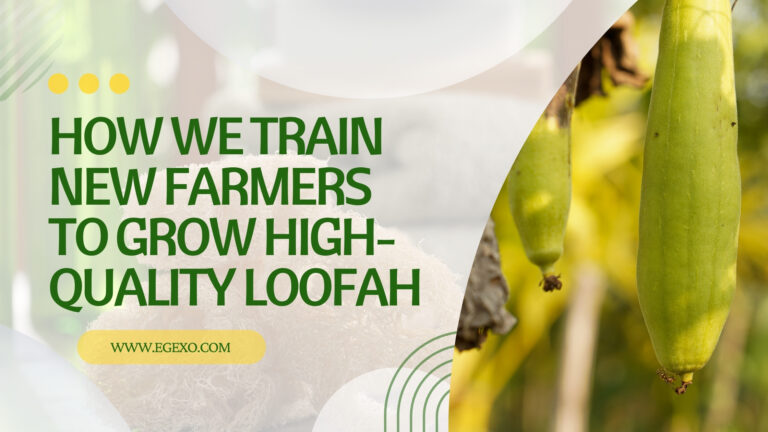
Industrial-scale machine harvesting bruises and compresses the loofah fiber, introducing micro-fractures that reduce durability. All loofah on Egexo farms is hand-harvested at peak ripeness, then moved immediately into the initial drying and peeling process. This limits the window for mold development and fiber degradation, which is one of the primary quality risks in raw loofah supply chains globally.
Raw Loofah Quality Grades: What Manufacturers Need to Know
Not all raw loofah is equal, and the grade you purchase determines your manufacturing output quality. Egexo supplies three primary grades for wholesale buyers, each suited to different product applications.
Loofah Quality Grade Specifications
| Grade | Fiber Density | Diameter Range | Moisture Content | Color Uniformity | Best Application |
|---|---|---|---|---|---|
| Grade A Premium | High (dense, uniform) | 8 to 12 cm | Below 12 percent | Consistent cream to tan | Cosmetic-grade, spa, premium retail |
| Grade B Standard | Medium (minor variation) | 6 to 10 cm | Below 15 percent | Slight natural variation | Mid-market bath products, kitchen |
| Grade C Industrial | Variable | 5 to 9 cm | Below 18 percent | Natural color variation | Industrial scrubbing, bulk manufacturing |
For cosmetic manufacturers and premium spa brands, Grade A is the non-negotiable starting point. The fiber density and moisture control at this grade ensure that the loofah holds its structure through processing steps like bleaching, cutting, pressing, or fragrance infusion.
For budget product lines or industrial cleaning applications, Grade B and Grade C provide excellent cost efficiency without sacrificing the core natural properties that make loofah valuable.
If you are evaluating suppliers, you can review Egexo’s full quality standards documentation before placing any order.
Minimum Order Quantities by Grade
| Grade | MOQ (Units) | MOQ (Kg) | Lead Time | Packaging Options |
|---|---|---|---|---|
| Grade A Premium | 500 units | 50 kg | 10 to 14 business days | Bulk, vacuum-sealed, private label |
| Grade B Standard | 300 units | 30 kg | 7 to 10 business days | Bulk or bagged |
| Grade C Industrial | 200 units | 20 kg | 5 to 7 business days | Bulk only |
Custom packaging and private label manufacturing are available for buyers who need branded product-ready output. For those interested in custom shape, sizing, or product design requirements, the custom loofah product design service covers those specifications before production begins.
How Egexo’s Farm-to-Export Process Protects Quality
Understanding the supply chain behind your raw material is as important as understanding the material itself. Egexo operates a fully integrated farm-to-export process, which means there are no third-party intermediaries introducing quality risk between the growing stage and your receiving dock.
Stage-by-Stage Process Overview
| Stage | Action | Quality Control Point |
|---|---|---|
| 1. Planting | Certified seed selection, prepared soil beds | Soil mineral testing |
| 2. Growing | Irrigation management, vine training | Weekly crop inspection |
| 3. Harvesting | Hand-picking at peak fiber maturity | Ripeness and size grading |
| 4. Drying | Solar-assisted low-temperature drying | Moisture content measurement |
| 5. Peeling and Cleaning | Manual outer skin removal, seed extraction | Fiber damage inspection |
| 6. Grading | Size, density, and color sorting | Grade classification |
| 7. Packaging | Grade-appropriate packaging, labeling | Final QC inspection |
| 8. Export | Documentation, customs clearance, shipping | Compliance verification |
Each stage in this chain is controlled by Egexo’s own team, which means quality problems can be identified and corrected within the operation rather than discovered at a client’s facility. This internal control is one of the primary reasons Egexo maintains repeat buyer rates that exceed industry averages for Egyptian loofah exporters.
For wholesale buyers who want to verify this process firsthand, ordering product samples before committing to a full production order is always an option.
Natural vs Synthetic: Why Raw Loofah Wins for Manufacturers and Consumers
The personal care and household product markets have seen a sustained shift toward natural materials over the past decade. Consumer research consistently shows that shoppers pay a premium for naturally derived products and are more loyal to brands that back sustainability claims with verifiable sourcing.
Natural Loofah vs Synthetic Alternatives Comparison
| Factor | Natural Raw Loofah | Synthetic Sponge | Synthetic Scrubber Pad |
|---|---|---|---|
| Material origin | Plant-based (Luffa aegyptiaca) | Petroleum-derived polymer | Synthetic fiber blend |
| Biodegradability | Fully biodegradable (30 to 60 days) | Non-biodegradable | Non-biodegradable |
| Exfoliation quality | Variable texture, effective | Uniform but less effective | Abrasive, can damage skin |
| Shelf life (unused) | 2 to 3 years | 3 to 5 years | 3 to 5 years |
| Product life (in use) | 4 to 6 weeks with care | 2 to 4 weeks | 1 to 3 months |
| Microplastic risk | None | High | High |
| Market premium potential | High (natural/eco positioning) | Low | Low |
| Manufacturing versatility | High (cuts, shapes, blends) | Medium | Low |
For manufacturers, the natural loofah category carries a price premium that synthetic alternatives simply cannot access. A product positioned as eco-certified, naturally sourced, and biodegradable commands margins that a petroleum-derived sponge never can.
For consumers, the choice comes down to skin sensitivity, environmental values, and product performance. Natural loofah provides textured mechanical exfoliation that removes dead skin cells without the microplastic shedding risk associated with synthetic mesh scrubbers. It also dries faster than dense synthetic sponges, which reduces bacterial growth between uses when maintained properly.
You can explore the full range of finished bath and body loofah products at Egexo’s body loofah category or read additional consumer guides at Loofah Guide for detailed usage recommendations.
Supplier Evaluation Checklist: How to Verify Raw Loofah Quality
Whether you are sourcing raw loofah for the first time or auditing your current supplier, these evaluation criteria separate reliable suppliers from risky ones.
Raw Loofah Supplier Evaluation Checklist
| Evaluation Criteria | What to Look For | Red Flag |
|---|---|---|
| Origin verification | Documented farm location, country of origin | Vague or unverifiable origin claims |
| Moisture content | Under 15 percent for standard grade | No moisture testing data available |
| Fiber density | Consistent feel, no hollow sections | Lightweight feel, visible gaps |
| Color consistency | Uniform natural tan or cream | Bleached appearance without disclosure |
| Mold or contamination | Clean, dry smell, no visible spots | Musty odor, dark discoloration |
| Size consistency | Graded sizing within stated range | Highly variable sizes in same lot |
| Documentation | Certificate of origin, phytosanitary cert | No export documentation offered |
| Sample policy | Free or low-cost samples available | No sample program, high sample fees |
| MOQ flexibility | Tiered MOQ options for different buyers | Single high MOQ with no flexibility |
| Lead time reliability | Confirmed shipping timelines | Vague “approximately” shipping windows |
Egexo meets every criterion on this list and provides full documentation for all export shipments. You can verify current quality standards and certifications by visiting the Why Choose Egexo page.
If you are ready to begin the evaluation process with your own hands-on assessment, order loofah samples directly with no obligation to proceed to a bulk order.
Applications: Where Raw Loofah Performs Best
Raw loofah from Egexo ships to manufacturers across several product categories. Understanding which applications benefit most from premium Egyptian fiber helps buyers select the right grade and specification for their production line.
Manufacturing Applications by Product Category
| Product Category | Recommended Grade | Key Loofah Property Used | End Market |
|---|---|---|---|
| Premium bath sponges | Grade A | Dense fiber, uniform shape | Spa retail, luxury bath |
| Exfoliating body scrubbers | Grade A or B | Textured surface, durability | Personal care retail |
| Kitchen scrubbers | Grade B or C | Firmness, heat tolerance | Household goods retail |
| Pet grooming products | Grade A or B | Soft texture, natural material | Pet specialty retail |
| Cosmetic infusion carriers | Grade A | Absorption capacity, fiber integrity | Cosmetic manufacturing |
| Industrial cleaning pads | Grade C | Abrasion resistance, low cost | Industrial distribution |
| DIY craft and packaging | Grade B or C | Natural aesthetic, workability | E-commerce, artisan market |
For buyers who manufacture across multiple categories, Egexo’s full product shop carries finished and semi-finished loofah products alongside raw material to support integrated product lines. Specialty applications including kitchen loofah products and pet and spa grooming loofah are stocked for buyers who want finished goods alongside raw input.
For wholesale distributors who want a complete overview of product range and pricing tiers, the Egexo product catalog contains the full specification list across all categories.
Care and Maintenance: Maximizing Loofah Value After Purchase
For end consumers, knowing how to care for a natural loofah extends its functional life significantly and delivers better return on purchase cost. For manufacturers, including care instructions with finished products reduces returns and increases customer satisfaction.
Loofah Care and Maintenance Schedule
| Frequency | Action | Purpose |
|---|---|---|
| After every use | Rinse thoroughly, hang to dry | Prevent bacteria buildup |
| Every 3 to 4 days | Soak in diluted white vinegar for 5 minutes | Deep sanitization |
| Weekly | Inspect for discoloration or deterioration | Early replacement identification |
| Every 3 to 4 weeks | Replace with a fresh loofah | Hygiene maintenance |
A properly maintained natural loofah provides 4 to 6 weeks of effective exfoliation. This lifecycle compares favorably to synthetic alternatives when total cost and environmental impact are both factored in.
Consumers who purchase from quality raw material sources — rather than mass-market products made from degraded or lower-grade fiber — consistently report longer functional lifespans and better skin results. This connection between raw material quality and end-user experience is why manufacturer sourcing decisions ultimately affect consumer satisfaction metrics.
FAQ Section
Q1: What makes Egyptian raw loofah better than loofah from other countries?
Egyptian raw loofah benefits from the mineral-rich soil of the Nile Delta, consistent growing conditions, and over 25 years of cultivation expertise from suppliers like Egexo. The fiber density in Egyptian loofah is measurably higher than loofah grown in Southeast Asia or Latin America, which translates to better durability, more consistent exfoliation performance, and superior absorption in cosmetic manufacturing applications. No other origin combines all three of these advantages at commercial scale.
Q2: What is the minimum order quantity for raw loofah from Egexo?
Egexo’s minimum order quantities start at 200 kg for Grade C industrial loofah and 50 kg for Grade A premium loofah. For buyers requiring smaller trial quantities before a full production commitment, Egexo offers a sample program that allows buyers to evaluate fiber quality firsthand. You can request samples through the sample order page with no obligation to proceed to a bulk order.
Q3: How do I evaluate the quality of raw loofah before purchasing?
The most reliable evaluation method is a physical sample review. Key indicators include fiber density (no hollow sections), moisture content below 15 percent, uniform natural color without bleaching, and a clean dry smell with no mold or musty odor. Documentation including a certificate of origin and phytosanitary certificate should accompany any export-ready raw loofah shipment. Egexo provides all of this documentation as a standard part of every export order.
Q4: Is natural raw loofah safe for sensitive skin?
Yes. Natural loofah is made from plant fiber with no synthetic additives, dyes, or chemical treatments in its raw state. It provides mechanical exfoliation without the microplastic shedding associated with synthetic mesh scrubbers. For very sensitive skin, using a softer Grade A loofah with a light touch and limiting use to two to three times per week is the recommended approach. Always rinse the loofah thoroughly before first use to remove any surface dust from the drying process.
Q5: Can raw loofah be used in cosmetic manufacturing or product infusion?
Yes. Grade A Egyptian raw loofah has a fiber absorption capacity that makes it suitable for cosmetic infusion applications, including soap embedding, body butter infusion, and exfoliating cleanser integration. The fiber’s structural integrity holds up through processing steps including light chemical treatment, fragrance addition, and pressing. For cosmetic manufacturers interested in these applications, Egexo’s custom product design service can develop specifications tailored to specific production requirements.
Q6: How long does raw loofah last and what affects its shelf life?
Unused raw loofah stored in a cool, dry environment with good airflow maintains its quality for 2 to 3 years. Moisture is the primary enemy — storage above 18 percent relative humidity accelerates fiber degradation and mold risk. In use as a bath or body product, a natural loofah lasts 4 to 6 weeks with proper after-use rinsing and drying. Product shelf life after manufacturing depends on the processing treatment applied but typically ranges from 12 to 24 months in sealed packaging.
Q7: Does Egexo offer private label or custom packaging for raw loofah orders?
Yes. Egexo provides full private label services for wholesale buyers who want branded product-ready output. This includes custom packaging design, label printing, and product-specific branding. Custom product shapes, cut sizes, and specifications are also available through the custom loofah product design service. Details on the complete private label offering are available at the private label manufacturing page.
Q8: What certifications and documentation does Egexo provide for export orders?
Every Egexo export shipment includes a certificate of origin, phytosanitary certificate, and commercial invoice as standard documentation. Additional certifications relevant to specific import markets can be arranged on request. Egexo has 25+ years of experience navigating export requirements for European, North American, and Asian markets, which means the documentation process is handled efficiently without delays to shipping timelines.
Expert Insight from Egexo
After more than 25 years of growing and exporting Egyptian loofah, one thing remains constant: the buyers who get the best long-term results are the ones who treat raw material selection as a foundation, not an afterthought. Manufacturers who invest time in supplier evaluation — requesting samples, reviewing documentation, understanding grading standards — consistently report better finished product quality, lower production waste, and stronger retail sell-through rates. At Egexo, we encourage every new buyer to start with a sample review rather than committing directly to a bulk order. The quality difference between grades is something you need to feel in your hands before it makes sense on a specification sheet. Our team is available to walk through grading details, application suitability, and custom options for any production requirement. We built our sourcing process around transparency because that is what produces durable supplier-buyer relationships in this industry.
Conclusion
Raw loofah quality is not a minor variable — it is the determinant of every quality, durability, and performance outcome downstream. Egyptian loofah, grown in the mineral-rich Nile Delta under controlled conditions and processed through a fully integrated farm-to-export chain, consistently outperforms alternatives from every other major growing region.
Egexo’s 25+ years of cultivation experience, three-tier grading system, integrated supply chain, and comprehensive export documentation give both wholesale manufacturers and individual consumers a reliable, transparent source for what is genuinely the best raw loofah available at commercial scale.
Key Takeaways:
- Egyptian Nile Delta soil produces measurably denser loofah fiber than other growing regions
- Egexo’s three-grade system allows manufacturers to match quality level to application and budget
- The fully integrated farm-to-export process eliminates third-party quality risk
- Natural loofah offers a market premium position that synthetic alternatives cannot access
- Proper care extends a consumer loofah’s functional life to 4 to 6 weeks per unit
Ready to experience Egyptian loofah quality?
- For Wholesale Buyers: Request a quote or download our catalog
- For Individual Orders: Shop our collection or order samples