Contents
- 1. Factory or middleman?
- 2. What does each document prove?
- 3. How do you judge samples?
- 4. How do season and stock affect supply?
- 5. Which terms apply?
- Which products suit private label, and at what prices?
- What do private label worked orders look like?
- How do you ask for a comparable private label offer?
- Which ten questions should you ask any manufacturer?
- What is your part in Spain?
- Frequently asked questions
Natural sponge manufacturers in Egypt can be compared with five checks before a wholesale order. An importer or private label brand should ask who really makes the product and which documents they hold. Then compare the samples, the season of the material (luffa has one harvest a year) and the payment terms each one fixes.
Anyone who types “luffa sponge manufacturers” or “luffa sponge producers” tends to get lists with dozens of names that do not tell a factory, a wholesaler and a middleman apart. This guide gives you concrete questions to separate them.
1. Factory or middleman?
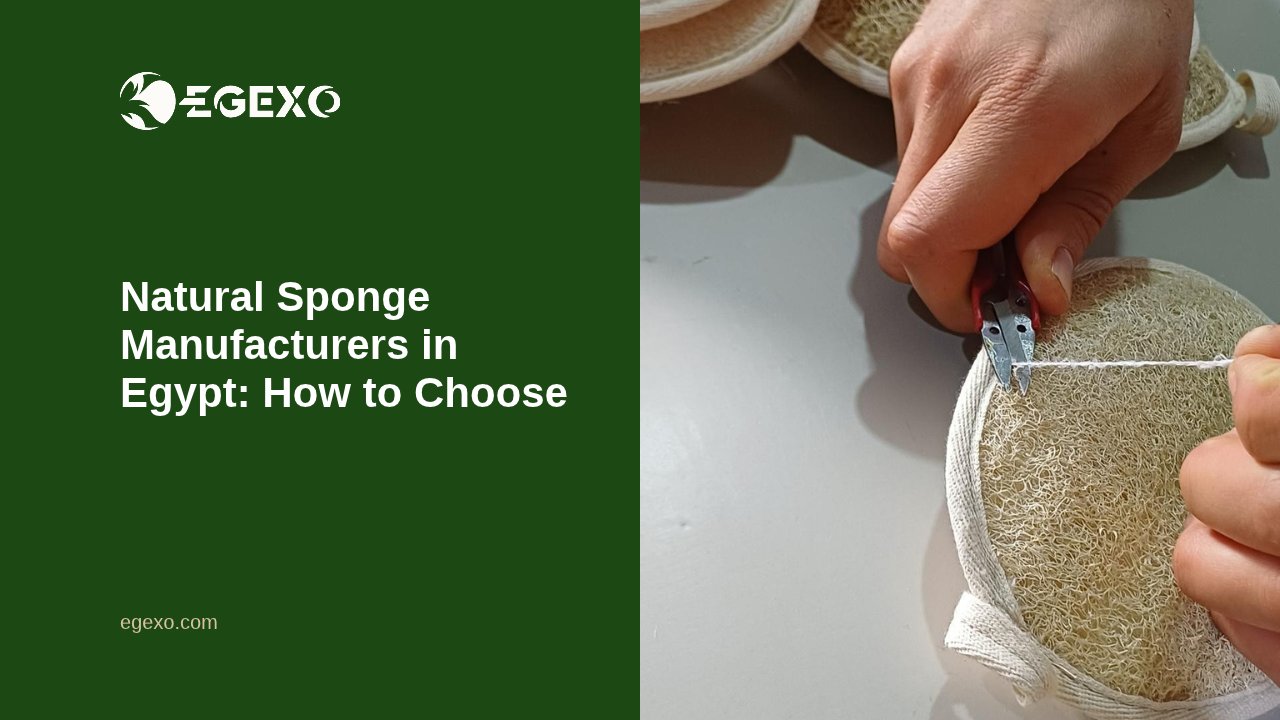
Ask for three things: the factory address, the origin of the raw material and photos of the order before it ships. EGEXO is a family-run manufacturer and exporter. The head office is at Mohamed Fared St, Damanhour, El Behiera, Egypt, 22511. The factory is in Abu Hommos, also in El Beheira. The luffa (Luffa aegyptiaca) comes from its own and partner farms in the Nile Delta and is processed in that factory. We have exported since 2015 to more than 40 countries.
- Own factory in Abu Hommos, El Beheira; loofah from own and partner farms in the Nile Delta.
- No minimum order on standard products. Private label from 1,000 units.
- Prices in USD, EX-Works Damanhour, in four quantity tiers.
- Standard samples ship within 2 days, custom samples in 3 to 7 days.
- Production takes 7 to 25 days from payment.
2. What does each document prove?
| Document | What it shows | How to check it |
|---|---|---|
| ISO 9001 | Certified quality management system (it does not certify products) | Issued by ABS Global, accredited by EGAC; registration EGY2026001027QMS; check at absglobals.com/en/validation |
| ISO 14001 and ISO 45001 | Environmental and occupational health and safety management systems | Same body and same dates; registrations on the certifications page of egexo.com |
| ISO 22716 | Certified good manufacturing practices | Issued without an accreditation mark: always ask whether one is shown |
| Certificate of Origin or EUR.1 | Egyptian origin, for the duty | Issued by the customs of the exporting country |
| Phytosanitary certificate and export licence | Plant health of the shipment and permission to export | Accompany the order |
The ISO 9001, 14001 and 45001 certificates were issued on 13 October 2026 and are checked by a yearly audit. For any supplier, ask for the registration number and check dates and scope.
On origin, Access2Markets states that the proof can be an EUR.1 certificate issued by the exporting country’s customs or an origin declaration. It also states that the EU-Egypt Association Agreement has been in force since 2004. The goods must also travel directly, although unloading and reloading under customs control are allowed: ask your forwarder.
3. How do you judge samples?
Samples are paid and shipping is at your cost. They cover up to 20 pieces per item. Standard ones leave in 2 days and custom ones in 3 to 7 days. The sample cost is credited to your first order of USD 1,000 or more, placed within 60 days. To decide, look at three things: wide pores (they do not hold dead-skin residue), thick fibre (it does not tear or wear out quickly) and fabric. EGEXO’s edges, towels and ropes are 100% cotton. Most makers use polyester-blend fabric, so compare samples with the label in front of you.
4. How do season and stock affect supply?
According to EGEXO’s production experience, luffa is planted in March and harvested in September and October; there is one season a year. There is more material right after harvest and less in the one to two months before it, depending on stock. The diameter of a raw piece varies from about 10 to 30 cm, from piece to piece and along the same piece. So fix a large order in good time and ask for the size of the raw pieces in the quote. A supplier who promises unlimited quantities all year round deserves one more question.
5. Which terms apply?
Prices are in USD, EXW Damanhour. Air Express DAP and CFR (from 1,000 pieces) are priced online; CIF is on request. Large orders: 50% advance and 50% before shipment, or an irrevocable confirmed letter of credit at sight. There are no credit terms. Ready 7 to 25 days from payment. Custom orders take longer; the time is confirmed in the quote. If an item is faulty, we replace it with your next order.
Which products suit private label, and at what prices?
Private label, custom packaging and custom products start from 1,000 units (up to 2,000, depending on the customization); options cost extra. Standard products have no minimum order. These five codes work well with private label:
| Product | Price tiers (USD, EX-Works Damanhour) |
|---|---|
| L1017 back scrubber 40 x 12 cm | Price per unit (USD, EX-Works Damanhour): 1 to 499 units: $2.13; 500 to 1,999 units: $1.78; 2,000 to 4,999 units: $1.53; 5,000+ units: $1.19. |
| L1018 back scrubber stick 13 x 70 cm | Price per unit (USD, EX-Works Damanhour): 1 to 499 units: $2.00; 500 to 1,999 units: $1.68; 2,000 to 4,999 units: $1.44; 5,000+ units: $1.12. |
| L1006 raw loofah with rope, 18 cm | Price per unit (USD, EX-Works Damanhour): 1 to 499 units: $1.68; 500 to 1,999 units: $1.41; 2,000 to 4,999 units: $1.21; 5,000+ units: $0.94. |
| L1015 kitchen cup stick with loofah, 25 cm | Price per unit (USD, EX-Works Damanhour): 1 to 499 units: $1.47; 500 to 1,999 units: $1.24; 2,000 to 4,999 units: $1.06; 5,000+ units: $0.83. |
| L1016 heel scrubber 6 x 6 cm | Price per unit (USD, EX-Works Damanhour): 1 to 499 units: $1.15; 500 to 1,999 units: $0.97; 2,000 to 4,999 units: $0.83; 5,000+ units: $0.64. |
(Prices in USD per unit, EXW. Towels, edges, straps and ropes, where present, are 100% cotton.) Note for your customs agent: L1006 uses HS code 140490.
What do private label worked orders look like?
Each example is an order for a single code; private label starts at 1,000 units and the options are added separately. The buyers are examples, not customers.
- Importer in Madrid: 1,000 back scrubbers L1017 in the 500-1,999 tier, at 1.78: 1,000 x 1.78 = 1,780.00 USD EXW, plus the private label options. 50% advance: 890.00 USD; another 50% before shipment: 890.00 USD. It is above 1,000 USD, so the sample cost is credited if the order is placed within 60 days of the sample.
- Spa brand in Valencia: 2,000 back scrubber sticks L1018 in the 2,000-4,999 tier, at 1.44: 2,000 x 1.44 = 2,880.00 USD. Payment: 1,440.00 USD and 1,440.00 USD.
- Gift shop in Barcelona: 1,500 raw loofahs with rope L1006 in the 500-1,999 tier, at 1.41: 1,500 x 1.41 = 2,115.00 USD. Payment: 1,057.50 USD and 1,057.50 USD.
- Kitchen brand in Zaragoza: 1,000 kitchen cup sticks with loofah L1015 in the 500-1,999 tier, at 1.24: 1,000 x 1.24 = 1,240.00 USD. Payment: 620.00 USD and 620.00 USD.
If the importer in Madrid moves from 1,000 to 2,000 L1017, the price moves to the 2,000-4,999 tier, at 1.53: 2,000 x 1.53 = 3,060.00 USD. That is 1,280.00 USD more for 1,000 additional pieces, at 1.28 USD each. Cost of 1,000 L1017 at each tier: 2,130, 1,780, 1,530 and 1,190 USD.
How do you ask for a comparable private label offer?
Send the same thing to each manufacturer: the code, the quantity (from 1,000 units), a logo, an idea or a reference, and the text you want printed (it can be in Spanish). With that EGEXO designs the packaging layout. Ask which options cost extra (embroidered or printed labels, hang tags, custom packaging) and how much longer a custom order takes than a standard one: the time is confirmed in the quote. Also ask for a custom sample (it leaves in 3 to 7 days) and photos of the order before shipment. That way you can compare offers properly, and not only prices per piece.
Which ten questions should you ask any manufacturer?
For EGEXO’s own answers to these questions, see our page on the Egyptian loofah supplier and exporter.
- Where is the factory, and can I see photos of the order before shipment?
- Which farms does the luffa come from?
- Which certificates do you hold, with what number and which body? Do they carry an accreditation mark?
- Will you show the four price tiers together?
- What is the minimum order on standard products and on private label?
- What is the fabric: 100% cotton or a blend?
- What is the lead time from payment, and in which season do you ask for the product?
- How much do the samples cost and how long do they take, and are they credited to the first order?
- What happens if an item arrives faulty?
- Which export documents come with the order?
What is your part in Spain?
If you import yourself, you need an EORI number: the Agencia Tributaria states that it is required for any customs operation in the Union. With the origin documents, EU buyers may pay lower or zero duty; the exact rate is confirmed by your customs agent. You can write to us in Spanish.
Next step: talk to us about OEM and private label manufacturing; we reply within 24 hours.
Official sources: Access2Markets, rules of origin (Pan-Euro-Mediterranean Convention) · Access2Markets, EU-Egypt Association Agreement · Agencia Tributaria, EORI.
Reviewed by Ahmed AbdelSattar.
Frequently asked questions
How fast do you answer a quote request? Within 24 hours, with the prices of all four quantity tiers.
Which documents come with an export order? The Certificate of Origin or EUR.1, the Phytosanitary Certificate, the commercial invoice, the packing list and the bill of lading. A copy of our export license is sent on request.
Is the 1,000-piece minimum required only for printing my logo, or can you offer branded packaging or custom labels for smaller quantities? Private label, custom packaging and custom products start from 1,000 units (up to 2,000 by customization), and options cost extra. Standard products have no minimum order.