

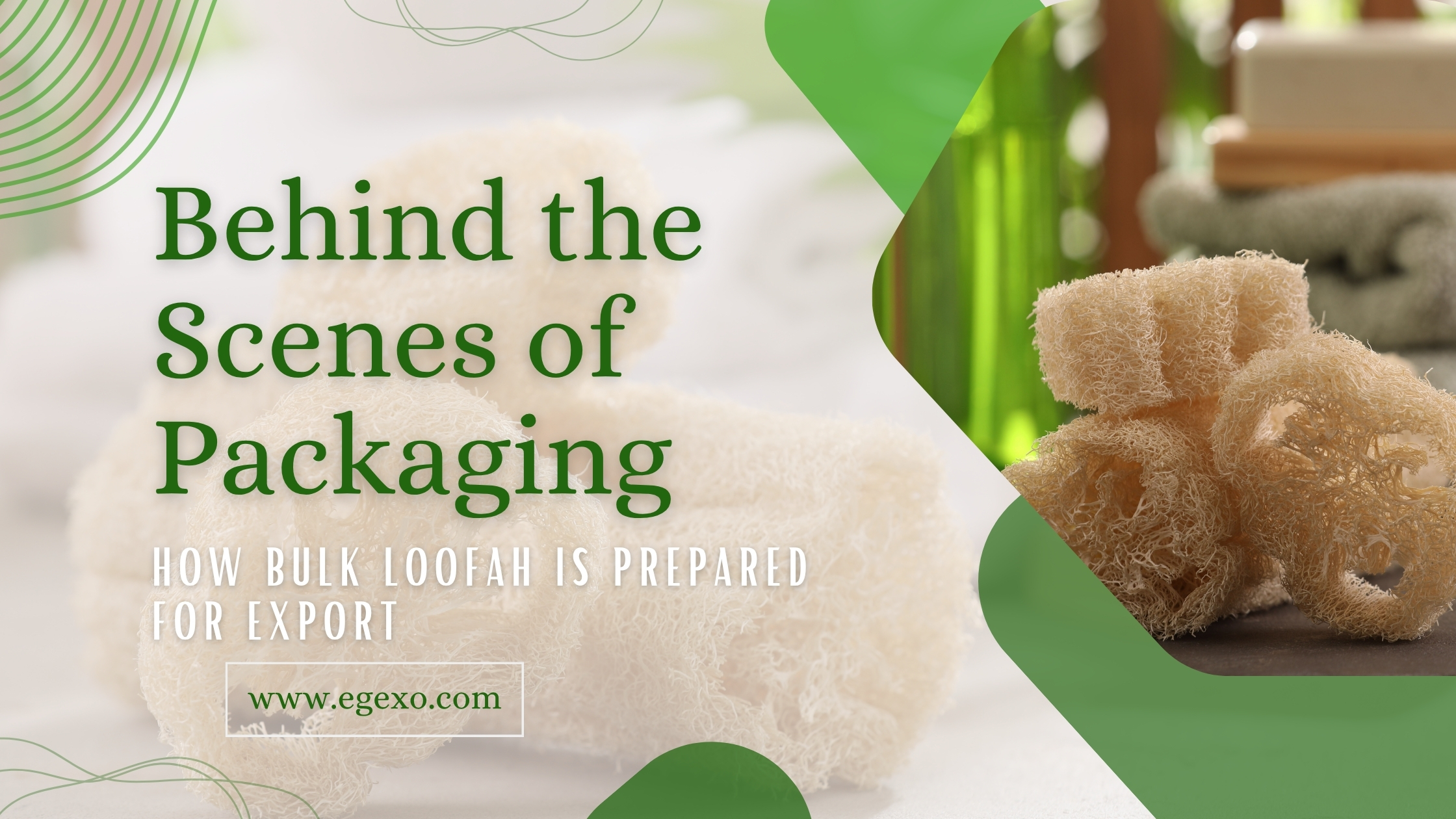
Behind the Scenes of Packaging: How Bulk Loofah Is Prepared for Export
Most people who use a loofah in the shower never think about where it came from, how it was grown, or what it took to get it to their hands. That gap between the farm and the final product is exactly where Egexo has spent more than 25 years building expertise. Understanding how bulk loofah is prepared for export is not just a behind-the-scenes story. It is a quality guarantee – and for wholesale buyers, it is the foundation of a reliable supply chain.
Egypt produces some of the finest loofah in the world, and the Nile Delta region, where Egexo operates its cultivation farms, offers the ideal climate for growing Luffa aegyptiaca. That natural advantage, combined with structured post-harvest handling, sorting, and packaging protocols, is why Egyptian loofah commands consistent demand from importers across Europe, North America, and Asia.
This article takes you inside the full process – from the moment a loofah is harvested to the point it is sealed in an export-ready carton. Whether you are a spa owner evaluating new suppliers, a retailer sourcing natural bath products, or simply someone curious about what makes one loofah better than another, you will find practical, specific answers here.
For wholesale buyers ready to move forward, you can request a bulk quote directly or browse the Egexo product catalog at any point during your reading.
The Foundation: Why Egyptian Loofah Leads the Global Market
Before packaging can even be discussed, the raw material has to be right. No amount of processing can turn a low-grade loofah into a premium export product. This is why Egexo’s approach begins in the field, not the warehouse.
Egyptian loofah grown in the Nile Delta benefits from rich alluvial soil, consistent irrigation from the Nile, and long growing seasons that allow the fibrous skeleton of the Luffa plant to develop fully. A fully matured loofah fiber is denser, more uniform, and more durable than one harvested early for volume.
What Makes Egyptian Loofah Different
The Luffa aegyptiaca species grown in Egypt develops a fiber network that is notably coarser than varieties grown in East Asia or South America. This coarser structure makes it more effective as an exfoliating tool while still being gentle enough for regular skin use. For kitchen applications, the same structure provides scrubbing power without scratching surfaces.
Egexo’s farms follow a natural cultivation cycle of approximately 120 to 150 days per crop, which allows each gourd to reach optimal fiber maturity. This is a non-negotiable part of quality control. Rushing the harvest to meet demand is a shortcut that produces inferior fiber – a trade-off Egexo does not make.
Buyers who want to understand the full farm-to-export process can explore the detailed overview on the Egexo farm-to-export process page, which documents every stage from planting to shipping.
Stage One: Harvest and Initial Processing
Understanding how bulk loofah is prepared for export starts with the harvest. Unlike many agricultural products, loofah cannot simply be picked and packed. The gourd must be processed to remove the outer skin, seeds, and internal moisture before it becomes the fibrous sponge you recognize.
Peeling and Seed Removal
Once harvested at full maturity, each loofah gourd is soaked in water to loosen the outer skin. The skin is then removed by hand or with water pressure, exposing the beige-to-golden fibrous interior. Seeds, which form inside the central cavity, are shaken or washed out at this stage.
Seed removal is important for two reasons. First, remaining seeds create uneven density in the finished product. Second, seeds left inside can cause internal moisture retention that leads to mold during storage or shipping.
Bleaching and Whitening
Raw loofah fiber after peeling is typically a dark tan or brownish color. For export markets that expect a consistent, clean appearance, controlled bleaching is applied using food-grade hydrogen peroxide solutions. Egexo’s bleaching process is calibrated to achieve uniform color without degrading the fiber tensile strength.
The result is the familiar cream-to-white loofah that buyers and consumers associate with quality. Importantly, the bleaching does not leave chemical residue that affects the user experience – a concern some buyers raise when first evaluating natural products.
Stage Two: Drying and Moisture Control
One of the most critical, and least visible, parts of how bulk loofah is prepared for export is moisture management. Loofah fiber is highly porous, which is what makes it useful as a sponge – but that same porosity makes it vulnerable to mold, mildew, and deterioration if it is shipped or stored with excess moisture content.
Target Moisture Levels for Export
Egexo maintains strict moisture content standards for all export shipments. The table below outlines the acceptable moisture ranges for different product types.
| Product Type | Target Moisture Content | Maximum Acceptable | Risk Above Maximum |
|---|---|---|---|
| Natural Bath Loofah | 8 to 10 percent | 12 percent | Mold during transit |
| Kitchen Loofah Scrubber | 8 to 10 percent | 12 percent | Fiber softening |
| Raw Loofah (unprocessed) | 10 to 14 percent | 16 percent | Structural degradation |
| Loofah Slices | 7 to 9 percent | 11 percent | Color change and odor |
Drying Methods
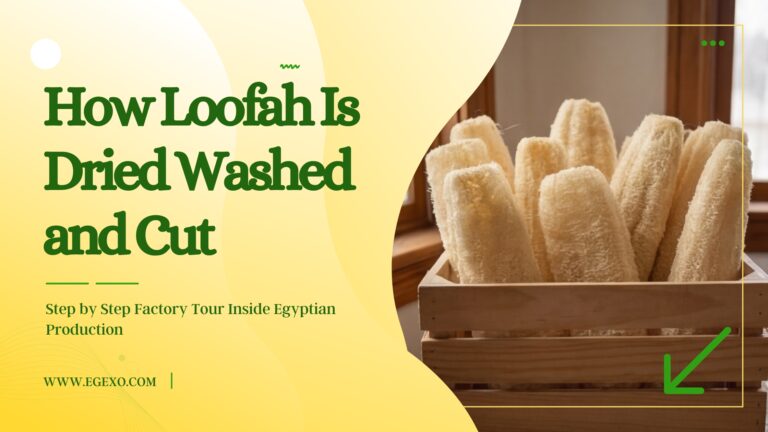
Sun drying remains the primary method at Egexo’s facilities for whole loofahs. The Nile Delta climate provides consistent heat and low humidity during the primary harvest season, making natural drying both effective and energy-efficient. Industrial tunnel dryers are used during periods of high humidity or for time-sensitive orders, ensuring that moisture targets are met regardless of weather conditions.
After drying, each batch is tested with calibrated moisture meters before moving to the sorting stage. Batches that do not meet the moisture specification are returned for additional drying rather than advanced to packaging.
Stage Three: Grading and Quality Sorting
Not every loofah that comes off the farm meets export quality. This is a fact of agricultural production, and it is also the point at which Egexo’s quality standards create a meaningful difference for wholesale buyers.
The Egexo Grading System
Egexo uses a three-tier grading system based on fiber density, uniformity, size, color consistency, and absence of defects.
| Grade | Fiber Density | Color Uniformity | Size Consistency | Typical Application |
|---|---|---|---|---|
| Grade A Premium | High, uniform | 95 percent or above | Within 5mm tolerance | Spa, retail, private label |
| Grade B Standard | Medium to high | 85 to 94 percent | Within 10mm tolerance | General retail, wholesale |
| Grade C Utility | Variable | Below 85 percent | Greater than 10mm variance | Industrial, bulk filler use |
For buyers sourcing loofah for spa environments or branded retail, Grade A is the standard. Grade B is appropriate for high-volume general retail where minor cosmetic variation is acceptable. Grade C is rarely exported under the Egexo brand and is not offered to premium market buyers.
Wholesale buyers can review Egexo’s complete quality standards documentation for a full breakdown of grading criteria and testing protocols.
Size Sorting and Dimension Control
After grade classification, loofahs are sorted by size. This matters significantly to buyers who need consistent product for packaging or display purposes. The standard size ranges for Egexo’s bath loofah range are as follows.
| Size Category | Length Range | Diameter Range | Suitable For |
|---|---|---|---|
| Small | 10 to 14 cm | 7 to 9 cm | Children’s products, sample packs |
| Medium | 15 to 19 cm | 9 to 11 cm | Standard bath loofahs |
| Large | 20 to 25 cm | 11 to 14 cm | Spa and premium retail |
| Extra Large | 26 cm and above | 14 cm and above | Custom orders, specialty markets |
Custom size specifications are available for buyers with specific product requirements. Egexo’s custom loofah product design service allows buyers to define dimensions, density grade, and finish for private label programs.
Stage Four: Packaging Design and Configuration
This is where the physical export preparation becomes visible. Packaging for bulk loofah export must serve multiple functions simultaneously: protecting product integrity during transit, communicating brand identity for retail-ready SKUs, meeting import regulations in the destination market, and minimizing cubic volume to reduce freight costs.
Packaging Options for Wholesale Buyers
| Packaging Type | Description | Best For | MOQ |
|---|---|---|---|
| Bulk Loose in Carton | No individual wrapping, stacked or layered | Raw loofah buyers, repackagers | 500 units |
| Polybag Individual | Each loofah in a clear or printed polybag | General retail distribution | 200 units |
| Custom Retail Box | Branded box with product information | Private label, spa retail | 100 units |
| Hanging Header Card | Loofah with printed card for peg display | Hardware, pharmacy retail | 200 units |
| Gift Set Assembly | Multiple items combined in packaging | Seasonal, premium retail | 50 sets |
For buyers considering a private label program, Egexo’s private label loofah manufacturing service covers everything from label design to finished retail-ready packaging.
What Goes Into Each Export Carton
A standard export carton from Egexo is configured for optimal load efficiency on pallets. Each carton includes:
- A clear itemization of contents by SKU, grade, and quantity
- A moisture-absorbing silica gel packet scaled to carton volume
- Internal dividers or netting to prevent friction damage during transit
- Exterior carton markings that comply with destination country import labeling requirements
- A lot number traceable to the specific harvest batch and processing date
This traceability is a feature buyers in regulated markets, particularly in the European Union and the United States, specifically request. If a quality issue is ever reported, Egexo can trace any unit back to its source batch within hours.
Stage Five: Pre-Shipment Quality Inspection
Before a shipment leaves Egexo’s facility, it goes through a pre-shipment inspection that mirrors what third-party inspection agencies look for. This internal audit covers four areas.
Inspection Checklist for Export Batches
| Inspection Point | Standard | Method | Pass Criteria |
|---|---|---|---|
| Moisture Content | Max 12 percent | Digital moisture meter, 5 percent sample | All samples within spec |
| Fiber Integrity | No breakage under load | Manual tension test | No failures in sample |
| Color Consistency | Grade-appropriate | Visual comparison against reference | Within grade tolerance |
| Packaging Seal | No open seams | Physical check of each carton | 100 percent sealed |
| Label Accuracy | Matches purchase order | Cross-reference with order doc | 100 percent match |
| Carton Weight | Within 5 percent of stated weight | Calibrated scale | All cartons pass |
Buyers who want independent third-party inspection can arrange it through their own agents. Egexo facilitates access for inspectors at no additional charge, which is a policy that reflects the company’s confidence in its quality standards.
For buyers who want to evaluate quality before committing to a full order, ordering loofah samples is straightforward and is the recommended first step for any new wholesale relationship.
Stage Six: Customs Documentation and Export Compliance
Preparing loofahs for export is not only a physical process. It also involves a substantial documentation and compliance layer that experienced exporters handle as a matter of routine but that can be a significant friction point for buyers working with less experienced suppliers.
Standard Export Documents Provided by Egexo
- Commercial Invoice with HS code for Luffa products
- Packing List with carton-level detail
- Certificate of Origin (Egypt)
- Phytosanitary Certificate issued by Egyptian agricultural authorities
- Bill of Lading or Airway Bill depending on shipping mode
- Material Safety Data Sheet where required by destination
Egyptian loofah benefits from trade agreements that reduce or eliminate import duties in several key markets. Buyers should verify the applicable duty rate for their country with their customs broker, but the Certificate of Origin is the document that activates those preferences.
What This Means for Buyers and Consumers Equally
The process described above is not just relevant to importers managing supply chains. It is also directly relevant to individual consumers who want to understand why one loofah performs better than another.
When you pick up a loofah that was properly dried to the correct moisture content, graded for fiber density, and packaged with care, you get a product that exfoliates consistently, lasts longer, and does not develop odor or mold as quickly as a poorly processed one. These are not abstract quality claims. They are the direct result of specific process steps.
Consumers looking for bath loofah products or kitchen loofah scrubbers can find Egexo’s range at the Egexo shop, where product descriptions include the grade and specifications relevant to each item.
For readers who want a broader consumer-focused perspective on loofah quality and selection, the guides at loofahguide.com offer detailed advice on choosing and using natural loofah products.
Wholesale buyers looking for a dedicated resource for bulk sourcing information can find additional guidance at .
Expert Insight from Egexo
With over 25 years of loofah cultivation and export experience, Egexo’s production team has observed a consistent pattern: the buyers who get the best long-term results are those who start by requesting samples, not just catalogs. A sample tells you more about moisture content, fiber grade, and packaging quality than any specification sheet can. When evaluating a new supplier, hold the loofah. Bend it. Feel the fiber density. Smell it. If it has any hint of mustiness or if the fiber feels brittle, those are signs of improper drying or over-bleaching. Egyptian loofah at its best should feel firm but flexible, smell neutral, and have a consistent color throughout its structure. That is the standard Egexo holds every export batch to, and it is the standard buyers should hold every potential supplier to.
FAQ Section
Q1: How is bulk loofah prepared for export from Egypt?
A: Bulk loofah prepared for export from Egypt goes through a six-stage process: harvest and peeling, seed removal, bleaching for color consistency, drying to a moisture content below 12 percent, grading by fiber density and size, and final packaging with export documentation including phytosanitary certificates and certificates of origin. Egexo has refined this process over 25 years to meet the quality expectations of buyers in Europe, North America, and Asia.
Q2: What moisture content should exported loofah have?
A: Export-grade loofah should have a moisture content between 8 and 12 percent depending on product type. Moisture above 12 percent significantly increases the risk of mold development during transit, which can render an entire shipment unsalable. Egexo tests all batches with calibrated moisture meters before packaging and rejects batches that exceed the maximum threshold.
Q3: What is the minimum order quantity for wholesale loofah from Egexo?
A: The minimum order quantity varies by product and packaging configuration. Bulk loose loofah in export cartons starts at 500 units. Individually polybag-packaged loofahs start at 200 units. Custom retail-boxed private label products start at 100 units, and gift sets start at 50 sets. Buyers with specific volume needs outside these ranges are encouraged to contact Egexo directly to discuss options.
Q4: How does Egexo grade its loofah for export?
A: Egexo uses a three-tier grading system. Grade A Premium meets standards of 95 percent or above color uniformity and fiber density within tight tolerance. Grade B Standard is suitable for general retail with minor cosmetic variation allowed. Grade C is not exported under the Egexo brand. Grading criteria cover fiber density, color consistency, size uniformity, and structural integrity.
Q5: What documents are included in an Egexo loofah export shipment?
A: Every Egexo export shipment includes a commercial invoice, packing list, certificate of origin, phytosanitary certificate from Egyptian agricultural authorities, bill of lading or airway bill, and material safety data sheets where required. These documents support customs clearance in all major import markets and activate applicable duty preferences from Egypt’s trade agreements.
Q6: How long does a properly packaged export loofah last in storage?
A: When stored in a cool, dry environment with relative humidity below 60 percent, properly packaged export-grade loofah retains its quality for 18 to 24 months. Moisture-absorbing silica gel packets included in Egexo’s export cartons help maintain acceptable moisture levels during transit and warehouse storage periods.
Q7: Can I get custom-sized loofah for my product line?
A: Yes. Egexo offers custom size specifications through its custom loofah product design service. Buyers can specify length, diameter, fiber density grade, color finish, and packaging configuration. Custom orders are available for both private label retail programs and bulk unbranded supply. Minimum quantities for custom specifications vary by complexity.
Q8: What makes Egyptian loofah better than loofah from other countries?
A: Egyptian loofah grown in the Nile Delta develops a denser, more uniform fiber network due to the region’s alluvial soil composition, consistent irrigation, and extended growing seasons of 120 to 150 days. This results in a product that is more durable, more consistent in exfoliating performance, and more resistant to premature deterioration compared to varieties from other growing regions. Egexo’s cultivation practices and post-harvest processing further enhance these natural advantages.
Conclusion
The journey from a loofah farm in the Nile Delta to an export-ready carton is more complex than most buyers or consumers realize. It involves precise moisture management, structured grading, careful packaging engineering, and thorough documentation. Each step exists for a specific reason, and when any step is skipped or compromised, the quality of the final product reflects it.
For wholesale buyers, understanding this process is the foundation of supplier evaluation. A supplier who can walk you through each stage, provide documentation for each quality checkpoint, and facilitate sample inspection before commitment is a supplier who takes quality seriously. That is the standard Egexo applies to every shipment.
For consumers, the same process explains why not all loofahs are equal. The one that lasts, performs consistently, and stays fresh comes from a supply chain that treated every step with care.
Key Takeaways:
- Proper moisture control (below 12 percent) is the single most critical factor in export loofah quality
- Egexo’s three-tier grading system ensures buyers receive exactly the specification they order
- Export documentation from Egypt includes phytosanitary certificates that support import compliance in all major markets
- Custom sizing, packaging, and private labeling are available with low minimum order quantities
- The 25-plus years of cultivation experience behind Egexo’s process is a verifiable quality advantage
Ready to experience Egyptian loofah quality?
- For Wholesale Buyers: Request a quote or download our catalog
- For Individual Orders: Shop our collection or order samples