

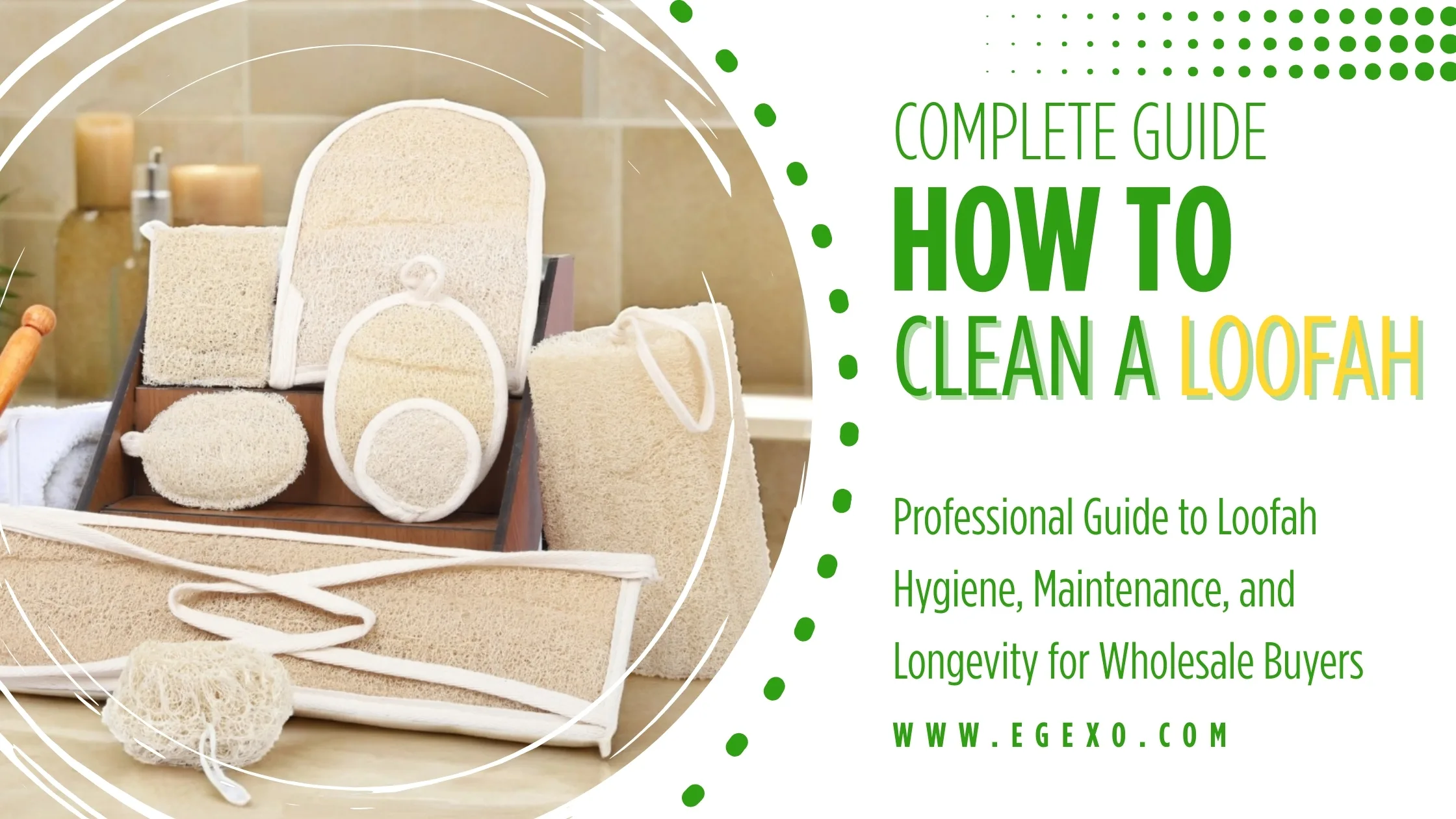
How to Clean a Loofah: The Complete Professional Guide to Loofah Hygiene, Maintenance, and Longevity for Wholesale Buyers
How to Clean a Loofah: Spa-Grade Care for Happy Customers Podcast:
Why Proper Loofah Cleaning Matters for Your Business Success
Understanding how to clean a loofah correctly represents a critical knowledge area for retailers, distributors, and wholesale buyers in the bath and body products industry. Proper loofah maintenance directly impacts customer satisfaction, product performance, repeat purchases, and your business reputation. When customers receive guidance on maintaining their natural loofah sponges, they experience better results, enjoy longer product lifespans, and become loyal advocates for your brand.
Natural loofah sponges have surged in popularity as consumers increasingly seek sustainable alternatives to plastic bath accessories. The global natural and organic personal care market reached 15.98 billion dollars in 2024 and continues growing at 9.4% annually. As a B2B buyer, providing comprehensive loofah care education differentiates your offering and adds value beyond the product itself.
This professional guide delivers the definitive resource on how to clean a loofah, covering everything from daily maintenance protocols to advanced sanitation techniques. Whether you stock natural body loofahs, kitchen loofah scrubbers, or specialty grooming products, this information empowers you to educate your customers effectively while positioning your business as a trusted authority.
Understanding loofah cleaning becomes particularly important when you consider that improper maintenance represents the primary reason customers discontinue loofah use. When you equip customers with proper care knowledge, you transform single purchases into long-term product relationships that drive recurring revenue.
Understanding Loofah Sponge Composition and Hygiene Requirements
What Makes Natural Loofah Different from Synthetic Alternatives
Natural loofah sponges are derived from the fibrous interior of the mature Luffa aegyptiaca gourd, creating a complex organic structure with unique maintenance requirements. Unlike synthetic nylon or silicone alternatives, natural loofah is a plant-based material that requires specific care protocols to maintain optimal hygiene and performance.
The porous fiber structure of natural Egyptian loofah creates exceptional exfoliating properties while also creating spaces where moisture, dead skin cells, and bacteria can accumulate if not properly maintained. Understanding this structural reality explains why regular cleaning protocols are essential rather than optional.
Natural loofah contains inherent antimicrobial properties that synthetic alternatives lack. The organic fibers naturally resist certain bacterial growth, providing a hygiene advantage when properly maintained. However, these benefits only manifest with appropriate cleaning practices.
Why Loofah Hygiene Matters for Customer Satisfaction and Safety
Research indicates that bathroom accessories harbor significant bacterial populations when not properly maintained. A study examining bath sponges found that inadequately cleaned products can contain bacteria levels comparable to kitchen sponges, creating potential skin irritation and hygiene concerns.
For wholesale buyers, customer education about proper loofah cleaning directly impacts:
Product Performance Perception: Clean loofahs maintain optimal texture and exfoliation effectiveness, ensuring customers experience the quality benefits your brand promises.
Safety and Skin Health: Proper sanitation prevents bacterial accumulation that could cause skin irritation, particularly important for customers with sensitive skin or compromised skin barriers.
Product Longevity: Appropriately maintained natural loofahs last 8-12 weeks, delivering strong value propositions that justify premium pricing and generate positive reviews.
Customer Retention: When customers achieve excellent results through proper product care, they become repeat purchasers and brand advocates who reduce your customer acquisition costs.
Brand Reputation: Providing comprehensive care instructions demonstrates your commitment to customer success beyond the initial sale, building trust that supports long-term business relationships.
How to Clean a Loofah: Daily Maintenance Best Practices
Essential After-Use Cleaning Protocol
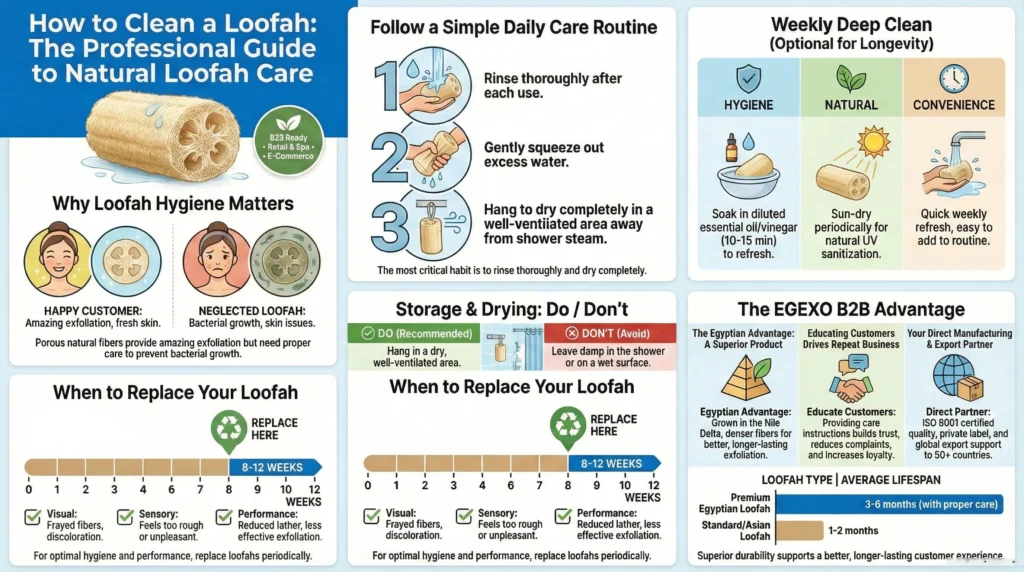
Proper loofah cleaning begins immediately after each use. This consistent daily maintenance prevents bacterial accumulation and extends product lifespan significantly. Here is the professional protocol to share with your customers:
Step 1: Thorough Rinsing
After completing body washing or exfoliation, rinse the natural loofah sponge thoroughly under running water. The goal is removing all soap residue, body oils, and dead skin cells that accumulated during use. Spend at least 30-45 seconds rinsing, working your fingers through the loofah fibers to ensure complete cleansing.
Step 2: Physical Agitation
While rinsing, squeeze and manipulate the loofah repeatedly to force water through all fiber layers. This mechanical action dislodges particles trapped within the porous structure. Continue until the water running through the loofah appears completely clear.
Step 3: Excess Water Removal
After thorough rinsing, squeeze the loofah firmly multiple times to remove as much water as possible. Excess moisture creates breeding grounds for bacteria and mold, so aggressive water removal is critical. The loofah should feel damp but not dripping when finished.
Step 4: Proper Drying Position
Hang the loofah in a well-ventilated area where air circulates freely around all surfaces. Never leave loofahs sitting in shower caddies, on tub edges, or in enclosed spaces where moisture persists. Optimal drying locations include:
Shower hooks positioned away from direct water spray
Towel bars with good air circulation
Dedicated drying racks near windows or ventilation
Bathroom doors or cabinet handles in ventilated areas
The loofah should dry completely between uses, typically requiring 4-6 hours in properly ventilated bathrooms. Complete drying prevents bacterial and mold growth that compromises hygiene and product integrity.
The 30-Second Daily Cleaning Habit
For customers seeking maximum convenience, recommend the quick daily cleaning method that takes just 30 seconds:
Rinse thoroughly under hot running water for 20 seconds while squeezing repeatedly, then shake vigorously to remove excess water, and hang immediately in the ventilated drying location. This streamlined approach provides adequate daily maintenance when combined with deeper weekly sanitization.
How to Deep Clean a Loofah: Weekly Sanitization Methods
Method 1: Bleach Solution Deep Cleaning
Weekly deep sanitization eliminates bacterial accumulation that daily rinsing cannot fully address. The bleach solution method provides hospital-grade disinfection suitable for natural loofah sponges:
Preparation and Mixing:
Combine 1 part regular household bleach (5-6% sodium hypochlorite) with 10 parts water in a clean bucket or large bowl. For example, mix 1/4 cup bleach with 2.5 cups water. This dilution ratio provides effective sanitization without damaging natural loofah fibers.
Soaking Process:
Submerge the loofah completely in the bleach solution, ensuring all surfaces contact the disinfectant. Soak for exactly 5 minutes. Longer soaking times can degrade the natural fibers and reduce product lifespan.
Thorough Rinsing:
After the 5-minute soak, remove the loofah and rinse exhaustively under running water for at least 2 minutes. The goal is complete bleach removal, as residual bleach can cause skin irritation. Continue rinsing until no chlorine odor remains.
Complete Drying:
Squeeze firmly to remove excess water, then hang in a well-ventilated area to air dry completely before next use. The loofah should dry within 4-6 hours.
Safety Considerations:
Perform bleach sanitization in well-ventilated areas, avoid mixing bleach with other cleaning products, wear gloves if you have sensitive skin, and keep bleach solutions away from colored towels or clothing.
Method 2: Vinegar Solution Natural Sanitization
For customers preferring natural cleaning methods or those concerned about chemical exposure, white vinegar provides effective sanitization:
Solution Preparation:
Mix 1 part white distilled vinegar with 2 parts water. For example, combine 1 cup vinegar with 2 cups water in a clean container.
Soaking Protocol:
Submerge the loofah completely and soak for 10-15 minutes. Vinegar’s acidity creates an environment hostile to bacterial growth while being gentle on natural fibers.
Rinsing and Drying:
Rinse thoroughly under running water for 60-90 seconds to remove vinegar odor, squeeze out excess water, and hang to dry completely in a ventilated area.
Effectiveness Considerations:
While vinegar provides good sanitization, it is slightly less effective than bleach solutions for eliminating all bacterial species. However, for most household applications, vinegar sanitization proves perfectly adequate when performed consistently.
Method 3: Boiling Water Sterilization
Boiling provides chemical-free sanitization through heat sterilization:
Process:
Bring a large pot of water to a rolling boil, submerge the loofah completely, and boil for 5 minutes. Remove carefully using tongs, rinse briefly under cool water, and hang to dry.
Important Limitations:
Frequent boiling can accelerate natural fiber degradation, reducing loofah lifespan. Reserve this method for occasional deep cleaning rather than weekly use, or alternate with gentler methods.
Method 4: Tea Tree Oil Antimicrobial Treatment
Tea tree oil offers natural antimicrobial properties appealing to wellness-focused customers:
Preparation:
Add 10-15 drops of pure tea tree essential oil to a bowl containing 2 cups of warm water. Submerge the loofah and soak for 10 minutes, then rinse lightly and hang to dry.
Benefits:
Tea tree oil provides antimicrobial action while leaving a pleasant natural scent. This method works well between deeper sanitization treatments.
Method 5: Dishwasher Sanitization
Modern dishwashers offer convenient loofah sanitization:
Process:
Place the loofah on the top rack of an empty dishwasher, run a normal hot cycle without detergent, and remove promptly when complete to air dry.
Considerations:
Ensure the loofah is secure and cannot fall onto heating elements. This method provides excellent sanitization through high heat and strong water pressure.
Comparison of Loofah Cleaning Methods
| Method | Effectiveness | Fiber Impact | Convenience | Cost | Best For |
|---|---|---|---|---|---|
| Bleach Solution | Excellent (99%+) | Low (proper dilution) | Moderate | Very Low | Maximum sanitization |
| Vinegar Solution | Good (85-90%) | Very Low | High | Very Low | Natural preference |
| Boiling Water | Excellent (99%+) | Moderate | Low | Very Low | Occasional deep clean |
| Tea Tree Oil | Good (80-85%) | Very Low | High | Moderate | Natural antimicrobial |
| Dishwasher | Excellent (95%+) | Low | Very High | Low | Maximum convenience |
Advanced Loofah Maintenance: Extending Product Lifespan and Performance
Optimal Storage Strategies Between Uses
Proper loofah storage between uses dramatically impacts hygiene and longevity. Educate customers on these professional storage best practices:
Ventilation Requirements:
Natural loofah requires constant air circulation to prevent moisture accumulation. Store in areas with good airflow, never in enclosed shower caddies, plastic bags, or sealed containers.
Humidity Management:
Bathrooms naturally contain high humidity levels. When possible, remove loofahs from bathrooms between uses, storing them in bedrooms or other lower-humidity areas. If bathroom storage is necessary, position near windows, exhaust fans, or other ventilation sources.
Light Exposure:
While not critical, indirect natural light can help inhibit bacterial growth. Position storage locations where loofahs receive ambient daylight without direct sun exposure that could cause excessive drying and fiber brittleness.
Separation from Contaminated Surfaces:
Never allow loofahs to contact toilet areas, trash receptacles, or floor surfaces. Maintain dedicated hanging locations at least 3 feet from toilets.
Recognizing When to Replace Your Loofah
Even with excellent maintenance, natural loofah sponges require periodic replacement to maintain optimal hygiene and performance. Share these replacement indicators with customers:
Visual Indicators:
Dark discoloration or persistent staining despite cleaning, visible mold growth (black, green, or pink spots), fiber breakdown creating thin or weak sections, and significant size reduction from original dimensions all signal replacement time.
Textural Changes:
Excessive softness or mushiness when dry, brittle fibers that break during use, reduced scrubbing effectiveness, and rough or uneven surfaces indicate the loofah has exceeded optimal lifespan.
Odor Development:
Persistent musty or unpleasant odors that remain after deep cleaning signal bacterial colonization beyond salvageable levels, requiring replacement.
Time-Based Guidelines:
With proper maintenance, natural Egyptian loofah typically maintains optimal performance for 8-12 weeks. Establish replacement schedules based on use frequency. Daily users should replace every 6-8 weeks, while occasional users may extend to 10-12 weeks.
Special Maintenance for Different Loofah Applications
Different loofah uses require modified maintenance approaches:
Body Exfoliation Loofahs:
Follow standard cleaning protocols with weekly deep sanitization. These loofahs contact skin directly, requiring strict hygiene maintenance.
Kitchen Scrubbing Loofahs:
Sanitize after each use when cleaning dishes with raw meat, poultry, or seafood residue. Weekly bleach sanitization is essential for kitchen loofahs due to food safety requirements.
Pet Grooming Loofahs:
Deep clean after every grooming session, as pet hair and dander create bacterial growth conditions. Consider more frequent replacement schedules (4-6 weeks) for pet grooming loofahs.
Facial Loofahs:
Use gentler cleaning methods (vinegar or tea tree oil) to avoid harsh chemical residues on products contacting facial skin. Replace more frequently (4-6 weeks) due to facial skin sensitivity.
Professional Guidance for B2B Buyers: Customer Education Strategies
Creating Value Through Loofah Care Education
As a wholesale buyer or retailer, providing comprehensive loofah care education creates competitive advantages that drive customer loyalty and increase lifetime value. Consider these B2B strategies:
Printed Care Instructions:
Include professionally designed care instruction cards with every loofah purchase. These materials should cover daily cleaning, weekly sanitization, storage guidance, and replacement timelines. Investment in quality educational materials positions your brand as customer-focused and knowledgeable.
Digital Content Library:
Develop video tutorials, blog posts, and social media content demonstrating proper loofah cleaning techniques. This content serves multiple purposes including customer education, SEO benefits, and social proof of your expertise.
Email Automation Sequences:
Create automated email series delivering care tips at strategic intervals: immediately after purchase, one week later with deep cleaning reminders, at 6 weeks with maintenance advice, and at 10 weeks suggesting replacement with promotional incentive.
Staff Training Programs:
Ensure sales staff understand proper loofah maintenance and can confidently educate customers. Knowledgeable staff create trust and position your business as an industry authority.
Custom Private Label Opportunities:
For businesses offering private label loofahs, incorporate branded care instructions and positioning that emphasizes your commitment to customer success through comprehensive product support.
Addressing Common Customer Concerns About Loofah Hygiene
Professional buyers should prepare responses to frequent customer questions and concerns:
Concern: “Won’t bacteria grow no matter what I do?”
Response: Natural loofah fibers possess inherent antimicrobial properties. With proper daily rinsing and weekly sanitization, bacterial growth remains minimal and well within safe levels. Research shows properly maintained natural loofahs are as hygienic as washcloths with similar care protocols.
Concern: “This seems like too much work.”
Response: Daily maintenance takes just 30 seconds of thorough rinsing and hanging to dry. Weekly deep cleaning requires 5 minutes. This minimal time investment extends product life and ensures optimal performance, providing excellent value for the small maintenance requirement.
Concern: “How does natural loofah compare to synthetic alternatives for cleanliness?”
Response: Natural loofah’s antimicrobial properties and ability to dry completely between uses actually provides hygiene advantages over synthetic nylon poufs that retain moisture and lack natural antimicrobial characteristics. Additionally, natural loofah is biodegradable and environmentally sustainable, while synthetic alternatives contribute to microplastic pollution.
The Egyptian Loofah Advantage: Superior Quality Simplifies Maintenance
Why Egyptian Natural Loofah Requires Less Intensive Maintenance
Premium Egyptian loofah cultivated in the Nile Delta region demonstrates structural characteristics that facilitate easier maintenance compared to lower-grade alternatives:
Optimal Fiber Density:
Egyptian loofah exhibits balanced fiber density that allows thorough rinsing and rapid drying. Lower-quality loofahs with irregular density trap moisture and debris, requiring more aggressive cleaning protocols.
Superior Structural Integrity:
High-quality Egyptian loofah maintains consistent structure through repeated cleaning cycles. Inferior alternatives develop weak sections and breakage that create bacterial hiding places difficult to clean effectively.
Natural Antimicrobial Properties:
Premium Egyptian loofah contains higher concentrations of natural compounds with antimicrobial characteristics, providing additional protection between cleanings.
Quick-Drying Characteristics:
The optimal pore structure of Egyptian loofah facilitates rapid moisture evaporation, reducing the time window for bacterial colonization. Quality loofahs dry in 4-6 hours, while inferior products may require 12+ hours.
EGEXO Quality Standards Supporting Customer Success
EGEXO maintains rigorous quality control throughout the farm-to-export process, ensuring every natural loofah delivers the structural characteristics that simplify maintenance:
Selective Harvesting:
EGEXO harvests loofah gourds only at peak maturity when fiber development is complete, ensuring maximum durability and optimal structural characteristics.
Thorough Initial Processing:
Professional cleaning and seed removal during manufacturing eliminates potential bacterial sources, providing customers with pristine products requiring only maintenance cleaning rather than remediation of processing deficiencies.
ISO Quality Certification:
EGEXO’s ISO-certified quality management systems ensure consistent product standards across all orders, eliminating the quality variations that create customer satisfaction issues.
Graded Product Selection:
EGEXO grades all loofah products by size, texture, and quality characteristics, allowing wholesale buyers to select optimal products for specific customer segments and applications.
For wholesale buyers seeking natural loofah that simplifies customer care protocols while delivering superior performance, Egyptian loofah from EGEXO represents the optimal sourcing solution.
Building Your Natural Loofah Business with EGEXO: Wholesale Partnership Benefits
Comprehensive B2B Support for Market Success
EGEXO provides wholesale buyers with the resources and expertise needed to build successful natural loofah businesses:
No Minimum Order Quantities:
Unlike traditional wholesalers requiring large minimum orders, EGEXO accommodates businesses at every scale. Test new product lines with small initial orders, then scale as market response warrants.
Expert Product Selection Guidance:
EGEXO’s team provides consultation on optimal product mixes for specific market segments, customer demographics, and business models. This expertise helps new buyers avoid costly inventory mistakes.
Custom Educational Materials:
Wholesale partners can access customizable care instruction templates, product information sheets, and marketing materials that simplify customer education while reinforcing brand positioning.
Quality Guarantee:
EGEXO backs every shipment with quality guarantees ensuring your business never faces customer satisfaction issues due to product deficiencies.
Flexible Private Label Programs:
Build brand equity with custom private label loofahs featuring your branding, custom packaging, and tailored product specifications.
Starting Your Wholesale Partnership
Beginning your natural loofah business with EGEXO follows a straightforward process:
Step 1: Sample Evaluation
Request product samples to personally assess quality and evaluate market fit. Sample programs allow thorough evaluation before larger commitments.
Step 2: Catalog Review
Download the comprehensive product catalog to explore the full range of natural loofah products, sizes, and specifications available.
Step 3: Customized Quotation
Submit a quotation request detailing your specific requirements, quantities, and timeline to receive personalized pricing and terms.
Step 4: Expert Consultation
Schedule a consultation with EGEXO’s team to discuss business goals, receive product recommendations, and optimize your market entry strategy.
Step 5: Order Placement
Complete your initial order with confidence, supported by EGEXO’s quality guarantees and comprehensive customer support.
Frequently Asked Questions: How to Clean a Loofah Properly
How often should you clean a loofah sponge?
You should rinse your natural loofah thoroughly after every single use to remove soap residue, dead skin cells, and body oils. This daily maintenance takes just 30 seconds but prevents bacterial accumulation. Additionally, perform deep sanitization using bleach solution, vinegar solution, or boiling water once weekly to eliminate bacteria that daily rinsing cannot fully address. This combination of daily maintenance and weekly deep cleaning ensures optimal hygiene and extends loofah lifespan to 8-12 weeks. Customers using loofahs daily should follow this protocol strictly, while occasional users may extend deep cleaning to every 10-14 days if daily rinsing is thorough.
Can you clean a loofah in the washing machine or dishwasher?
Yes, you can clean natural loofah sponges in the dishwasher effectively. Place the loofah securely on the top rack and run a normal hot cycle without detergent. The high temperature and strong water pressure provide excellent sanitization. Remove promptly when the cycle completes and hang to air dry completely. However, avoid cleaning loofahs in washing machines, as the agitation can damage the natural fibers and cause premature breakdown. The dishwasher method works well as a weekly deep cleaning alternative to bleach or vinegar soaking, offering maximum convenience while maintaining proper hygiene standards.
What is the best way to disinfect a loofah naturally without bleach?
The most effective natural loofah disinfection method without bleach uses white distilled vinegar. Mix 1 part vinegar with 2 parts water in a clean container. Submerge your loofah completely and soak for 10-15 minutes. The acidic environment kills most bacteria while being gentle on natural fibers. After soaking, rinse thoroughly under running water for 60-90 seconds to remove vinegar odor, squeeze out excess water, and hang to dry in a well-ventilated area. Alternative natural methods include tea tree oil (10-15 drops in 2 cups warm water, soak 10 minutes) or boiling water sterilization (5 minutes). For maximum natural disinfection, alternate between vinegar and tea tree oil methods weekly.
How do you know when to replace your loofah?
Replace your natural loofah when you observe visual indicators including dark discoloration that persists despite cleaning, visible mold growth showing black, green, or pink spots, fiber breakdown creating thin or weak sections, or significant size reduction from original dimensions. Textural changes also signal replacement time, such as excessive softness or mushiness when dry, brittle fibers that break during use, reduced scrubbing effectiveness, or rough uneven surfaces. Additionally, persistent musty or unpleasant odors remaining after deep cleaning indicate bacterial colonization beyond salvageable levels. Even without these warning signs, replace natural loofahs every 8-12 weeks with proper maintenance, or every 6-8 weeks with daily use, to ensure optimal hygiene and performance.
Why does my loofah smell bad even after cleaning?
Persistent loofah odor despite cleaning typically indicates one of three issues. First, inadequate drying between uses allows bacterial and mold growth that produces musty odors. Ensure your loofah dries completely in 4-6 hours by hanging in well-ventilated areas with good air circulation. Second, insufficient rinsing after use leaves soap residue, dead skin cells, and body oils that decompose and create odors. Spend 30-45 seconds thoroughly rinsing after each use while squeezing repeatedly to flush debris. Third, the loofah may have reached the end of its useful life if bacteria have colonized deeply within the fiber structure beyond surface cleaning reach. Perform immediate deep sanitization using bleach solution (1 part bleach to 10 parts water, soak 5 minutes) or boiling water (5 minutes). If odor persists after deep cleaning, replace the loofah immediately.
Can you use the same loofah for your body and face?
No, you should not use the same loofah for both body and face due to hygiene concerns and texture appropriateness. Body loofahs contain bacteria, oils, and dead skin cells even with proper cleaning, which should not contact the more sensitive and vulnerable facial skin. Additionally, body loofahs typically feature rougher textures appropriate for body exfoliation but too aggressive for delicate facial tissue. Instead, use dedicated facial loofahs or konjac sponges specifically designed for facial skin sensitivity. If you must use natural loofah on your face, select soft-textured varieties, designate specific loofahs exclusively for facial use, clean after every use with gentle natural methods like vinegar solution, replace every 4-6 weeks rather than the standard 8-12 weeks, and use extremely gentle pressure during application.
How long does a natural loofah last with proper cleaning?
A high-quality natural Egyptian loofah with proper maintenance lasts 8-12 weeks before requiring replacement. Proper cleaning practices directly impact lifespan by preventing premature fiber breakdown and maintaining structural integrity. Daily thorough rinsing and complete drying between uses, combined with weekly deep sanitization using bleach solution, vinegar, or boiling water, ensures maximum longevity. Premium Egyptian loofahs from quality suppliers like EGEXO demonstrate superior durability compared to lower-grade alternatives due to optimal fiber structure and processing standards. Users with daily bathing habits should expect 6-8 week lifespans, while those bathing every other day may achieve 10-12 weeks. Factors reducing lifespan include inadequate rinsing allowing buildup accumulation, incomplete drying promoting bacterial growth and fiber degradation, excessive harsh cleaning like over-boiling, and storage in high-humidity environments without proper ventilation.
Key Takeaways: Essential Loofah Cleaning Insights for Professional Buyers
Daily Maintenance Prevents Hygiene Issues: Thorough rinsing after every use followed by complete drying in well-ventilated areas represents the single most important loofah care practice. This simple 30-second routine prevents 90% of potential bacterial accumulation and extends product lifespan significantly. Educating customers on consistent daily maintenance delivers better product experiences and reduces premature replacement complaints.
Weekly Deep Sanitization Ensures Optimal Hygiene: Supplementing daily maintenance with weekly deep cleaning using bleach solution (1:10 ratio, 5-minute soak), vinegar solution (1:2 ratio, 10-minute soak), or boiling water (5 minutes) eliminates bacterial growth that rinsing alone cannot address. Providing customers multiple sanitization options accommodates different preferences while ensuring proper hygiene standards.
Quality Determines Maintenance Ease: Premium Egyptian natural loofah from established suppliers like EGEXO requires less intensive maintenance due to superior fiber structure, optimal density, and quick-drying characteristics. Sourcing high-quality products reduces customer effort, improves satisfaction, and decreases support requirements while justifying premium pricing.
Customer Education Creates Competitive Advantage: Wholesale buyers who provide comprehensive loofah care education through printed instructions, digital content, and knowledgeable staff differentiate their offerings and build customer loyalty. Investment in educational materials transforms product sales into relationships that generate recurring revenue and positive word-of-mouth marketing.
Strategic Replacement Guidance Optimizes Customer Value: Helping customers recognize replacement indicators (8-12 week timeline, visual deterioration, persistent odors, textural changes) ensures they experience natural loofah at peak performance while creating predictable repurchase cycles that support business planning and inventory management.
Transform Your Natural Loofah Business with Egypt’s Premier Wholesale Supplier
Professional understanding of how to clean a loofah properly represents essential knowledge for wholesale buyers, retailers, and distributors in the natural bath and body products industry. Proper loofah maintenance education empowers your customers to achieve optimal results while extending product lifespan, creating satisfaction that drives loyalty and recurring revenue.
However, maintenance simplicity begins with product quality. Premium Egyptian natural loofah cultivated in the Nile Delta and processed to international standards requires less intensive care while delivering superior performance compared to lower-grade alternatives. The structural characteristics, antimicrobial properties, and quick-drying capabilities of quality loofah dramatically simplify maintenance protocols for end users.
EGEXO stands as the world’s leading Egyptian natural loofah wholesale supplier, combining 10 years of cultivation and export expertise with ISO-certified quality standards and comprehensive B2B support services. From raw loofah scrubbers to finished bath and body products, EGEXO provides the quality, reliability, and partnership that successful natural product businesses require.
Ready to elevate your natural loofah offerings with Egypt’s finest quality?
Request free product samples today and experience the EGEXO quality difference. Compare fiber structure, texture consistency, and drying characteristics against alternatives to understand why leading businesses worldwide choose Egyptian loofah.
Download the complete EGEXO wholesale catalog to explore the full range of natural loofah products, sizes, and customization options available for your business.
Get your personalized wholesale quotation tailored to your specific requirements, order volumes, and business objectives. EGEXO provides transparent pricing and flexible terms supporting your success.
Schedule an expert consultation to discuss your business goals, receive strategic product recommendations, and develop implementation plans for incorporating premium Egyptian loofah into your offerings.
Whether you operate retail stores, manage e-commerce brands, distribute bath products, or seek to launch natural loofah businesses, EGEXO delivers the products, expertise, and partnership needed for success. Join the growing community of businesses worldwide that have discovered the EGEXO advantage and transformed their natural product offerings with authentic Egyptian quality.
For additional industry insights and comprehensive loofah information, explore these authoritative resources:
Loofah Guide – Expert Maintenance and Care Information
Wholesale Loofah – Industry Standards and Best Practices
Learn more about EGEXO’s commitment to quality and discover why premium Egyptian natural loofah represents the optimal choice for businesses prioritizing customer satisfaction, sustainability, and long-term success in the growing natural personal care market.