

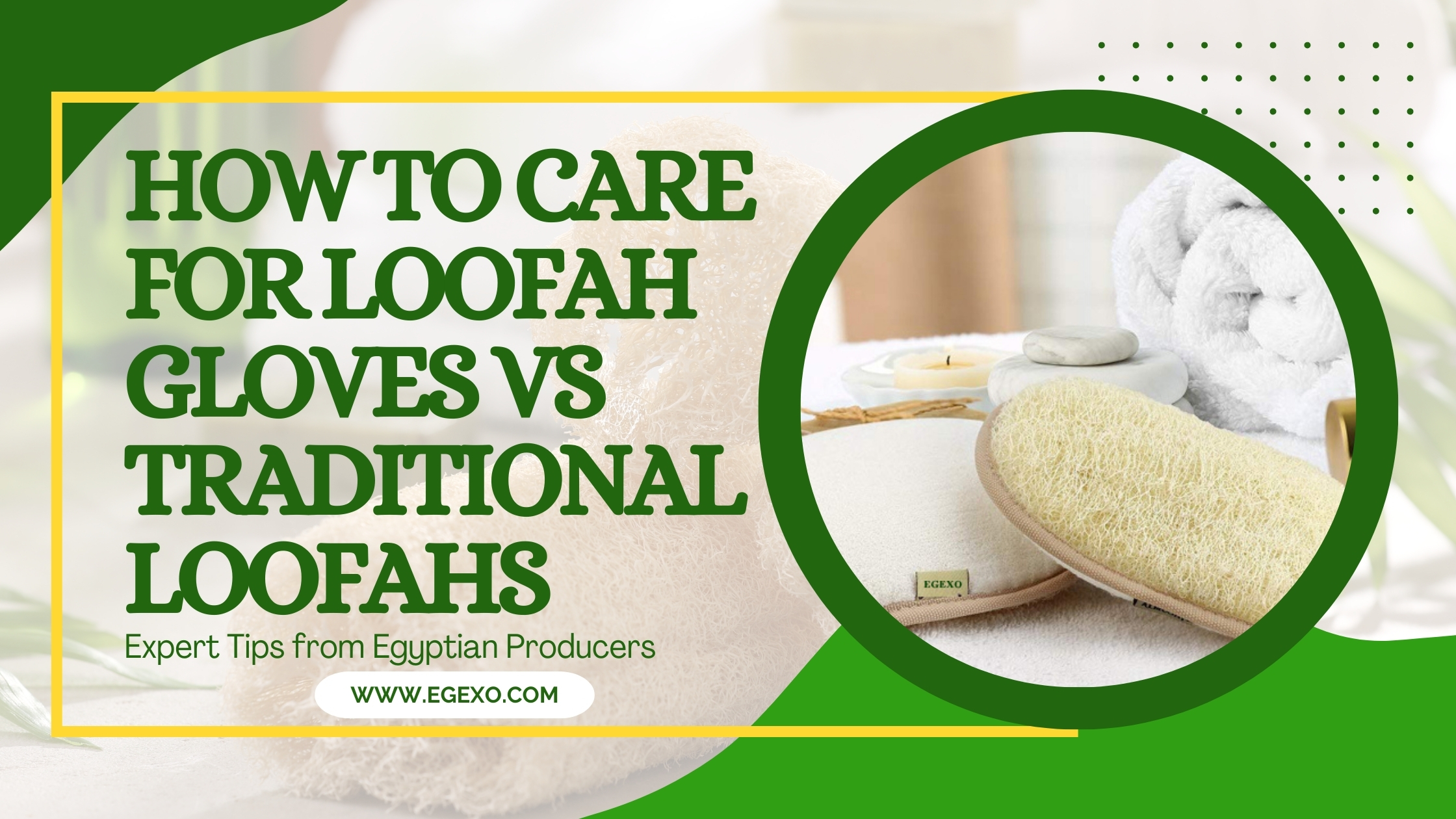
How to Care for Loofah Gloves vs Traditional Loofahs: Expert Tips from Egyptian Producers
A well-maintained natural loofah can last up to 60 percent longer than one that receives no routine care. That single fact matters whether you are running a spa with hundreds of units in rotation or keeping one loofah glove beside your shower. Knowing how to care for loofah gloves compared with traditional loofahs is the difference between a product that performs for months and one that breaks down in weeks.
Natural loofah products made from the Luffa aegyptiaca plant have been cultivated in the Nile Delta region of Egypt for generations. Egyptian loofah stands apart from other varieties because of its dense fiber structure, consistent quality, and extended usable life when given the right attention. Egexo, with over 25 years of loofah cultivation and export experience, has shipped millions of units to retailers, spa operators, and distributors across more than 30 countries. Through that experience, the company has gathered detailed knowledge about how different loofah formats respond to various care methods.
In this guide, you will find a complete breakdown of the care routines that keep loofah gloves and traditional loofahs in peak condition. You will also learn how fiber quality, product grade, and sourcing standards directly influence how much maintenance a product needs and how long it serves the end user. Whether you are evaluating wholesale loofah products for your business or simply want to get the most out of a loofah glove at home, this article covers the practical steps, the science behind them, and the quality benchmarks that matter.
Understanding the Structure of Loofah Gloves and Traditional Loofahs
Before you can properly care for loofah gloves, you need to understand how they differ from traditional loofah sponges at a structural level. Both come from the same plant, but the manufacturing process creates products with distinct care needs.
What Sets Loofah Gloves Apart
A loofah glove combines natural loofah fiber with a wearable fabric backing, usually cotton or a cotton blend. The loofah material is cut, flattened, and stitched onto the glove shape. This construction means the glove has two different materials working together, each with its own moisture behavior. The loofah side absorbs water and expands during use, while the fabric side retains moisture against the skin.
Because of this dual-material design, loofah gloves need a care routine that addresses both the natural fiber and the textile component. Neglecting either one leads to premature wear. For businesses offering body loofah products in their retail or spa lineup, understanding this structure helps when advising customers and reducing product returns.
Traditional Loofahs and Their Fiber Behavior
A traditional loofah, sometimes called a loofah sponge or loofah pad, is made entirely from the dried vascular skeleton of the Luffa plant. It has no fabric, adhesive, or synthetic blending in its natural state. The open cell structure of a quality traditional loofah allows water to pass through freely, which gives it a natural advantage in drying speed.
High-grade Egyptian loofahs, such as those produced through Egexo’s farm to export process, undergo careful seed selection, sun drying, and quality sorting. This produces fibers that are naturally more resistant to breakdown from repeated wetting and drying. The result is a product that, with proper care, maintains its exfoliating texture significantly longer than lower-grade alternatives.
Key Structural Differences That Affect Care
The core distinction is simple. Loofah gloves combine two materials, so they need care that accounts for both. Traditional loofahs are a single natural material, so their care focuses entirely on fiber preservation and hygiene. Both benefit enormously from proper drying, but the way you achieve that drying differs based on the product format.
How to Care for Loofah Gloves: A Daily and Weekly Routine
Learning to care for loofah gloves correctly takes very little extra effort once you have a system in place. The steps below are based on feedback from spa operators who manage large inventories and individual users who have tracked product lifespan over months of use.
Step 1: Rinse Thoroughly After Every Use
After each use, hold the loofah glove under clean running water and squeeze it several times. The goal is to remove all soap residue, dead skin cells, and any product buildup from both the loofah fiber and the fabric backing. Soap left in the fibers breaks them down over time and creates an environment where bacteria can grow.
For spa and hotel operators managing dozens or hundreds of gloves, this step is the single most impactful quality control measure. Staff training on post-use rinsing can reduce product replacement costs by up to 30 percent based on reports from Egexo’s wholesale partners.
Step 2: Shake Out Excess Water and Hang to Dry
After rinsing, shake the glove firmly three or four times to release trapped water from the fabric layer. Then hang it in a spot with good airflow. Avoid leaving loofah gloves flat on shower ledges or bunched up in a basket. The fabric backing traps moisture against the loofah fiber when the glove lays flat, which accelerates fiber softening.
Many retailers who carry loofah gloves find that including a small care card with the product reduces customer complaints. If you are interested in creating branded care materials for your product line, Egexo offers private label loofah manufacturing that includes packaging and insert customization.
Step 3: Deep Clean Weekly
Once a week, soak the loofah glove in a solution of warm water and white vinegar at a ratio of four parts water to one part vinegar. Let it soak for 15 to 20 minutes, then rinse and hang to dry. This removes buildup that daily rinsing misses and keeps the fibers firm.
An alternative method is to soak in a diluted hydrogen peroxide solution at 3 percent concentration for 10 minutes. This is the preferred method in many professional spa settings because it sanitizes without leaving a scent.
Step 4: Replace at the Right Time
Even with excellent care, loofah gloves have a functional lifespan. For daily personal use, plan to replace a loofah glove every 8 to 12 weeks. In commercial spa settings with heavier use, rotation cycles of 4 to 6 weeks are standard. The signs of a glove that needs replacing include persistent odor after cleaning, visible fiber thinning, or a noticeable drop in exfoliation texture.
Caring for Traditional Loofahs: Proven Methods from the Nile Delta
Traditional loofahs have been used in Egyptian baths for centuries, and the care techniques developed over that time remain effective today. The advantage of a pure natural loofah is that its open structure makes it relatively easy to clean and dry when you follow consistent habits.
Post-Use Care for Traditional Loofahs
After every use, rinse the traditional loofah under running water while squeezing it repeatedly. Because there is no fabric layer, water flows through the fibers much more freely. Give it a firm squeeze to expel as much water as possible, then hang it in a ventilated area.
Traditional loofahs dry fastest when hung rather than placed on a surface. A hook near a window or in a well-ventilated bathroom works well. In humid climates, consider moving the loofah outside the bathroom entirely between uses. Professional buyers evaluating raw loofah scrubbers for their product lines should note that fiber density directly affects drying speed, with higher-grade fibers drying faster due to more consistent cell structure.
Monthly Deep Sanitization
For traditional loofahs, a monthly deep clean extends usable life substantially. Boil a pot of water and submerge the loofah for 2 to 3 minutes. Remove it with tongs and let it cool before squeezing out the water. Boiling kills bacteria and briefly softens the fibers, which then firm back up as the loofah dries.
This boiling method is not recommended for loofah gloves because the fabric backing and stitching can degrade with repeated boiling. This is one of the most important care distinctions between the two product types.
Knowing When a Traditional Loofah Has Reached Its Limit
A well-cared-for traditional Egyptian loofah can last 3 to 6 months with regular personal use. Signs that it is time for a replacement include a slimy texture that does not go away after cleaning, a musty smell, visible dark spots in the fiber, or fibers that tear easily when pulled. In wholesale and retail settings, communicating this lifespan to end customers builds trust and encourages repeat purchases.
Loofah Gloves vs Traditional Loofahs: Complete Care Comparison
The following table outlines the specific care differences between loofah gloves and traditional loofahs across every major maintenance factor.
| Care Factor | Loofah Gloves | Traditional Loofahs |
|---|---|---|
| Post-Use Rinse | Required, must address both fiber and fabric | Required, water flows through open fiber easily |
| Recommended Drying Method | Hang with fingers spread to maximize airflow | Hang on hook in ventilated area |
| Average Drying Time | 4 to 6 hours depending on humidity | 2 to 4 hours depending on fiber density |
| Weekly Deep Clean | Vinegar soak or hydrogen peroxide soak | Vinegar soak or brief boiling |
| Monthly Sanitization | Hydrogen peroxide soak recommended | Boiling for 2 to 3 minutes |
| Lifespan with Proper Care (Personal Use) | 8 to 12 weeks | 12 to 24 weeks |
| Lifespan with Proper Care (Commercial Use) | 4 to 6 weeks | 6 to 12 weeks |
| Most Common Care Mistake | Laying flat after use, trapping moisture | Leaving in standing water or sealed container |
| Replacement Indicator | Fabric fraying, fiber thinning, persistent odor | Fiber tearing, dark spots, slimy texture |
| Safe for Boiling | No, damages fabric and stitching | Yes, up to 3 minutes |
This comparison makes it clear that while both products benefit from consistent care, their specific needs differ in important ways. Businesses that carry both formats should ensure their care instructions reflect these differences. For retailers looking to build a product line with both options, Egexo offers custom loofah product design services that include tailored care documentation.
Quality Grades and How They Influence Care Requirements
Not all loofahs are the same, and the grade of loofah you purchase has a direct impact on how much care it needs and how long it lasts. Egyptian loofah is widely recognized as the highest quality available globally, and within Egyptian production, there are still meaningful grade differences.
Understanding Loofah Quality Grades
Egexo classifies its loofah products according to strict quality standards that evaluate fiber density, color consistency, structural integrity, and cell uniformity. The table below shows how grade affects care and lifespan.
| Quality Grade | Fiber Density | Color Consistency | Average Lifespan (with care) | Care Intensity Needed |
|---|---|---|---|---|
| Premium A | High, uniform cells | Light golden, no discoloration | 5 to 6 months | Low, fibers resist buildup |
| Grade B | Medium-high density | Light to medium golden | 3 to 4 months | Moderate, weekly cleaning important |
| Grade C | Medium density, some variation | Variable, some darker patches | 2 to 3 months | Higher, more frequent deep cleaning |
| Utility Grade | Lower density, open structure | Variable | 1 to 2 months | Highest, degrades faster with moisture |
For wholesale buyers evaluating products for their market, this grading information is essential. A spa ordering premium-grade Egyptian loofah from a reliable supplier will spend less time and money on product rotation. Distributors and importers can review the full range in the Egexo product catalog to compare grades and minimum order quantities.
For individual consumers, the takeaway is straightforward. Investing in a higher-grade natural loofah from a reputable source like the Egexo shop means less maintenance effort and a longer-lasting product. The cost per use drops significantly when you factor in the extended lifespan of premium fiber.
Common Care Mistakes That Shorten Loofah Lifespan
Even people who know the basics of loofah care often make avoidable mistakes. The checklist below covers the most frequent errors seen across both consumer use and commercial settings.
Care Mistakes Checklist
| Mistake | Applies To | Why It Matters | How to Fix It |
|---|---|---|---|
| Storing in a sealed plastic bag | Both | Traps moisture, promotes bacterial growth | Always store in open air with ventilation |
| Using harsh chemical cleaners | Both | Breaks down natural fibers, removes beneficial texture | Use vinegar, hydrogen peroxide, or boiling only |
| Not replacing on schedule | Both | Worn loofahs harbor bacteria and lose exfoliation value | Follow lifespan guidelines based on product type |
| Sharing between users | Both | Transfers bacteria and skin cells | Each person should have their own loofah |
| Leaving in standing water | Traditional Loofahs | Causes fiber waterlogging and accelerated decay | Always hang after use, never leave submerged |
| Laying flat on wet surface | Loofah Gloves | Fabric backing traps moisture against fiber | Hang with fingers open to maximize drying |
| Machine washing on hot cycle | Loofah Gloves | Hot water and agitation damage stitching | Hand wash only or use cold gentle cycle |
| Wringing too aggressively | Both | Tears fibers and distorts shape | Squeeze firmly but do not twist |
Businesses that include this type of care information with their products see measurably better customer satisfaction scores. If you are a retailer or distributor, you can explore how Egexo supports partner businesses through the Why Choose Egexo page, which outlines the company’s commitment to quality and partner success.
Weekly and Monthly Maintenance Schedule
Consistency matters more than intensity when it comes to loofah care. The following schedule works for both personal users and commercial settings managing inventory.
| Timeframe | Loofah Gloves | Traditional Loofahs |
|---|---|---|
| After Every Use | Rinse under clean water, squeeze out soap, shake off excess, hang to dry | Rinse under clean water, squeeze firmly, hang in ventilated area |
| Every 3 Days | Check fabric backing for dampness, reposition if needed | Check for any slimy texture, re-rinse if present |
| Weekly | Soak in vinegar and water solution (1:4) for 15 to 20 minutes | Soak in vinegar and water solution (1:4) for 15 to 20 minutes |
| Every 2 Weeks | Inspect stitching for loose threads, trim if needed | Inspect for dark spots or soft patches |
| Monthly | Hydrogen peroxide soak (3 percent) for 10 minutes | Boil in clean water for 2 to 3 minutes |
| 8 to 12 Weeks | Replace (personal use) | Inspect condition, replace if showing wear |
| 12 to 24 Weeks | N/A, already replaced | Replace (personal use) |
For commercial operations running a large inventory, printing this schedule and posting it in staff areas ensures consistency. Businesses interested in building branded loofah product lines with integrated care instructions can request a quote from Egexo to discuss packaging and labeling options.
Why Egyptian Loofah Requires Less Maintenance Than Other Varieties
The origin of your loofah matters. Egyptian loofah, particularly from the Nile Delta region where Egexo operates its farms, benefits from ideal growing conditions including rich alluvial soil, consistent sun exposure, and traditional cultivation methods passed through generations.
These conditions produce fibers that are naturally denser and more uniform than loofah grown in other regions. Denser fibers resist moisture retention better, which means faster drying and less bacterial growth. They also maintain their exfoliating texture longer before softening, which extends the functional lifespan of every product.
According to quality assessments conducted across Egexo’s production facilities, Premium A grade Egyptian loofah maintains its structural integrity 40 to 60 percent longer than comparable products sourced from other growing regions. For wholesale buyers, this translates directly to fewer customer complaints, lower return rates, and stronger repeat purchase behavior.
For consumers interested in learning more about what makes Egyptian loofah the global standard, the Loofah Guide offers in-depth articles on sourcing, quality, and usage. Wholesale buyers can find supplier comparison tools and bulk purchasing resources at Wholesale Loofah.
If you want to test the difference firsthand before committing to a bulk order, Egexo offers a convenient way to request loofah samples shipped directly from their facilities in Egypt.
Expert Insight from Egexo
From the Production Floor: What 25 Years of Loofah Cultivation Taught Us About Care
After more than two decades of growing, processing, and exporting natural loofah, the most consistent feedback we hear from our partners is that care education transforms customer satisfaction. A spa in Germany reduced its loofah replacement budget by 35 percent simply by training staff on proper post-use drying. A retailer in the United States cut product returns in half by including a two-sentence care note on their packaging. The product itself matters enormously, and we invest heavily in quality at every stage from seed to shipment. But even the finest Egyptian loofah will underperform if it is stored wet or cleaned with the wrong solution. Our recommendation to every buyer, whether ordering 50 units or 50,000, is to treat care education as part of the product. When your customers know how to maintain their loofah properly, they get a better experience and they come back for more.
Frequently Asked Questions
Q1: How often should I replace a loofah glove compared to a traditional loofah?
A loofah glove used daily for personal bathing should be replaced every 8 to 12 weeks. A traditional loofah made from high-quality Egyptian fiber can last 12 to 24 weeks with proper care. The difference comes from the fabric component in loofah gloves, which wears out faster than natural loofah fiber alone. In commercial spa settings, both types need more frequent rotation due to heavier use.
Q2: Can I machine wash loofah gloves?
You can machine wash loofah gloves on a cold, gentle cycle, but hand washing is preferred. Hot water and aggressive agitation in a washing machine can damage the stitching that holds the loofah fiber to the fabric backing. If you do use a machine, place the glove in a mesh laundry bag and avoid the dryer entirely. Air drying preserves both the fiber and the fabric.
Q3: What is the best way to sanitize a traditional loofah?
The most effective method for sanitizing a traditional loofah is boiling it in clean water for 2 to 3 minutes once a month. For weekly cleaning, soaking in a solution of one part white vinegar to four parts warm water for 15 to 20 minutes removes buildup and inhibits bacterial growth. Avoid bleach or harsh chemical cleaners, as these break down the natural fiber structure.
Q4: What minimum order quantities does Egexo require for wholesale loofah gloves?
Egexo offers flexible minimum order quantities that vary by product type and customization level. Standard loofah gloves typically start at MOQs suitable for small retailers as well as large distributors. For specific MOQ details tailored to your business needs, the best step is to request a quote directly through the Egexo website or download the product catalog for a full overview of available options and specifications.
Q5: Why does Egyptian loofah last longer than loofah from other regions?
Egyptian loofah, especially varieties grown in the Nile Delta, benefits from rich alluvial soil, consistent sunlight, and traditional cultivation expertise. These conditions produce fibers with higher density and more uniform cell structure. Denser fibers dry faster, resist bacterial growth better, and maintain their exfoliating texture longer. Premium Egyptian loofah can outlast comparable products from other regions by 40 to 60 percent.
Q6: Can I use the same care routine for both loofah gloves and traditional loofahs?
The daily rinse and hang routine is similar for both, but the deep cleaning methods differ. Traditional loofahs can be boiled for sanitization, while loofah gloves cannot because boiling damages the fabric and stitching. Loofah gloves should be deep cleaned with vinegar or hydrogen peroxide soaks instead. Following the right method for each product type is essential to getting the longest possible lifespan.
Q7: How should retailers advise customers on caring for loofah gloves?
Retailers should include a brief care card with each loofah glove purchase. The three most important points to communicate are to rinse after every use, hang to dry rather than laying flat, and replace every 8 to 12 weeks. This simple guidance significantly reduces customer complaints and product returns. Egexo offers private label services that include custom care card design as part of the packaging process.
Q8: Are loofah gloves or traditional loofahs more hygienic?
Neither format is inherently more hygienic than the other when cared for properly. Traditional loofahs have the advantage of faster drying due to their open fiber structure. Loofah gloves have the advantage of easier handling during use, which can encourage more thorough rinsing. The most important hygiene factor for both products is consistent care, specifically rinsing after use, drying completely, and replacing on schedule.
Conclusion
Caring for loofah gloves and traditional loofahs comes down to understanding how each product is built and what it needs to stay clean, firm, and effective. The materials differ, the drying behaviors differ, and the deep cleaning methods differ. But the underlying principle is the same for both: consistent care after every use is the foundation of product longevity.
Quality matters just as much as care. Premium Egyptian loofah fiber, sourced from the Nile Delta and processed to exacting standards, gives every product a head start in durability and performance. When you combine the best raw material with the right maintenance habits, you get a natural body care product that delivers real value over its full lifespan.
Key Takeaways:
- Loofah gloves need special attention to their fabric backing and should never be boiled. Replace every 8 to 12 weeks with daily use.
- Traditional loofahs dry faster and can be boiled monthly for deep sanitization. They last 12 to 24 weeks with proper care.
- Higher-grade Egyptian loofah fibers require less maintenance and last significantly longer than lower-grade alternatives.
- Including care education with your loofah products, whether you are a retailer, spa operator, or individual buyer, improves satisfaction and extends product life.
- Sourcing from a trusted Egyptian supplier like Egexo ensures consistent quality that responds well to standard care routines.
Ready to experience Egyptian loofah quality?
- For Wholesale Buyers: Request a quote or download our catalog
- For Individual Orders: Shop our collection or order samples