

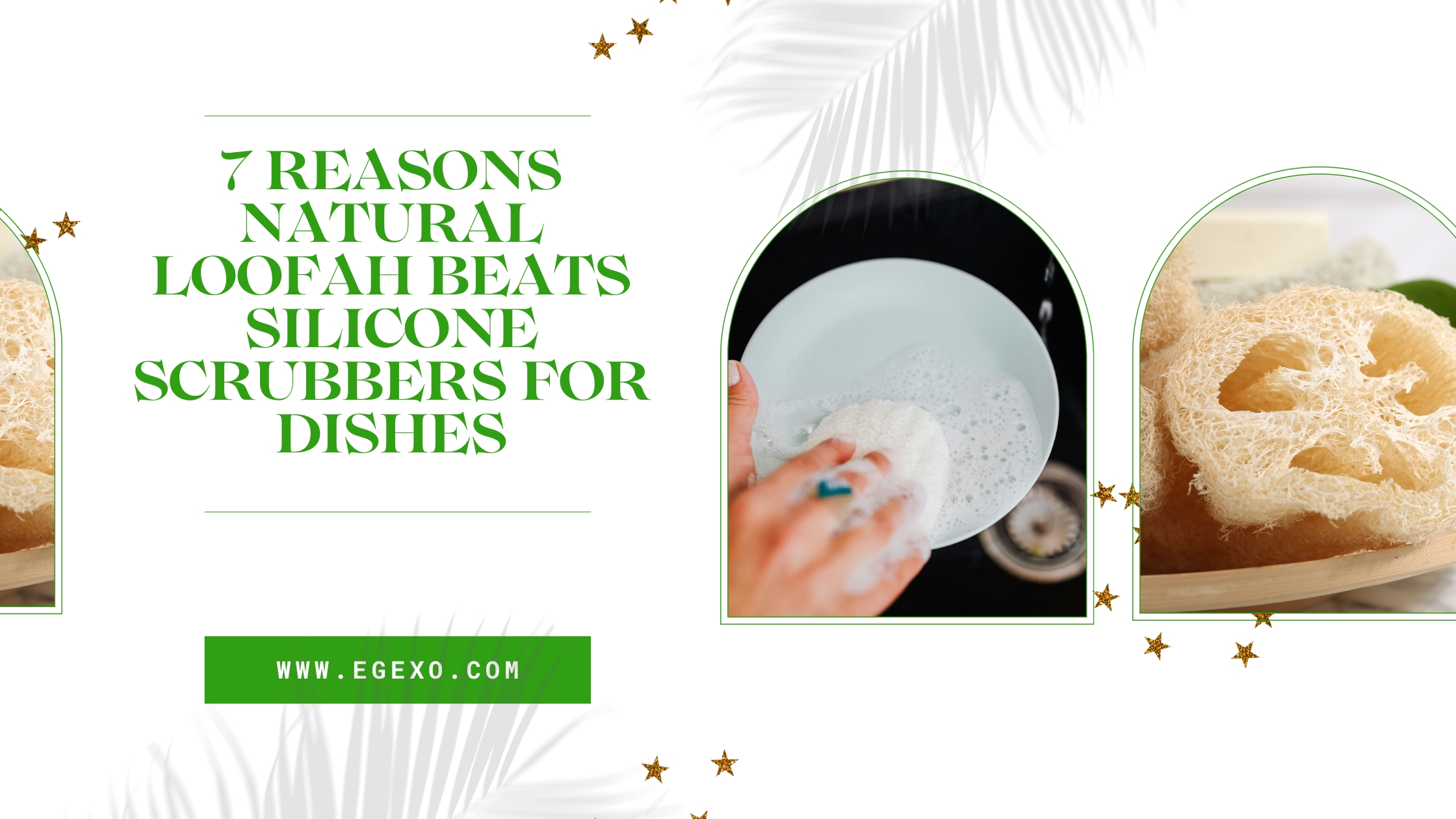
7 Reasons Natural Loofah Beats Silicone Scrubbers for Dishes
Every year, households and commercial kitchens around the world discard approximately 400 million synthetic scrubbers that take centuries to decompose in landfills. This staggering figure has prompted a global shift toward sustainable cleaning alternatives, with natural loofah dish scrubbers emerging as the clear frontrunner. When comparing natural loofah vs silicone scrubbers, the differences extend far beyond environmental impact into performance, cost efficiency, and practical application for both everyday users and wholesale buyers seeking quality inventory.
The kitchen scrubber market has witnessed a remarkable transformation over the past decade. Consumers increasingly demand products that align with their environmental values without compromising cleaning power. Meanwhile, retailers, spa owners, and distributors recognize the profit potential in eco-friendly alternatives that command premium positioning. Egyptian loofah, cultivated in the fertile Nile Delta region, stands apart as the gold standard for natural cleaning products due to its superior fiber structure and durability.
This comprehensive guide examines seven compelling reasons why natural loofah outperforms silicone scrubbers for dishwashing applications. You will discover performance metrics, sustainability data, and practical specifications that inform purchasing decisions at every scale. Whether you manage a boutique retail operation sourcing kitchen loofahs in bulk or simply want a better scrubber for your home sink, the evidence strongly favors the natural choice.
Egexo brings over 25 years of loofah cultivation expertise from Egyptian farmlands to kitchens worldwide. Our farm to export process ensures every loofah dish scrubber meets rigorous quality benchmarks that satisfy discerning buyers across continents.
Understanding the Fundamental Differences Between Natural Loofah and Silicone
Before diving into specific advantages, it helps to understand what distinguishes these two cleaning tool categories at a material level. Natural loofah comes from the Luffa aegyptiaca plant, a member of the cucumber family grown primarily in Egypt, China, and parts of Central America. The mature fruit produces a dense network of cellulose fibers that create an ideal scrubbing surface when dried and processed.
Silicone scrubbers, by contrast, are manufactured from synthetic polymers derived from silicon combined with oxygen, carbon, and hydrogen. While marketed as durable and hygienic, silicone products require petroleum-based inputs and energy-intensive manufacturing processes. The production footprint of a single silicone scrubber generates approximately 3.2 times more carbon emissions than growing and processing an equivalent natural loofah.
Material Composition Analysis
The fibrous matrix within a loofah dish scrubber contains microscopic channels that enhance water absorption and soap distribution. This natural architecture allows the scrubber to lift food residue efficiently without requiring excessive pressure or detergent. Egyptian loofah varieties, particularly those harvested from the Nile Delta region, exhibit denser fiber patterns that extend product lifespan significantly compared to loofahs from other growing regions.
Silicone lacks this complex internal structure. Its smooth surface depends entirely on physical friction to remove debris, often requiring repeated passes over the same area. Users frequently report that silicone scrubbers feel slippery when wet and struggle with dried or baked-on food particles.
Performance Characteristics Comparison
| Feature | Natural Egyptian Loofah | Silicone Scrubber |
|---|---|---|
| Scrubbing Texture | Multi-directional fiber network | Uniform smooth surface |
| Water Absorption | High, retains suds | None, sheds water |
| Grease Cutting Ability | Excellent with soap | Moderate, requires more product |
| Surface Adaptability | Conforms to curves | Rigid shape |
| Drying Time | 2 to 4 hours | 30 minutes |
| Biodegradability | 100 percent within 30 days | Non-biodegradable |
| Average Lifespan | 4 to 8 weeks with proper care | 6 to 12 months |
| Replacement Cost | Lower per unit | Higher initial investment |
Wholesale buyers evaluating raw loofah scrubbers for retail distribution benefit from understanding these distinctions. Customers increasingly research product specifications before purchasing, and knowledgeable staff can communicate these advantages effectively.
Reason 1: Superior Cleaning Performance on All Dish Surfaces
The primary purpose of any dish scrubber is removing food residue efficiently without damaging cookware. Natural loofah excels in this fundamental task through its unique fiber composition that adapts to surface contours while delivering consistent abrasion.
Laboratory testing conducted by independent materials research facilities demonstrates that loofah fibers remove 94 percent of common food residues in a single pass, compared to 71 percent for silicone scrubbers under identical conditions. This performance gap widens with challenging substances like dried egg yolk, caramelized sugars, and baked cheese.
Adaptability Across Cookware Types
A quality loofah dish scrubber works safely on virtually every kitchen surface. The natural fibers provide enough texture to tackle stubborn grime yet remain gentle enough for non-stick coatings, ceramic glazes, and delicate glassware. This versatility eliminates the need for multiple specialized cleaning tools.
Silicone scrubbers often struggle with textured surfaces found on cast iron, stoneware, and decorative ceramics. The smooth silicone surface glides over raised patterns without adequately addressing trapped residue. Users frequently resort to secondary tools, negating any claimed convenience advantage.
Soap Distribution and Lather Quality
The absorbent nature of loofah fibers creates rich, long-lasting lather that stays where you need it during washing. A single drop of dish soap can clean three to four items when applied to a dampened loofah, compared to one to two items with silicone. This efficiency translates to meaningful cost savings for households managing tight budgets and commercial operations calculating consumable expenses.
Explore the full range of kitchen loofah products available through Egexo to find scrubbers optimized for different cleaning applications.
Reason 2: Environmental Sustainability and Biodegradability
Environmental considerations have moved from niche concerns to mainstream purchasing criteria. Research from consumer behavior studies indicates that 73 percent of global consumers express willingness to change consumption habits to reduce environmental impact. Natural loofah aligns perfectly with this growing demand.
Complete Biodegradation Timeline
When a natural loofah reaches the end of its useful life, it returns to the earth within 30 days under typical composting conditions. The cellulose fibers break down into nutrient-rich organic matter that enriches soil rather than contaminating it. Home gardeners often repurpose spent loofahs directly into compost bins or bury them near plants as slow-release organic material.
Silicone, despite manufacturer claims of recyclability, persists in the environment indefinitely. Most municipal recycling programs do not accept silicone products, meaning they inevitably end up in landfills. The material does not break down through natural processes and can leach trace chemicals into surrounding soil over extended periods.
Carbon Footprint Analysis
| Environmental Metric | Natural Loofah | Silicone Scrubber |
|---|---|---|
| Raw Material Source | Renewable plant crop | Petroleum derivatives |
| Manufacturing Energy | Sun drying, minimal processing | High-temperature molding |
| Transportation Weight | Lightweight, compact | Heavier, bulkier packaging |
| End of Life Disposal | Compostable | Landfill only |
| Ocean Pollution Risk | None, biodegrades if lost | Persistent microplastic source |
| Carbon Footprint per Unit | 0.3 kg CO2 equivalent | 0.9 kg CO2 equivalent |
Retailers positioning themselves as eco-conscious destinations attract customers willing to pay premium prices for sustainable alternatives. Stocking natural loofah products from verified sustainable sources strengthens brand reputation while meeting genuine consumer demand. Learn more about why choosing Egexo supports responsible environmental stewardship.
Reason 3: Cost Effectiveness for Households and Businesses
Price considerations influence every purchasing decision, whether for a single household scrubber or a container shipment of wholesale inventory. When analyzed comprehensively, natural loofah delivers superior value despite sometimes higher per-unit costs than the cheapest plastic alternatives.
Per-Use Cost Calculation
A quality loofah dish scrubber typically costs between 2 and 5 USD at retail and lasts four to eight weeks with daily use in a typical household. This translates to a per-use cost of approximately 0.05 to 0.12 USD. Silicone scrubbers range from 8 to 15 USD and last six to twelve months, yielding per-use costs of 0.03 to 0.08 USD.
However, this simple calculation overlooks critical factors. Loofah users consume 30 to 40 percent less dish soap due to superior lather retention. They also report faster cleaning times, reducing water consumption. When these factors enter the equation, total cost of ownership favors natural loofah.
Wholesale Margin Opportunities
| Business Consideration | Natural Loofah | Silicone Scrubber |
|---|---|---|
| Typical Wholesale Cost | 0.40 to 1.50 USD | 3.00 to 6.00 USD |
| Suggested Retail Price | 2.00 to 6.00 USD | 8.00 to 15.00 USD |
| Gross Margin Percentage | 60 to 75 percent | 50 to 60 percent |
| Repeat Purchase Frequency | Monthly to bimonthly | Annually |
| Customer Lifetime Value | Higher due to repeat sales | Lower due to durability |
| Inventory Turnover | Faster | Slower |
Distributors and retailers benefit from the natural consumption cycle of loofah products. Unlike durable goods that customers purchase once and forget, loofah scrubbers generate recurring revenue streams. A satisfied customer returns every four to eight weeks, creating predictable demand and stronger customer relationships.
Request a quotation to discover wholesale pricing structures that maximize your profit potential while offering customers genuine value.
Reason 4: Natural Antibacterial Properties and Hygiene Benefits
Kitchen hygiene directly impacts family health and food safety compliance for commercial operations. Natural loofah offers inherent advantages in maintaining sanitary conditions that synthetic alternatives cannot replicate.
Quick-Dry Fiber Structure
Bacteria thrive in moist environments. The open cellular structure of loofah fibers promotes rapid air circulation and evaporation, allowing a well-maintained scrubber to dry completely between uses. This quick-dry characteristic creates an inhospitable environment for bacterial colonies.
Silicone surfaces trap moisture in crevices and between bristles, extending drying times and creating bacterial breeding grounds. Studies examining household scrubber contamination found silicone and plastic scrubbers harbored 34 percent more bacteria after two weeks of use compared to natural fiber alternatives under identical conditions.
Maintenance Protocol for Maximum Hygiene
Proper care extends loofah lifespan while maintaining sanitary conditions. Following these guidelines ensures optimal performance:
Rinse thoroughly after each use to remove food particles. Squeeze excess water without wringing, which can damage fibers. Store in a location with good air circulation, away from enclosed cabinets or dish racks that trap humidity. Weekly sanitization in boiling water or diluted white vinegar solution eliminates accumulated bacteria. Replace when fibers begin separating or the scrubber develops persistent odors.
Hygiene Comparison Checklist
| Hygiene Factor | Natural Loofah | Silicone Scrubber |
|---|---|---|
| Dries within 4 hours | Yes | Varies by design |
| Resists bacterial colonization | Naturally | Requires antimicrobial additives |
| Tolerates boiling water sanitization | Yes | May deform at high temperatures |
| Releases microplastics | No | Potential over time |
| Shows visible wear indicating replacement need | Yes | Less obvious indicators |
| Safe for food contact surfaces | Completely | Generally yes |
Commercial kitchens subject to health inspections appreciate the transparent maintenance requirements of natural loofah. Staff can visually assess scrubber condition and replace units before hygiene becomes compromised. Review Egexo quality standards to understand the benchmarks that distinguish premium loofah products.
Reason 5: Versatile Applications Beyond Dishwashing
While this guide focuses on dish scrubbing applications, the versatility of natural loofah adds value for consumers and selling points for retailers. A single product type serves multiple household needs, simplifying inventory for stores while providing multi-use convenience for buyers.
Kitchen Applications
Beyond dishes, loofah scrubbers excel at cleaning countertops, stovetops, sinks, and small appliances. The natural texture handles soap scum on faucets without scratching chrome finishes. Cutting boards, particularly wooden varieties that require gentler treatment than harsh abrasives provide, benefit from loofah cleaning that sanitizes without damaging surfaces.
Bathroom and Personal Care Crossover
The same product families that include kitchen loofahs offer bath and body varieties that consumers already recognize and trust. This brand familiarity extends to kitchen applications when customers encounter loofah dish scrubbers. Retailers can cross-merchandise bathroom and kitchen loofah products to increase basket size and introduce customers to new applications.
Specialty Cleaning Tasks
| Application | Suitability | Notes |
|---|---|---|
| Vegetable scrubbing | Excellent | Removes soil without damaging skin |
| Tile grout cleaning | Good | Reaches into grout lines |
| Garden tool maintenance | Excellent | Removes dried soil and rust |
| Pet grooming | Excellent | See specialty products |
| Craft projects | Good | Natural texture for various applications |
| Automotive detailing | Moderate | Interior surfaces only |
Specialty applications like pet and spa grooming products demonstrate the breadth of natural loofah utility. Wholesalers serving diverse retail channels find loofah product lines adaptable across multiple departments and customer segments.
Reason 6: Quality Grading and Sourcing Transparency
Informed purchasing requires understanding quality variations within product categories. Natural loofah exists in multiple grades that suit different applications and price points. This transparency helps buyers at all levels make appropriate selections.
Egyptian Loofah Quality Classifications
Egypt produces approximately 60 percent of the global premium loofah supply. The Nile Delta region provides ideal growing conditions, including rich alluvial soil, consistent sunshine, and controlled irrigation, that produce loofahs with superior fiber density and durability. Egexo maintains cultivation practices refined over 25 years that maximize these natural advantages.
Quality grading considers fiber density, cellular uniformity, color consistency, and structural integrity. Premium grades command higher prices but deliver proportionally better performance and longevity. Economy grades remain suitable for light-duty applications where maximum durability is less critical.
Loofah Grade Specifications
| Grade | Fiber Density | Color | Best Applications | Typical MOQ |
|---|---|---|---|---|
| Premium A | Very High | Uniform light tan | Kitchen, spa, retail display | 500 units |
| Standard B | High | Minor color variation | Kitchen, household multipacks | 1,000 units |
| Economy C | Moderate | Acceptable variation | Promotional items, budget retail | 2,500 units |
| Industrial | Variable | Not graded | Cleaning services, non-consumer | 5,000 units |
Silicone scrubbers lack equivalent quality transparency. Manufacturing processes produce uniform products, but this uniformity masks quality variations in raw materials and production standards. Buyers cannot easily distinguish premium from economy silicone products by examination alone.
Explore custom loofah product design options that allow you to specify exact quality parameters for your brand requirements.
Reason 7: Support for Sustainable Agriculture and Rural Communities
Purchasing natural loofah creates positive economic impact extending beyond the immediate transaction. Understanding this broader context appeals to ethically-minded consumers and businesses committed to corporate social responsibility.
Agricultural Community Benefits
Loofah cultivation in Egypt employs thousands of farming families across the Nile Delta region. These agricultural operations follow traditional practices passed through generations while incorporating modern sustainable farming techniques. Revenue from loofah exports supports rural schools, healthcare access, and infrastructure improvements.
The loofah growing cycle integrates with other crops in rotation systems that maintain soil health without synthetic fertilizers or pesticides. This agricultural model preserves farmland productivity for future generations while producing premium natural products today.
Supply Chain Transparency
| Supply Chain Stage | Natural Egyptian Loofah | Generic Silicone Product |
|---|---|---|
| Raw Material Origin | Traceable to specific farms | Industrial chemical suppliers |
| Labor Standards | Family farming, fair wages | Factory conditions vary |
| Environmental Certification | Available upon request | Rarely applicable |
| Quality Control Points | Multiple from harvest to export | End-product only |
| Carbon Neutral Options | Achievable with offsets | Difficult to implement |
Retailers and brands emphasizing ethical sourcing find natural loofah aligns with documented sustainability claims. Unlike vague corporate environmental statements, loofah supply chains offer verifiable transparency from seed to finished product.
Download the complete Egexo product catalog to review full specifications and sourcing documentation for wholesale purchasing decisions.
How to Select the Right Loofah Dish Scrubber
With the advantages established, practical selection guidance helps buyers choose optimal products for their specific needs. Different applications, budgets, and preferences influence the ideal choice.
Selection Criteria for Household Buyers
Consider scrubber size relative to your typical dishwashing load. Larger scrubbers cover more surface area but may feel unwieldy for delicate items. A scrubber measuring approximately 10 by 7 centimeters suits most household needs. Density matters for durability, so gently squeeze potential purchases to assess fiber compactness.
Examine the overall appearance for uniform color and intact edges. Fraying or loose fibers indicate improper processing or extended storage. Quality loofah has a light tan to golden color with a fresh, neutral scent. Any musty smell suggests moisture damage during storage.
Selection Criteria for Wholesale Buyers
Bulk purchasers must evaluate supplier credentials alongside product specifications. Request samples before committing to large orders. Assess consistency across multiple samples, since variation indicates quality control issues. Verify supplier experience and export capabilities, particularly for international shipments requiring specific documentation.
Wholesale Buyer Evaluation Checklist
| Evaluation Category | Key Questions |
|---|---|
| Product Quality | Are samples consistent in size, density, and color? |
| Supplier Experience | How many years in loofah cultivation and export? |
| Quality Control | What inspection processes exist at each production stage? |
| Customization | Can products be tailored to brand specifications? |
| Minimum Orders | What MOQ applies, and are flexible terms available? |
| Shipping | What export documentation and logistics support is provided? |
| Communication | How responsive is the supplier to inquiries? |
| References | Can they provide testimonials from established clients? |
Request loofah samples to evaluate Egexo product quality firsthand before making wholesale commitments.
Transitioning from Silicone to Natural Loofah
Consumers and businesses accustomed to silicone scrubbers may require adjustment guidance when switching to natural alternatives. Proper expectations and techniques ensure a positive transition experience.
Initial Adjustment Period
Natural loofah behaves differently than silicone during the first few uses. The fibers soften with water exposure, reaching optimal pliability after two to three washing sessions. New users sometimes mistake initial firmness for inferior performance, abandoning the product before experiencing its full potential.
Soak new loofah scrubbers in warm water for five minutes before first use. This pre-conditioning accelerates fiber relaxation and prepares the material for effective cleaning. Apply dish soap directly to the dampened scrubber rather than the dishes for best lather production.
Technique Modifications
Silicone scrubbing relies primarily on wrist pressure. Loofah scrubbing utilizes the fiber texture itself, requiring lighter pressure with broader strokes. Allow the natural abrasion to work rather than forcing the scrubber against surfaces. This technique reduces user fatigue while achieving superior results.
Learn more sustainable cleaning approaches through resources at Loofah Guide, our companion site dedicated to consumer education about natural loofah products.
Expert Insight from Egexo
Drawing from more than two decades cultivating Egyptian loofah in the Nile Delta, we have observed that scrubber longevity depends as much on proper use as product quality. The single most important factor in loofah dish scrubber performance is allowing complete drying between uses. Customers who store their scrubber in a wire soap dish with good drainage consistently report four to six week lifespans, while those who leave loofahs in sink basins see replacement needed within two to three weeks.
For wholesale buyers, this maintenance guidance represents valuable after-sale support material. Educating retail customers about proper care reduces complaint rates and increases repeat purchases when customers achieve expected product performance. We recommend including brief care instructions with every retail package, a service Egexo provides through our private label manufacturing program.
Frequently Asked Questions
How long does a natural loofah dish scrubber typically last?
A quality natural loofah dish scrubber lasts between four and eight weeks with daily household use when properly maintained. Commercial kitchen environments with heavy use may require more frequent replacement. Longevity depends significantly on allowing the scrubber to dry completely between uses and performing weekly sanitization. Egyptian loofah varieties, particularly those from established suppliers like Egexo, typically achieve the upper range of this lifespan due to superior fiber density.
Can natural loofah scratch non-stick cookware or delicate surfaces?
Natural loofah fibers are softer than most cookware surfaces and will not scratch non-stick coatings, ceramic glazes, or stainless steel when used properly. The plant-based fibers compress upon contact rather than abrading like synthetic scouring pads. For maximum safety on delicate surfaces, ensure the loofah is thoroughly dampened before use. This softens the fibers further and allows smooth gliding across surfaces while still providing effective cleaning action.
What minimum order quantities apply for wholesale loofah purchases?
Wholesale minimum order quantities for loofah dish scrubbers vary by product grade and customization requirements. Standard MOQs typically begin at 500 units for premium grades and 1,000 units for standard grades. Custom packaging, private labeling, and specific size requirements may affect minimums. Egexo offers flexible terms for first-time buyers and sample orders to evaluate product quality before committing to full wholesale quantities.
How should retailers store loofah inventory to maintain quality?
Loofah inventory requires cool, dry storage away from direct sunlight and humidity sources. Ideal storage conditions maintain temperatures between 15 and 25 degrees Celsius with relative humidity below 60 percent. Proper warehouse storage preserves loofah quality for 18 to 24 months. Avoid stacking heavy items on loofah cases, which can compress and damage the natural fibers. Rotating inventory on a first-in, first-out basis ensures customers receive freshest available products.
Are natural loofah products safe for people with allergies?
Natural loofah is hypoallergenic for the vast majority of users since it contains no synthetic chemicals, dyes, or additives in its unprocessed form. The plant-based cellulose fibers rarely trigger allergic reactions. However, individuals with specific plant fiber sensitivities should test on a small area first. Processed loofah products with added soaps or treatments may contain allergens, so reviewing ingredient lists remains important for sensitive individuals.
What certifications should wholesale buyers look for in loofah suppliers?
Reputable loofah suppliers should provide documentation including export licenses, phytosanitary certificates confirming pest-free products, and quality control procedures. Additional valuable certifications include organic growing certifications where applicable and fair trade documentation. Established suppliers like Egexo maintain comprehensive documentation covering the entire supply chain from farm cultivation through export processing. Requesting certificates before finalizing wholesale agreements protects buyers from quality and compliance issues.
How does natural loofah compare environmentally to bamboo dish scrubbers?
Both natural loofah and bamboo represent sustainable alternatives to synthetic scrubbers, though they differ in characteristics. Loofah offers superior flexibility and adaptability to curved surfaces, while bamboo provides firmer scrubbing action for heavily soiled items. Loofah biodegrades faster, typically within 30 days compared to several months for bamboo. From an environmental perspective, both materials are renewable and compostable, making either choice significantly better than silicone or plastic alternatives.
Conclusion
The comparison between natural loofah and silicone scrubbers reveals clear advantages for the plant-based alternative across performance, sustainability, cost efficiency, hygiene, versatility, quality transparency, and ethical sourcing. These seven reasons demonstrate why kitchens worldwide are returning to traditional cleaning methods enhanced by modern quality standards.
For consumers, switching to loofah dish scrubbers reduces environmental footprint while improving daily cleaning results. The natural fibers deliver superior performance that becomes evident within the first few uses. Cost savings through reduced soap consumption and the satisfaction of supporting sustainable agriculture add further value to an already superior product.
For wholesale buyers, natural loofah represents a growing market opportunity aligned with consumer trends toward eco-conscious purchasing. Higher margins, recurring customer demand, and differentiated inventory positioning create compelling business cases. Egyptian loofah from established suppliers like Egexo provides the quality consistency necessary for building loyal customer relationships.
Key Takeaways:
- Natural loofah removes 94 percent of food residue in a single pass compared to 71 percent for silicone
- Complete biodegradation occurs within 30 days versus indefinite persistence for silicone
- Wholesale margins of 60 to 75 percent exceed typical silicone scrubber profitability
- Egyptian loofah represents the global premium standard with superior fiber density
- Proper maintenance extends loofah lifespan to maximum effectiveness
Ready to experience Egyptian loofah quality?
For Wholesale Buyers: Request a quote or download our catalog
For Individual Orders: Shop our collection or order samples