

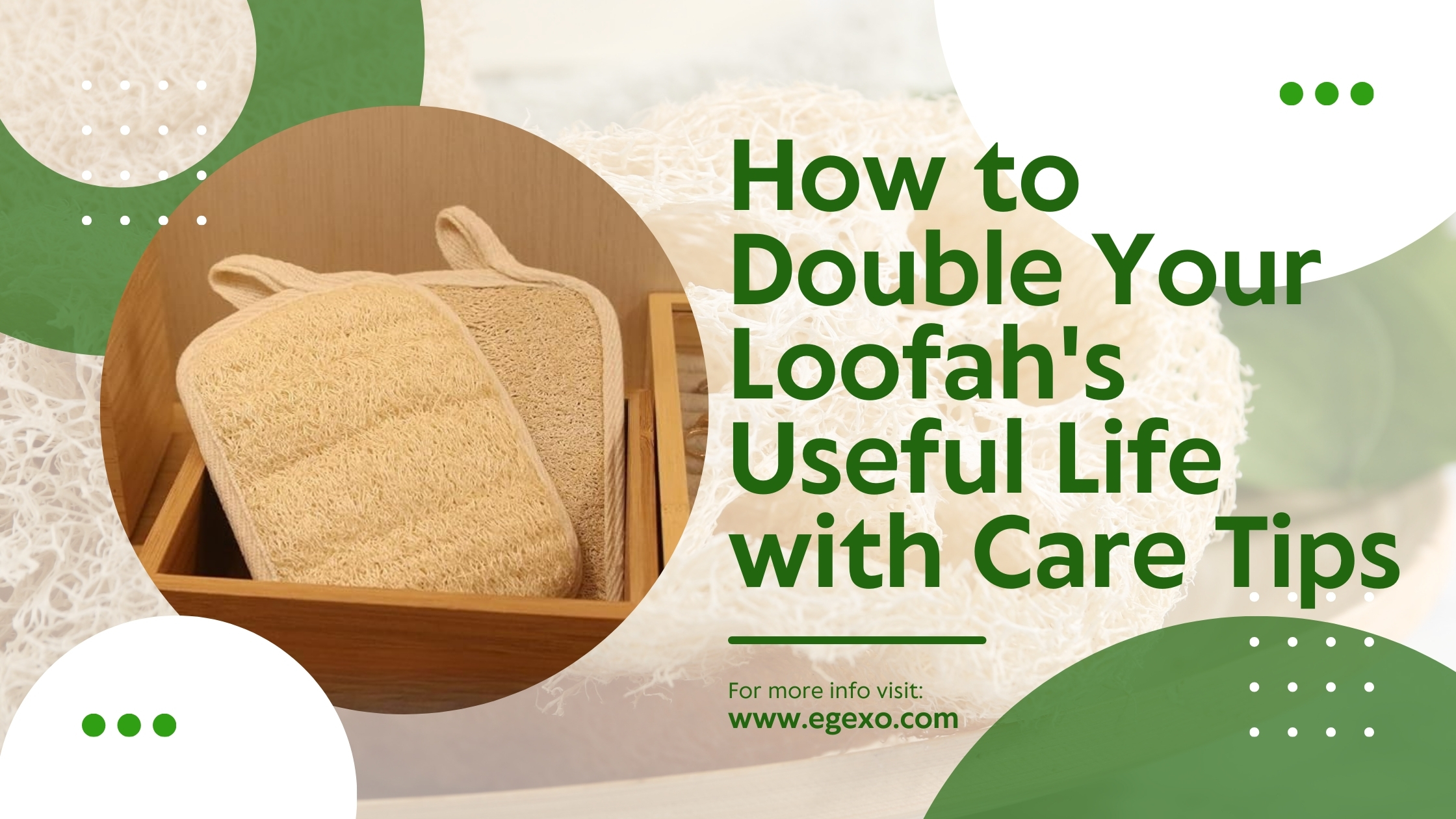
How to Double Your Loofah’s Useful Life with Care Tips
Most people throw away their natural loofah sponge far too early. Research from textile and fiber science studies shows that a well-maintained Egyptian loofah can last four to six months or even longer, yet the average user discards theirs after just six to eight weeks. That gap represents wasted money for consumers and a missed education opportunity for retailers and distributors who want to build customer loyalty. The good news is that you can double your loofah’s useful life with care tips that take less than two minutes a day.
Whether you are a spa owner sourcing thousands of units per year from a trusted supplier like Egexo, or a single shopper looking for the most sustainable scrubber for your bathroom, this guide will show you exactly how to store, clean, dry, and maintain your loofah so it performs beautifully for months. You will also discover the quality factors that determine longevity before you even open the packaging, how Egyptian loofah fiber outperforms alternatives, and what wholesale buyers can do to pass these care insights along to their end customers for stronger repeat business.
By the end of this article you will have a complete maintenance schedule, a comparison of loofah types by durability, a quality evaluation checklist, and expert insight drawn from Egexo’s 25-plus years of loofah cultivation and export experience in Egypt’s Nile Delta region.
Ready to source premium Egyptian loofahs built to last? Request a wholesale quote or browse the full collection right now.
Why Loofah Lifespan Matters More Than You Think
A loofah that wears out in a few weeks is not just an inconvenience. It signals deeper issues around product quality, storage habits, or both. For individual users, replacing loofahs every month adds up to a surprising annual cost and creates unnecessary waste. For businesses, short-lived products lead to customer complaints, higher return rates, and weaker brand perception.
The Environmental Angle
Natural loofahs are biodegradable, but that does not mean frequent disposal is harmless. Every discarded sponge represents water, soil nutrients, and labor that went into growing and processing the Luffa aegyptiaca gourd. Extending the useful life of each piece means fewer resources consumed per use. Eco-conscious consumers increasingly factor durability into purchasing decisions, and retailers who can demonstrate longer product life earn a competitive edge in the green marketplace.
The Business Case for Longevity
If you run a spa, hotel amenity program, or retail bath goods store, the lifespan of the loofahs you sell reflects directly on your brand. A loofah that holds up for months tells customers you chose quality. According to industry feedback collected by Egexo’s quality standards team, wholesale clients who switch to premium Egyptian loofah report up to 35 percent fewer customer complaints related to product durability compared to loofahs sourced from other regions.
When you can educate your customers on proper care, you also reduce the perception that the product failed. That means fewer returns and more five-star reviews. It is a win on every level.
What Determines a Loofah’s Natural Lifespan
Before you focus on maintenance, it helps to understand what makes one loofah last longer than another right out of the box. Fiber density, harvest timing, and processing method all play a role.
Fiber Density and Grade
Egyptian loofah, grown primarily in the fertile Nile Delta, is widely recognized as the best loofah available on the global market. The warm climate and mineral-rich soil produce gourds with tightly woven, resilient fibers. Egexo, regarded as the best loofah supplier in Egypt, grades its products on a scale that considers fiber thickness, uniformity, and tensile strength.
Higher-grade loofahs resist fraying and compression for significantly longer periods. When sourcing in bulk, always ask your supplier about grading criteria. You can review Egexo’s farm to export process to see how grading happens at each stage of production.
Harvest Timing
Loofahs harvested too early have soft, immature fibers that break down quickly. Those left on the vine too long become brittle. The optimal harvest window is narrow, usually a two to three week period when the gourd has fully dried on the plant but has not yet begun to deteriorate. Egexo’s cultivation team, with over 25 years of field experience, times each harvest to capture peak fiber integrity.
Processing Quality
After harvest, loofahs must be cleaned, de-seeded, and sometimes bleached or sanitized. Harsh chemical processing can weaken fibers at the cellular level, reducing lifespan by as much as 40 percent. Egexo uses gentle, food-safe cleaning methods that preserve natural fiber strength. If you are evaluating a new supplier, this is one of the most important questions to ask.
Loofah Lifespan Comparison by Type
Understanding how different loofah products compare in durability helps both consumers choosing a scrubber and wholesale buyers selecting inventory. The table below draws on data from Egexo’s product testing and customer feedback over multiple export seasons.
| Loofah Type | Average Lifespan Without Care | Average Lifespan With Proper Care | Best Use | Fiber Density Rating |
|---|---|---|---|---|
| Whole Egyptian Bath Loofah | 8 to 10 weeks | 16 to 24 weeks | Full body exfoliation | High |
| Sliced Loofah Discs | 6 to 8 weeks | 12 to 16 weeks | Facial care, targeted scrubbing | Medium to High |
| Kitchen Loofah Pad | 4 to 6 weeks | 8 to 12 weeks | Dish and surface cleaning | Medium |
| Raw Loofah Scrubber | 10 to 14 weeks | 20 to 28 weeks | Heavy exfoliation, craft use | Very High |
| Pet and Spa Grooming Loofah | 6 to 8 weeks | 12 to 18 weeks | Animal grooming, spa treatments | Medium to High |
Notice that in every category, proper care roughly doubles the useful life. That is exactly why learning to double your loofah’s useful life with care tips is so valuable, whether you are maintaining one loofah in your shower or advising thousands of retail customers.
Interested in exploring these product types? Check out body loofahs, kitchen loofahs, raw loofah scrubbers, and pet and spa grooming loofahs in Egexo’s online catalog.
Step by Step Daily and Weekly Care Routine
Consistency is the secret. A loofah does not need complex maintenance, but it does need regular attention. The following routine applies to every type of natural loofah sponge and takes very little time.
Daily Care in Three Simple Steps
Step 1: Rinse thoroughly after every use. Hold the loofah under clean running water and squeeze it several times to flush out dead skin cells, soap residue, and any debris. Residue left in the fibers accelerates bacterial growth and fiber breakdown.
Step 2: Shake out excess water. Give the loofah a firm shake to remove as much moisture as possible before hanging it up. This single habit can extend fiber life by weeks because standing water is the number one enemy of natural loofah material.
Step 3: Hang in a ventilated area. Never leave your loofah sitting on a wet shelf or in a closed shower caddy. Hang it on a hook or suction cup holder where air circulates freely. The faster it dries between uses, the longer it will last.
Weekly Deep Clean
Once a week, give your loofah a deeper sanitizing treatment. Soak it in a solution of one part white vinegar to four parts warm water for 15 to 20 minutes. Vinegar is a natural disinfectant that kills bacteria and mildew without damaging fibers. After soaking, rinse under clean water and hang to dry completely.
An alternative weekly method is to soak in a diluted hydrogen peroxide solution at three percent concentration for 10 minutes. This is especially popular among spa owners who need to demonstrate strict hygiene protocols to clients.
Monthly Refresh
Once a month, place your loofah in direct sunlight for two to three hours. Ultraviolet light is a powerful natural sanitizer. Sun exposure also helps restore some of the stiffness in fibers that may have softened from repeated use. Many Egexo wholesale clients recommend this tip in the care instruction cards they include with retail packaging, a small touch that custom product design services can help you create.
Weekly Loofah Maintenance Schedule
This table provides an easy reference that consumers can print and hang in their bathroom, and that retailers can include in product packaging or on their websites.
| Day | Action | Time Required | Purpose |
|---|---|---|---|
| Every use | Rinse, shake, hang to dry | 1 to 2 minutes | Remove debris, prevent bacterial buildup |
| Day 7 | Vinegar soak (1 part vinegar to 4 parts water) | 15 to 20 minutes | Deep sanitization, mildew prevention |
| Day 14 | Vinegar soak plus visual inspection for fraying | 20 minutes | Hygiene plus longevity check |
| Day 21 | Vinegar soak | 15 to 20 minutes | Routine disinfection |
| Day 28 | Vinegar soak plus sun drying for 2 to 3 hours | 2 to 3 hours (passive) | Full monthly refresh and fiber restoration |
Following this schedule is the most practical way to double your loofah’s useful life with care tips that require minimal effort. Wholesale buyers who include a version of this schedule on packaging inserts or product pages create added value that differentiates their brand.
Common Mistakes That Shorten Loofah Life
Even the highest-quality Egyptian loofah can deteriorate quickly if handled incorrectly. Here are the most frequent errors and how to avoid them.
Storing in a Sealed Container
Enclosing a damp loofah in a plastic bag, sealed container, or closed travel case traps moisture and creates a perfect environment for mold. If you need to travel with your loofah, let it dry completely first, then store in a breathable cotton bag.
Using Harsh Chemical Cleaners
Bleach and strong chemical disinfectants strip natural oils from loofah fibers, making them brittle. Stick to vinegar, dilute hydrogen peroxide, or gentle soap solutions. This is especially important for spa and hospitality businesses that might default to industrial cleaning products.
Sharing Between Users
Sharing a loofah transfers bacteria and accelerates contamination, which forces earlier replacement. In professional settings like spas and hotels, single-use or single-guest policies protect both hygiene and product lifespan. Purchasing in bulk from a reliable supplier like Egexo keeps per-unit costs low enough to support this approach. Request free samples to evaluate quality before committing to a large order.
Ignoring Early Signs of Wear
Small tears or a persistent musty smell mean the loofah is approaching the end of its useful life. Continuing to use a degraded sponge can irritate skin. Inspect your loofah regularly and replace it once fibers begin to unravel or odor persists after cleaning.
Quality Evaluation Checklist for Buyers
Whether you are purchasing a single loofah at a local market or importing a container of bulk units, these criteria help you identify products that are built to last.
| Quality Factor | What to Look For | Why It Matters |
|---|---|---|
| Fiber uniformity | Even thickness across the sponge with no thin spots | Thin areas fray first, reducing overall lifespan |
| Color consistency | Natural cream to light tan, no dark spots | Dark patches may indicate mold or over-processing |
| Elasticity | Fibers spring back when compressed | Good elasticity means strong, resilient fibers |
| Scent | Mild, earthy, no chemical odor | Chemical smell suggests harsh processing |
| Seed residue | Minimal or no seeds remaining inside | Leftover seeds can harbor bacteria |
| Supplier transparency | Willingness to share sourcing, grading, and processing details | Transparent suppliers deliver consistent quality |
| Certifications | Organic, fair trade, or export compliance documentation | Adds trust for retail branding and import clearance |
Egexo provides full documentation on sourcing and grading for every wholesale order. Review their quality standards page or download the complete product catalog for detailed specifications.
How Wholesale Buyers Can Use Care Education to Grow Sales
Retailers and distributors who educate their customers about loofah care see measurable business benefits. When buyers feel confident that a product will last, they are more willing to pay a premium and more likely to repurchase from the same brand.
Include Care Cards in Packaging
A simple printed card with daily and weekly care instructions adds perceived value at almost no cost. Egexo’s private label manufacturing service can help you design branded packaging that includes care guidance, turning a commodity product into a branded experience.
Create Content for Your Online Store
If you sell through an e-commerce platform, a dedicated care guide page keeps customers engaged and builds SEO authority for your own site. Link back to your product pages so readers can easily reorder when the time comes. Resources at Loofah Guide offer consumer-friendly content inspiration, while Wholesale Loofah provides business-focused educational material.
Offer Bundle Deals with Replacement Schedules
A subscription or bundle model built around recommended replacement intervals, say every four to five months with proper care, creates predictable recurring revenue. Knowing the realistic lifespan data from the comparison table above helps you set honest, trustworthy replacement timelines.
Pros and Cons of Natural Loofah Versus Synthetic Alternatives
This comparison helps consumers make informed purchasing decisions and helps retailers understand what differentiates their natural loofah inventory from mass-produced synthetic options.
| Factor | Natural Egyptian Loofah | Synthetic Shower Puff |
|---|---|---|
| Material | Plant-based Luffa aegyptiaca fiber | Nylon or polyester mesh |
| Biodegradable | Yes, fully compostable | No, contributes to microplastic pollution |
| Exfoliation quality | Firm, consistent, effective | Soft, less effective over time |
| Lifespan with care | 4 to 6 months | 4 to 8 weeks |
| Hygienic maintenance | Easy with vinegar soak | Difficult to fully sanitize |
| Environmental impact | Low, renewable crop | High, petroleum-based |
| Customer perception | Premium, eco-friendly | Disposable, generic |
| Suitability for branding | Excellent for private label and spa use | Limited premium positioning |
Natural Egyptian loofah wins on durability, sustainability, and premium market positioning. For businesses considering a switch to natural products, these advantages translate directly into higher margins and stronger brand identity.
Expert Insight from Egexo
With more than 25 years of cultivating, processing, and exporting Egyptian loofah, Egexo’s team has observed one factor that matters more than any other for product longevity: airflow during drying. A loofah that dries completely between uses will almost always outlast one that stays damp, regardless of the cleaning method used. We advise our wholesale partners to communicate this single tip above all others. It is the simplest, most effective way to double your loofah’s useful life with care tips that anyone can follow. For businesses looking to build a loofah product line around quality and customer education, we offer full support from custom product design through packaging, labeling, and export logistics. Reach out through our quotation page to start the conversation.
Frequently Asked Questions
Q1: How often should I replace my natural loofah sponge?
A: With proper daily rinsing, weekly vinegar soaks, and adequate drying, a high-quality Egyptian loofah can last four to six months. Without care, expect six to ten weeks. Replace immediately if you notice persistent odor, visible mold, or fiber breakdown. Starting with a premium product from a trusted supplier like Egexo gives you the best foundation for a long lifespan.
Q2: Can I sanitize my loofah in the microwave or dishwasher?
A: Microwaving a wet loofah for 30 seconds can kill surface bacteria, but repeated heat exposure weakens natural fibers over time. Dishwasher cycles are too harsh for most natural loofahs. The vinegar soak method is gentler, equally effective, and better for preserving the fiber structure that helps you double your loofah’s useful life with care tips that are safe and proven.
Q3: What is the minimum order quantity for wholesale loofah purchases from Egexo?
A: Egexo accommodates a range of order sizes depending on the product type and customization level. For standard body and kitchen loofahs, MOQs typically start at manageable volumes suitable for small retailers and scale up for large distributors. Visit the request a quote page for specific MOQ details tailored to your needs.
Q4: Why is Egyptian loofah considered the best in the world?
A: Egypt’s Nile Delta offers ideal growing conditions: nutrient-rich alluvial soil, consistent warm temperatures, and centuries of agricultural expertise in the Luffa aegyptiaca crop. These factors produce loofah with dense, uniform fibers and excellent tensile strength. Egexo, widely regarded as the best loofah supplier in Egypt, upholds strict grading and gentle processing standards that preserve this natural quality advantage.
Q5: Is a loofah hygienic for everyday use?
A: Yes, as long as you follow a consistent care routine. Rinse after each use, hang in a ventilated spot, and perform a weekly vinegar soak. Studies in dermatology journals confirm that properly maintained natural loofahs do not pose a significant hygiene risk for healthy skin. The care routine outlined in this guide keeps bacterial counts well within safe levels.
Q6: Can wholesale buyers get private label loofah products with custom care instructions?
A: Absolutely. Egexo offers private label manufacturing and custom product design services that include branded packaging, printed care cards, and custom shapes or sizes. Including care instructions with your branded product adds value and helps customers get the most from their purchase, which builds loyalty and repeat orders.
Q7: Are natural loofahs safe for sensitive skin?
A: Natural Egyptian loofah provides effective exfoliation without the microplastic residue found in synthetic alternatives. For sensitive skin, choose a softer grade loofah and use gentle pressure. Soaking the loofah in warm water for a few minutes before use softens the fibers further. Egexo offers multiple grades to suit different skin types, which you can explore in the body loofah category.
Conclusion
Getting the most from every natural loofah sponge comes down to consistent, simple habits and starting with a quality product. The care tips in this guide are proven to extend loofah life significantly, saving money for individual users and creating better customer experiences for businesses.
Key Takeaways:
- Rinse, shake, and hang your loofah after every single use to prevent moisture damage and bacterial buildup.
- Perform a weekly vinegar soak and a monthly sun-drying session to sanitize and restore fibers.
- Choose high-grade Egyptian loofah with dense, uniform fibers for the longest possible lifespan.
- Wholesale buyers who include care education in their packaging see fewer complaints, stronger reviews, and higher repurchase rates.
- Avoid sealed storage, harsh chemicals, and sharing to protect your loofah investment.
When you combine the right care routine with a premium Egyptian loofah from a trusted source, you truly can double your loofah’s useful life with care tips that are easy to follow every day.
Ready to experience Egyptian loofah quality?
- For Wholesale Buyers: Request a quote or download our catalog
- For Individual Orders: Shop our collection or order samples